Free architecture website template
Edit it by hand: it is one index.html with no build step, so you can open it in any text editor, change the words and photos, and upload it to any static host. Not a coder? Describe your business in one sentence to 8B's AI website builder and it designs a new site for you, with more pages when you need them. Designing is free; publishing with hosting is $9 a month, billed yearly. It also works inside Claude and ChatGPT.
MIT license · Made by 8B, an AI website builder · Plain text: midblock.md, data: midblock.json
About this architecture website template
Architecture website template: a one-page HTML site for a small architecture office, with a projects row that walks sideways, a four-step method, a register table, five team portraits and an enquiry form. Among flat pastel blocks, street photos start as smeared colour and sharpen as you scroll. That motion runs on CSS with no JavaScript libraries, in one file of about 27 KB gzipped, and AGENTS.md tells an AI coding agent what to edit.
At a glance, November 2026. One 107 KB index.html with its CSS and JavaScript inside, 12 sections, 14 Unsplash photos credited in CREDITS.md, Mozilla Headline and Mozilla Text from Google Fonts, no JavaScript libraries: CSS scroll-driven animations and a small inline motion script with built-in smooth wheel scrolling, no script loaded from a CDN.
People who land on an architectural website want to see built work, find out who draws it and learn how to start a conversation. This page puts all three into one scroll: five project cards, a method in four steps, a team row and an enquiry form. As an architect portfolio website it sizes each card by the project's plot, so a narrow plot looks narrow. A practice with several partners can use it as an architects portfolio website, since the team row holds five portraits. Architects websites often lean on a grid of thumbnails; here the cards walk sideways as you scroll, in browsers that run the scroll motion.
On an architectural website template, collect the facts only the office can give before touching the design: name, city, address, phone, email, hours, each real project with its plot width, floors and year, and the people with their roles. An agent left alone may fill gaps with plausible inventions, so when you vibe code this architecture website template for Claude Code, Cursor or Codex, tell it to stop and ask. Each project card takes its width from the inline --plot value, the plot width in metres. Keep the section ids, the classes AGENTS.md lists and the form fields named name, email and plot, which the contact script reads.
Among website templates for architects, this one suits a practice with about five projects worth showing and a method to explain. A builder who quotes jobs after a site visit is better served by the contractor template, built around services, prices and visits. This is the light build: the same look and scroll behaviour with no animation library and no script from a CDN, about 27 KB of code gzipped in one file, where the GSAP version needs about 71 KB and three extra requests. What it cannot do as shipped is give each building its own page: the project cards are plain blocks, not links.
Good for:
Turn the architecture website template into your site with an AI agent
With an AI coding agent
Files (PowerShell: curl.exe):
curl -LO https://raw.githubusercontent.com/8bsite/architecture-website-template/main/index.html
curl -LO https://raw.githubusercontent.com/8bsite/architecture-website-template/main/AGENTS.md
curl -LO https://raw.githubusercontent.com/8bsite/architecture-website-template/main/LICENSE
curl -LO https://raw.githubusercontent.com/8bsite/architecture-website-template/main/CREDITS.mdPrompt for the agent:
Read AGENTS.md, then edit index.html. Turn this template into the site for <my architecture office: name, city and address, projects with plot width, floors, year and photos, working steps, the team with roles, hours, how a client sends an enquiry>. Replace first the office name, city, five project cards, register table and team, and set the footer wordmark's length number to the new name's character count. Motion is CSS scroll-driven animation plus the inline motion kit: keep the gate script, the section ids, the data-8b-section and data-8b-motion attributes and the form fields name, email and plot; add no library. Never invent hours, addresses, licences, reviews or contacts; ask me.In a terminal
npx degit 8bsite/architecture-website-template my-siteGSAP build
Prefer GSAP? The same design built with GSAP, ScrollTrigger and Lenis smooth scroll, loaded from jsDelivr, is in the repository as index.gsap.html: 71 KB of code to download gzipped against 27 KB for this one, and the scroll motion also plays in Firefox.
curl -LO https://raw.githubusercontent.com/8bsite/architecture-website-template/main/index.gsap.htmlArchitecture website design prompt for any AI tool
Paste this into Claude Code, Codex, Cursor, Lovable, v0 or Bolt to build an architecture office site from scratch, or brief a designer. It is this template's design written as decisions; with the template itself, the short prompt above is enough.
Build a one-page website for <my architecture office: name, city, what we design, team size>. Sections in order: opening, buildings, method, register table, colour bands, neighbours quotes, floor by floor, studio team, questions, enquiry form, footer. Type: Mozilla Headline, condensed and semi-bold, for headings and the wordmark; Mozilla Text for body, buttons, form fields and spaced uppercase labels. Colours: #d9e4f0 pale sky page, #1a2430 text and dark sections, #f3eeed cream blocks, #e7a36a sand, #b9471f brick red stripes and hovers, #26419b tram blue band. Layout: square-cornered flat blocks stepped like facades, project cards sized by plot width, photos cut into vertical slabs. Do not use a purple gradient, a full-bleed hero photo with centred text, rounded cards or a thumbnail grid. Motion: one idea, street photos that start as smeared colour and sharpen as you scroll, with the projects row sliding sideways. Build it with CSS scroll-driven animations and a little inline script, no animation library; without support or with reduced motion, show the finished static layout. Ask me for name, city, address, phone, hours, each project with plot width, floors and year, and the people with their roles; never invent projects, licences or reviews, and leave a marked placeholder for anything missing. One primary action, Bring us a plot, leading to the enquiry form from the navigation, the first screen and the footer. Mobile: check at 390 px, tap targets of at least 44 px, a working menu. Acceptance: no console errors, visible keyboard focus, a form that checks name, email and plot, and a list of every placeholder left.Architecture website design and motion
Palette
#d9e4f0 page background, pale sky#1a2430 text, buttons, dark sections#f3eeed cream blocks: the headline block, two of the three facts, the first quote, the form panel#ffffff register and team sections, text on navy#e7a36a sand: third block on the first screen, labels on navy, one colour band#e6dad8 plaster pink blocks and one colour band#b9471f brick red stripes, hovers#3f6964 door green: badge markers and one colour band#26419b tram blue band#d22630 red scan line and thin red bands#475463 muted grey-blue for small labels, table headings, notes and rules on navy#a9c1dd upper end of the sky gradient behind the first screenFonts
- Mozilla Headline: section headings and the wordmark: condensed, semi-bold, tight lines
- Mozilla Text: body text, buttons, form fields and spaced uppercase labels
Square-cornered blocks of flat colour stand on a pale sky, stepped like facades along a street. Photos are cut into vertical slabs or sized by each plot's relative width above a striped pavement. Colour bands, 2px rules and portraits at stepped heights carry the street idea down the page.
Section headings are set in Mozilla Headline condensed to 75 percent width, keeping long sentences compact. On hover, buttons fill with palette stripes and underlines stretch. On the first screen smeared streaks drift in a loop, a thin red line sweeps the method photo, and each building photo shifts a few percent inside its frame, a quiet layered depth.
Every value of this architecture website design, with the type scale, spacing and the motion rules, is in its DESIGN.md file (Google's format), ready for a coding agent or Stitch.
What is on the architecture website page
- NavigationTop bar: wordmark, four section links, Bring us a plot button; phone menu overlay
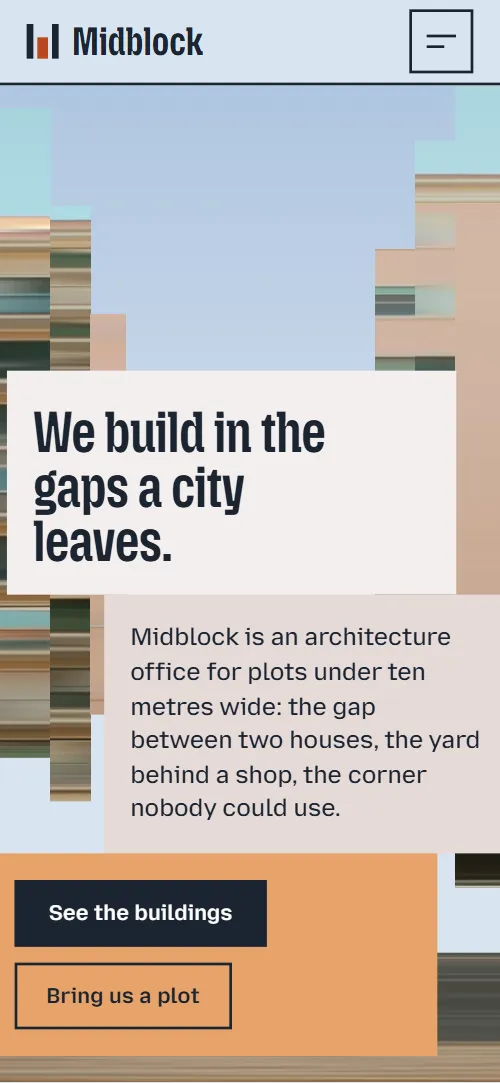
- We build in the gaps a city leaves.First screen: headline on stepped blocks between slabs of a street photo, then a manifesto and three short facts
Smooth wheel scrolling throughout. The first screen holds while street-photo slabs grow and squeeze from streaks of colour into focus, the middle photo opens from a slit and the headline blocks drift up; then a smeared band climbs over the street.
- Five buildings, none wider than a busProjects walked sideways: five buildings at their relative plot widths, each with a plate
Pinned, the five buildings pass sideways as you scroll; each photo sharpens from a smear and shifts inside its frame.
- We read a street for a whole dayMethod in four steps beside a photo crossed by a red scan line
Scrolling the four steps sends a red line across the photo, leaving a smeared copy behind and lighting each time label.
- The gap registerTable of entries with status badges (demo: a public list of plots)
In view, three colour stripes grow from hairlines and the heading, text and button slide in from alternating sides.
- Borrowed coloursSix full-width colour bands, each with a name, a sentence and where it is used
Tied to scroll, the six bands unroll downwards one by one, each label wiping in from the left.
- What the neighbours saidThree testimonials on blocks at stepped heights, with one photo
In view, the three quotes slide in from alternating sides and the photo squeezes from a streak into focus.
- 9 Ropewalk, floor by floorOne project floor by floor: a building photo cut into seven slices beside a list of seven levels
Reading down the seven levels slides the photo's slices left and right, and the slice for the level being read sits nearest to aligned.
- Five people, one long tableTeam: five portraits at stepped heights with names and roles
Tied to scroll, the five portraits rise or drop into their stepped row, each sharpening from a streak.
- Questions we hear on siteQuestions and answers (native <details>)
The heading and its intro slide in from opposite sides as the section comes into view.
- Bring us a plotEnquiry form between two street-photo slabs, then address, phone, email and hours
Tied to scroll, two street-photo slabs slide in from the edges towards the form and sharpen from streaks.
- PagesColour bands, width-filling MIDBLOCK wordmark, links, address, copyright and the Design: 8B credit
As the footer comes into view, four colour stripes grow from hairlines above the full-width wordmark.
Before you publish the architecture website site
- Replace social preview image, favicon, contact form (sends nothing yet), phone number and email address and the invented demo facts (prices, dates, addresses). AGENTS.md lists them.
- Bring us a plot (nav, first screen, footer) and Add a plot (register) lead to
#contactnow; point them to your booking or enquiry URL, or leave them on the form. - On phones the opening's second screen (manifesto and facts) is taller than the viewport, so the climbing bands are mostly seen behind and around it, and just before the buildings walk starts the top of its frame is empty for a moment.
- The floors photo has a white sky: when the slices slide apart, their white ends read as white blocks on the navy ground.
Questions about this architecture website template
Is this a free architect website template I can use for a client's practice?
Yes. The MIT licence covers the page's code, so an office or its web designer can publish it for a client with no fee. The 14 demo photos keep the Unsplash License and the two fonts keep the Open Font License, and CREDITS.md lists both. Use the office's own project photos before launch. Everything sits on a single scroll: for many pages, treat it as the home page.
Does the enquiry form send anything?
No. As shipped, the form checks that a name, a valid email and the plot address are present, shows a thank-you line and clears the fields; no request is made anywhere. To receive enquiries, wire it to Formspree or, on Netlify, to Netlify Forms; AGENTS.md gives the code for both. The thank-you text also promises a reply within a week, so change that to your own promise.
How do I hand this to Claude Code, Cursor or Codex?
Fetch the files with the four curl lines at the start of AGENTS.md, open that folder in the agent and tell it to follow AGENTS.md while it edits index.html. Describe the office in the same message: name, city, projects, team. A link would only give it a summary, so use the files. Without the files, the architecture website design prompt below works in any AI tool.
Which parts of the file must I leave alone?
The section ids, the classes AGENTS.md lists, the data-8b-section and data-8b-motion attributes, the gate script in the head and the motion kit at the end of the body. The motion is CSS scroll-driven animation with no GSAP or Lenis to load, so add no library. The contact script needs fields named name, email and plot, and the CSS expects five portraits, four time labels and seven floor slices.
Can the register table list finished projects instead?
Yes. It is a plain HTML table with five columns and a status badge, and no script touches it, so rows can be added, removed or turned into projects, sites or listings. On phones each row folds into a stacked record with labels for width, depth and orientation.
Are there architecture portfolio website examples I can look at?
The live demo is one. It shows an invented small office with five projects, an eight-row register and a five-person team in a single HTML file. Every name, address and figure in it is made up, so replace them and swap the photos before publishing. In v0, the architecture card starts a chat from its files.
Can I use it as an architects portfolio website for a solo practice?
Yes. Put your own projects into the building cards, delete the studio section and keep the register only if you list plots or sites. AGENTS.md says which markup, styles, scripts and links go away with a section, so nothing is left pointing at it.
What happens in Firefox, with reduced motion or without JavaScript?
Without CSS scroll-driven animations (Firefox today) or with reduced motion on, the scroll motion and smooth wheel are off: the project cards wrap onto rows, the method photo shows no scan, and the first screen keeps its side slabs as still streaks over the sky. In Firefox they still rise in and drift. Without JavaScript the phone menu opens nothing and the form shows no thank-you line.