What comes with the real estate website template
- index.html: the pure HTML and CSS version, one single HTML file, 109 KB.
- index.gsap.html: the same design built with GSAP, ScrollTrigger and Lenis, for scroll motion in every browser, Firefox included.
- AGENTS.md: what a coding agent must keep and what to replace, so Claude Code, Codex or Cursor edit it without breaking the scenes.
- DESIGN.md: every colour, font, spacing and motion rule of this real estate website design.
- PROMPTS.md: the agent prompt and the design prompt below.
- CREDITS.md and LICENSE.md: the photos and fonts with their licenses, and the 8B license.
- Updates to this template, at no extra cost.
Yours to edit: one index.html with no build step, so you or a coding agent can change the words, prices and photos and upload it to any static host. Not a coder? Describe your business in one sentence to 8B's AI website builder and it designs a new site for you, with more pages when you need them. Designing is free; publishing with hosting is $9 a month, billed yearly. It also works inside Claude and ChatGPT.
Premium template · $39, one-time license · Made by 8B, an AI website builder · Updated November 2026 · Plain text: newel.md
About this real estate website template
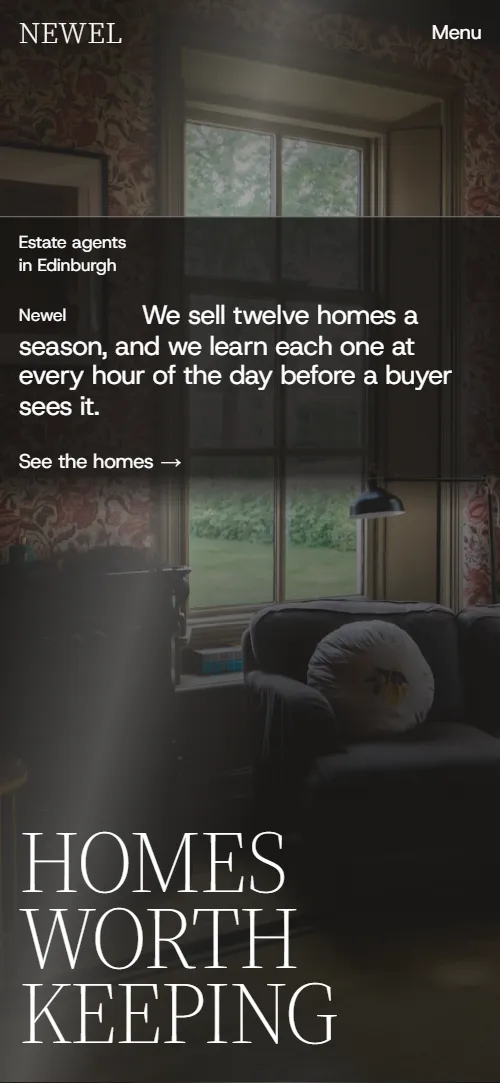
Real estate website template for an independent agency or a realtor who sells a few homes well: one HTML file with homes for sale in an asymmetric gallery, how a sale runs step by step, neighbourhoods with typical prices, owners' stories, a journal and a valuation request form. It opens on a dark period sitting room that fills with light until it becomes the white page, and a band of light carries one frame through four rooms at their best hour. It is a single HTML file in pure HTML and CSS, and a GSAP version of the same page comes with it.
At a glance, November 2026. One 109 KB index.html: a single HTML file in pure HTML and CSS with a few lines of built-in JavaScript, 12 sections, 21 Unsplash photos, Host Grotesk and Source Serif 4. A GSAP build of the same page, 96 KB, comes with it.
It suits an independent estate agency, a boutique brokerage that sells period or luxury homes, a realtor building a personal brand, a buying agent or a property finder. Real estate websites mostly need four things on one scroll: the homes for sale with price and rooms, how you sell, the areas you know and a way to book a valuation, and this page gives each its own section. A real estate agency website built from it also gets what sets a small agency apart from a portal: the listing clichés you refuse to write, the best hour of each home and the owners who still live there years later.
The demo business is Newel, an invented agency in Edinburgh that takes on twelve homes a season. Every street, price, district and quote is demo copy to replace. The listings show address, type, bedrooms, price and best hour, so a realtor in any city fills in its own homes; prices are in pounds with Scottish offers-over wording, which you change to your own market's terms.
If you would rather not edit HTML at all, 8B, the AI website builder designs a site from one sentence about your business, with more pages when you need them. This template is for people who want this exact design in their own hands: one index.html with its CSS and its motion inside, which you or a coding agent can edit and host anywhere, next to the listing pages or the portal you already use.
Good for:
What a real estate website needs
Real estate agency websites that win instructions and buyers answer the same questions quickly. Here is how this template covers each of them.
- Homes for sale up front. A gallery of four homes with address, type, bedrooms, price and the hour each home looks best, right after the first screen.
- A clear reason to choose you. The method is spelled out: four visits before pricing, one agent who writes the listing, twelve photographs, one buyer at a time.
- How a sale works and how long it takes. Five steps in hairline rows, each with the weeks it takes, from the first visit to the keys.
- Local knowledge. Five neighbourhoods, each with a note, typical flat and house prices and a street photo.
- Proof from past clients. Three owners who bought through the agency, with the year they bought and a quote.
- Listings that are easy to update. Each home is one short block: a coding agent adds or removes a home from one sentence, and the captions can link to your portal or listing pages, which stay the place for search and full details.
- A valuation request. The contact section has a valuation form, the office address, opening hours, phone and email. Connect the form before you go live.
What it does not have is property search, a map, a portal feed or an admin panel: it is built for an agency that sells a handful of homes at a time and keeps its full listings on a portal.
Real estate website design and motion
Palette
#ffffff page ground, text on the dark sections#171513 warm ink: text, hairlines, the best-hour section and the shade over the opening photo#5c5246 taupe: the listing clichés, the owners' stories and the contact section groundsFonts
- Source Serif 4: the huge light uppercase headings, district names and quotes
- Host Grotesk: body text, captions, labels, navigation, buttons and form fields
A white page with warm ink text and taupe and near-black sections for contrast. Every section opens with huge light serif capitals placed on the grid, then hairline rows with a small label in the margin, an indented paragraph and an arrow link. The homes for sale sit in an asymmetric gallery (one large, two small, one wide) with split captions; the neighbourhoods are a list of display names, each with a note, typical prices and a wide street photo; the about section sets the wordmark across the full width. On phones the heading words stack to the left and the gallery becomes large, two side by side, then wide.
The idea behind the page is light and the hour: the agency learns each home at every hour and shows it at its best one. So the opening room fills with light until it turns into the page, a soft band of light drifts across the first screen, the best-hour section carries one frame from a morning kitchen to an evening snug, and photos arrive slightly overexposed and settle.
What is on the real estate website page
- NavigationHeader with the wordmark, five links and Book a valuation, and a menu with the phone and email
The header sits clear over the opening photo, turns into a white bar as you scroll and hides on the way down, coming back when you scroll up.
- Homes worth keepingTwo screens: a dark period sitting room with HOMES WORTH KEEPING, then a white statement with a newel post photo and the agency's method
On load the photo settles from slightly larger and the three heading words rise; a soft band of light drifts across the room and the photo pans slowly. On scroll the heading words part like curtains and the room fills with light until it becomes the white second screen.
- On the marketFour homes for sale in an asymmetric gallery, captions with address, type, bedrooms, price and best hour
Each photo starts closed on its top edge with the captions lined up like an index; as the gallery scrolls in, each caption travels down to its place and pulls its photo open like a blind, the photo settling from slightly enlarged.
- Four phrases you will not find in our listingsFour listing cliches struck through, each beside the sentence the agency writes instead
As each pair arrives, the cliché fills the row in display capitals, a line strikes it through, and it shrinks into its small label while the sentence that replaces it rises line by line.
- How a sale runsHow a sale runs: five steps in hairline rows with the weeks each takes
The heading rises and the hairline of each step draws across as the rows come into view.
- Seen at its best hourFour rooms at their best hour: time, room, note and photo, on a dark ground
The section holds one large frame while a slanted band of light crosses it and carries it to the next room; each room arrives overexposed and settles, and the time and caption change with it, from 8:10 to 21:00.
- Five districts, each sold by an agent who lives in itFive neighbourhoods with a note, typical flat and house prices and a street photo
The district names start as one compact list; as you scroll, each name holds while the street photo above it opens and pushes the rest of the list down.
- Still thereThree owners who bought through the agency, with the year, a quote and a photo
The heading rises, the hairlines draw and the photo arrives overexposed and settles.
- NewelThe wordmark across the full width, an office photo and a paragraph about the team
The wordmark arrives as if seen from close up, its first letters filling the screen, and steps back until the name fills the width, while the row rises under it.
- Notes from the stairwell: what twelve homes a season teach us, written down.Three dated journal notes with photos
The three notes start as a tilted pile in the first column and are dealt into their columns; on phones each note comes in from alternating sides.
- Book a valuationValuation request form with the best-hour question, and the office address, hours, phone and email
The heading rises and the office photo arrives overexposed and settles.
- FooterFooter with address, sitemap links, social links, a seasonal newsletter field and the company line
Before you publish the real estate website site
- Replace social preview image, favicon, phone number, email address, contact form (sends nothing yet) and social media links and the invented demo facts (names, prices, areas, quotes). AGENTS.md lists them.
- Home captions, All twelve homes and the Homes for sale links lead to
/homes and /homes/<street>, pages the template does not containnow; point them to your listing pages or your property portal. - Journal notes and All notes lead to
/journal and /journal/<note>, pages the template does not containnow; point them to your blog posts, or remove the section. - Meet the team link in the about section lead to
/about, a page the template does not containnow; point them to your team page, or remove the link. - Book a valuation in the header and the menu lead to
#contactnow; point them to keep it once the valuation form is connected. - Instagram and LinkedIn links in the footer lead to
the networks' home pagesnow; point them to your own profiles, or remove them. - Scroll-driven animation runs when the browser supports it (Chrome, Edge and Safari today; Firefox does not yet) and the visitor has not asked for reduced motion. Otherwise each section shows its finished layout; the GSAP build, index.gsap.html, also plays the scroll motion in Firefox.
- The valuation form and the newsletter field send nothing: connect them to a form service, your CRM or your mailing list. Without a page script there is no thank-you line after sending.
- It is one page: the home captions, journal notes and team link point to pages the template does not contain. There is no property search, map or feed from a property portal; link to your listings or portal.
- The hours scene is built for four rooms and the listing gallery for four homes: a different count needs its layout and scene adjusted.
Questions about this real estate website template
What do I get for $39?
The real estate website template as a single HTML file, index.html, in pure HTML and CSS, a GSAP build of the same page as index.gsap.html, a DESIGN.md with every colour, font and motion rule, an AGENTS.md for coding agents, the agent prompt and the design prompt from this page, and CREDITS.md for the photos and fonts. Updates to this template are included.
Can I use this real estate template for client sites?
Yes. One purchase lets you build as many sites as you like with it, for your own agency or for clients, and change anything. What it does not allow is selling or giving away the template itself, as a template, theme or kit, or putting its source in a public repository.
How do I add, change or remove homes for sale?
Each home is one block of HTML with a photo, the address and one caption line. With Claude Code, Codex or Cursor you say it in a sentence, such as add the Leith flat at offers over 310,000 and remove Dean Path, and the agent edits the block; by hand you copy a block and change the words. There is no admin panel, property search or portal feed: if your listings change every day, keep them on Zillow, Rightmove or your MLS site and link the captions there, and use this page as the agency's front door. If you want a site with more pages that you edit without code, 8B's AI website builder makes one from a sentence about your agency.
Does the valuation form send requests?
Not yet. The form asks for name, email, phone, the address of the home and the hour when it looks its best, but it sends nothing until you connect a form service such as Formspree or Netlify Forms, or your CRM. The newsletter field in the footer is the same. The pure HTML and CSS version shows no thank-you line after sending, so point the form at a thank-you page or add one.
Will it work with Claude Code, Codex or Cursor?
Yes. Put index.html and AGENTS.md in your project and give the agent the prompt that comes with the template. AGENTS.md says which attributes the scroll motion reads, what to keep and what to replace, so the agent swaps homes, prices, districts and photos without breaking the scenes.
What do visitors see in Firefox or with reduced motion?
Firefox does not support scroll-driven animations yet, so it shows every section in its finished layout, as does any browser when the visitor asks for reduced motion. If the scroll motion must also play in Firefox, use the GSAP build, index.gsap.html, which loads GSAP, ScrollTrigger and Lenis from a CDN.
More templates for property, building and interiors
Other designs for businesses around the home.
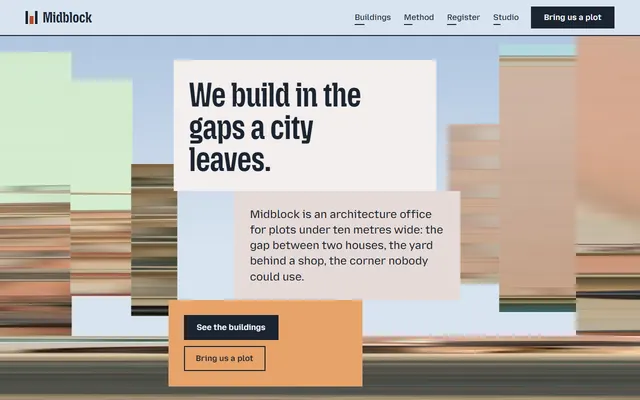
Architecture office: buildings on narrow city plots, method, team and an enquiry form.

Interior design studio: projects, a glossary, prices and the meeting steps.
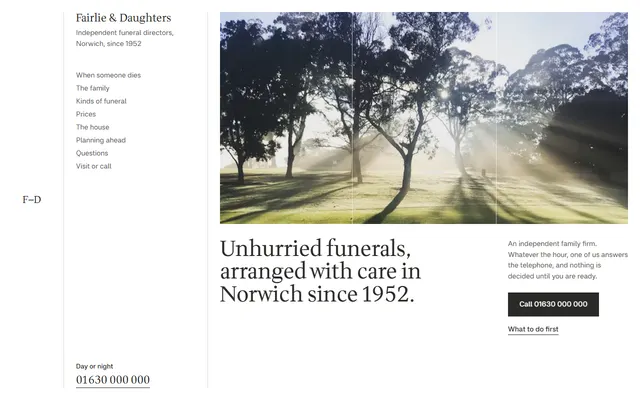
Funeral home: what to do first, the team, kinds of funeral, a full price list and a call-back form.

Home renovation: a four-stage method, services as rooms of a plan and prices per square foot.
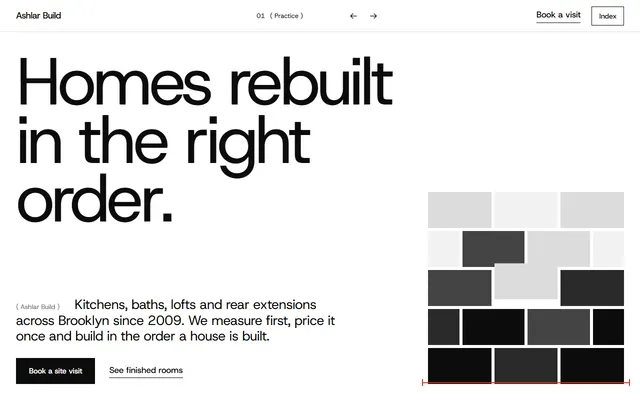
Construction company: services with prices, finished work, crew and a site-visit form.

Private chef service: ways to book, seasonal menus with prices, sourcing, chefs and an enquiry form.
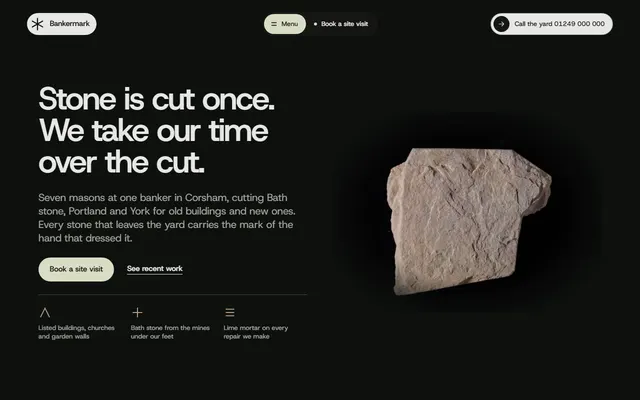
Stonemason for stone yards and masons, lettering prices.

Kitchen company: five kinds of job, in-house trades, a five-step fit, recent fits and a survey form.