What comes with the improv theater website template
- index.html: the pure HTML and CSS version, one single HTML file, 140 KB.
- index.gsap.html: the same design built with GSAP, ScrollTrigger and Lenis, for scroll motion in every browser, Firefox included.
- AGENTS.md: what a coding agent must keep and what to replace, so Claude Code, Codex or Cursor edit it without breaking the scenes.
- DESIGN.md: every colour, font, spacing and motion rule of this improv theater website design.
- PROMPTS.md: the agent prompt and the design prompt below.
- CREDITS.md and LICENSE.md: the photos and fonts with their licenses, and the 8B license.
- Updates to this template, at no extra cost.
Yours to edit: one index.html with no build step, so you or a coding agent can change the words, prices and photos and upload it to any static host. Not a coder? Describe your business in one sentence to 8B's AI website builder and it designs a new site for you, with more pages when you need them. Designing is free; publishing with hosting is $9 a month, billed yearly. It also works inside Claude and ChatGPT.
Premium template · $39, one-time license · Made by 8B, an AI website builder · Updated November 2026 · Plain text: stegreif.md
About this improv theater website template
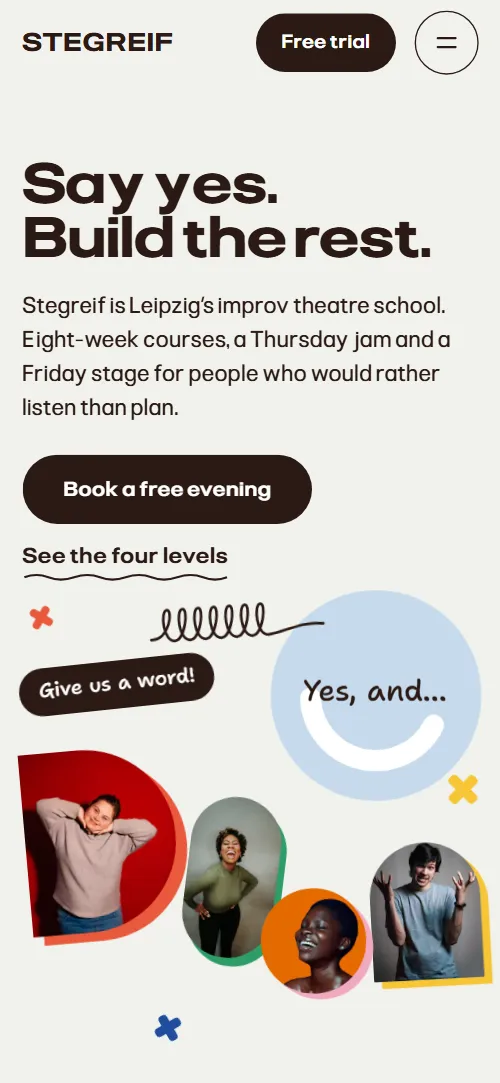
Improv theater website template for a school that teaches improvisation and plays shows: one HTML file with a three-move method, four course levels with prices and start dates, teachers, a first evening from 19:00 to 22:00, a show schedule, audience suggestions, team workshops and a free trial evening form. It opens on a loose cast of coloured shapes with people inside, which turns upright and lines up on a stage floor as you scroll. It is a single HTML file in pure HTML and CSS, and a GSAP version of the same page comes with it.
At a glance, November 2026. One 140 KB index.html: a single HTML file in pure HTML and CSS with a few lines of built-in JavaScript, 13 sections, 23 Unsplash photos, Pliant and Shantell Sans. A GSAP build of the same page, 122 KB, comes with it.
It suits an improv school, an acting or drama studio for adults, a comedy training group or a theatre company that sells classes next to its shows. Improv theater websites mostly need the same few things on one scroll: what a beginner does in a first evening, the levels with prices and the next start date, who teaches, what is on stage this month and how to try it for free. This page gives each its own section, plus workshops for companies, which many schools sell next to classes.
The demo school is invented: Stegreif, an improv theatre school in Leipzig. Every teacher, date, price, quote and audience suggestion is demo copy to replace. The courses are written as levels with a length, a price and a next start date, and the shows as date, time, title, price and a reserve link, so a school in any city or language fills in its own evenings, currency and group languages.
If you would rather not edit HTML at all, 8B, the AI website builder designs a site from one sentence about your school, with more pages when you need them. This template is for people who want this exact design in their own hands: one index.html with its CSS and its motion inside, which you or a coding agent can edit and host anywhere, next to the ticket page or booking tool you already use.
Good for:
What an improv theater website needs
A beginner decides in a minute whether to walk into a rehearsal room. Here is how this template answers the questions an improv school gets first.
- What improv is, in plain words. A short statement after the first screen and three giant words, Offer, Accept and Add, each with a line of example dialogue.
- Levels, prices and the next start. Four level cards on one track, each with a length, a price in euros and the next start date, and a card that invites a trial evening.
- A way to try it for free. A trial evening button in the header and the first screen, a timeline of the first evening from 19:00 to 22:00, and a form in the contact section.
- Who teaches. Four teacher cards with a role and a one-line note, the founder's card wider.
- What is on stage. Four Friday shows with date, time, price and a reserve link, beside a revolving stage of photos.
- Answers to nervous questions. Six questions as native details rows: not funny, freezing, language, a missed evening, age and reduced prices.
- Workshops for companies. A team section with what teams practise, three formats with prices for up to 16 people and a client quote.
What it does not have is a ticket shop, course checkout or class calendar: the Reserve links and the form are where visitors ask for a place, and you can point them at your ticket or booking page. It suits a school that fills its groups by a message or a short form.
Improv theater website design and motion
Palette
#F1F2EE page ground#2B1A14 chocolate ink: text, the shows and footer grounds, dark pills and buttons#EA5A3D red: cast shapes, the founder's teacher card, the revolving disc and the red half of the team photo#F6C536 yellow: cast shapes, tags and a teacher card#2F9D68 green: cast shapes, tags and a teacher card#1F4C9C blue: the blue half of the team photo and tags#F2A9C0 pink: cast shapes and tags#C6DAEC pale blue: the Yes, and bubble, the first method spotlight and the form circleFonts
- Pliant: headings, body text, labels, navigation and buttons
- Shantell Sans: the handwritten notes, example lines, speech tags and the team quote
A cool near-white page with wide margins, heavy sentence-case headlines in chocolate ink and small wide uppercase labels. Coloured shapes with people inside carry the story: a cast in the opening, giant words in the method, level cards in different heights, teacher cards in red, chocolate, green and yellow with the founder's wider. The shows sit on a dark chocolate ground beside a turning disc of photos, the suggestions are clipped speech tags, and the footer is chocolate again. Handwritten notes and pencil marks run over it. On phones the cast sits under the text, the level track and the evening pile stay, and the quotes become one column.
The idea behind the page is an ensemble: like improvisers turning one suggestion into a scene, a loose cast of shapes warms up and then takes positions, and the shapes come back in new formations: a travelling spotlight in the method, level cards like steps, a bow in the footer. The pencil layer plays the director's notes: a scribble that straightens into the stage floor and a ring drawn around the words that matter. Photos of people sit inside the shapes, so people and geometry read as one cast.
What is on the improv theater website page
- NavigationHeader with the wordmark, five links and a Free trial button, and a menu with the same links
The header hides as you scroll down and returns when you scroll up.
- Say yes. Build the rest.Two screens: a loose cast of coloured shapes with people, a Give us a word tag and the headline Say yes. Build the rest., then a statement on the cast lined up on a stage floor
On load the headline phrases rise and the cast pops in; each shape then bounces on its own beat and the arc inside the Yes, and bubble sways. On scroll the pieces travel and turn upright, the crosses become plus signs and the scribble flattens into a floor line, until four people stand in a line-up with the bubble above right and the tag above left.
- Three moves. Every scene.Three giant words Offer, Accept and Add with an example line each and one shape travelling through them
One shape behind the words travels from Offer to Accept to Add, changing from a circle to a long capsule to an arch and from pale blue to red to yellow; the row it reaches comes to full strength while the others rest dimmed, and a pencil ring is drawn around the words start anywhere in the intro.
- Four levels. No audition.Four course levels on a horizontal track with prices, start dates and a trial card, a line climbing through them
The screen holds while the track slides sideways with the four level cards set like rising steps, and a thin pencil line draws itself under each card's foot and up to the next, ending in an arrowhead after the last.
- The people who will say yes to you first.Four teacher cards in different colours, the founder's wider, with a role and a one-line note
Each teacher card rises into place from a small tilt and settles with a small overshoot as it reaches the screen.
- Your first evening, from tea to the corner pub.A first evening as five stacking cards from 19:00 to 22:00, each with a photo
The five cards stick one over another near the top of the screen; each card that gets covered shrinks back, tilts a little and darkens, and a pencil ring is drawn around the word free.
- Fridays: no script, no net.Four Friday shows with date, time, price and a reserve link beside a revolving stage of photos, on a dark ground
A disc of photos turns a quarter for each show as you scroll, while the photos counter-turn to stay upright, so the show being read has its photo at the front.
- Last month, Leipzig gave us…Twelve audience suggestions as clipped speech tags of different shapes and colours
The speech tags rise in from a small tilt one by one as they reach the screen and settle with an overshoot.
- Bring a team. Leave an ensemble.Team workshops with a photo split into a red and a blue half, what teams practise, three formats with prices and a client quote
The red half and the blue half of the team photo start out towards the screen edges, tinted and tilted, and slide together into one circle; as they lock the tints clear to the photo's own colour. A pencil ring is drawn around the Plan a workshop button.
- Before your first eveningSix questions as native details rows with a handwritten aside
The question rows rise in from a small tilt one by one as they reach the screen.
- What people say on the walk homeFour student quotes as speech tags with small portraits in two staggered columns
The four quote tags drift at different depths, two up and two down, and sway from a tilt through their resting angle as they cross the screen.
- Come to a free trial evening.Free trial evening with address, phone, email, office hours, a studio photo and a form for name, email, evening, group language and a note
A pencil ring is drawn around the words free trial in the heading.
- FooterFooter with the wordmark, a short description, a link list, Instagram, YouTube and Newsletter pills, the legal line and a small cast of shapes taking a bow
Seven plain shapes rise one by one from below the footer line, tilting, and land upright in a row for a bow as the footer arrives, a callback to the opening.
Before you publish the improv theater website site
- Replace social preview image, favicon, email address, phone number, contact form (sends nothing yet) and social media links and the invented demo facts (names, prices, areas, quotes). AGENTS.md lists them.
- Free trial in the header, Book a free evening, Try one evening first, Plan a workshop, Newsletter and the four Reserve links lead to
#contactnow; point them to your booking or ticket pages, or keep #contact once the form is connected. - See the four levels, All levels and prices lead to
#coursesnow; point them to keep as it is. - The wordmark, How a scene is built, This month on stage, Workshops for companies, Questions before you start and the header links lead to
#opening, #method, #shows, #teams, #faqnow; point them to keep as they are. - Email link in the questions, phone and email links in the contact section lead to
tel:+493410000000 and hallo@stegreif.examplenow; point them to your office number and email, in the link and in the visible text. - Impressum and Datenschutz in the footer lead to
#footer, no legal pagesnow; point them to your imprint and privacy pages. - Instagram and YouTube in the footer lead to
the networks' home pagesnow; point them to your own profiles, or remove them. - Scroll-driven animation runs when the browser supports it (Chrome, Edge and Safari today, Safari from version 26.2; Firefox does not yet) and the visitor has not asked for reduced motion. Otherwise each section shows its finished layout; the GSAP build, index.gsap.html, also plays the scroll motion in Firefox (GSAP 3.13).
- The trial evening form sends nothing and the Newsletter button only scrolls to it: connect the form to a form service or your mailing list. The pure HTML and CSS version has no thank-you line after sending; only the GSAP build shows one, and it sends nothing either.
- It is one page: Impressum and Datenschutz link to the footer, and the shows, courses and workshops have no pages of their own. There is no ticket shop or course checkout; the Reserve links lead to the form.
- The revolving stage turns four photos for four shows, the evening pile is built for five cards and the opening cast is a fixed set of four photos, three crosses, a bubble and a tag: a different count needs its scene adjusted. Prices are in euros.
Questions about this improv theater website template
What do I get for $39?
The improv theater website template as a single HTML file, index.html, in pure HTML and CSS, a GSAP build of the same page as index.gsap.html, a DESIGN.md with every colour, font and motion rule, an AGENTS.md for coding agents, the agent prompt and the design prompt from this page, and CREDITS.md for the photos and fonts. Updates to this template are included.
Can I use this improv template for client sites?
Yes. One purchase lets you build as many sites as you like with it, for your own school or for clients, and change anything. What it does not allow is selling or giving away the template itself, as a template, theme or kit, or putting its source in a public repository.
How do I change the courses, prices and show dates?
Each level is one card with a name, a short description, a length with the price and the next start date; each show is one entry with date, time, title, text, price and a reserve link. With Claude Code, Codex or Cursor you say it in a sentence, such as set Level 2 to 280 euros and move the next start to 14 January, and the agent edits the card; by hand you change the words in place. There is no ticket shop or course checkout, so the Reserve links point to the form until you swap them for your ticket or booking page. If you want a site with more pages that you edit without code, 8B's AI website builder makes one from a sentence about your school.
Does the trial evening form send requests?
Not yet. The form asks for name, email, which evening, the group language and a note, and it sends nothing until you connect a form service such as Formspree or Netlify Forms, or your mailing list. The pure HTML and CSS version shows no thank-you line after sending; the GSAP build shows one. The Newsletter button in the footer only scrolls to the form. The list of evenings in the form is demo text to replace with your own trial dates.
Will it work with Claude Code, Codex or Cursor?
Yes. Put index.html and AGENTS.md in your project and give the agent the prompt that comes with the template. AGENTS.md says which attributes the scroll motion reads, what to keep and what to replace, so the agent swaps levels, shows, teachers and photos without breaking the scenes.
What do visitors see in Firefox or with reduced motion?
Firefox does not support scroll-driven animations yet, so it shows every section in its finished layout, as does any browser when the visitor asks for reduced motion. If the scroll motion must also play in Firefox, use the GSAP build, index.gsap.html, which loads GSAP, ScrollTrigger and Lenis from a CDN.
More templates for classes, stages and shows
Other designs for schools and venues that teach or perform.
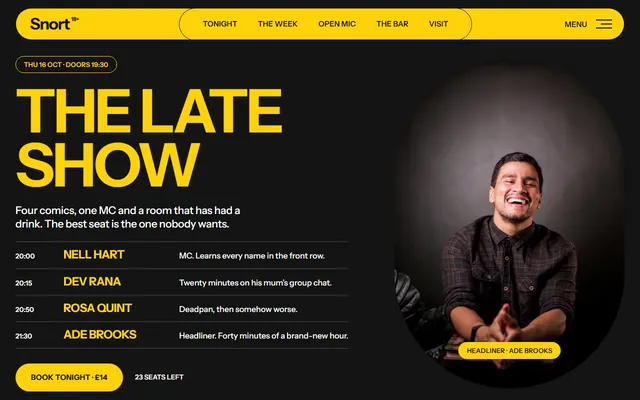
A comedy club in a railway arch: tonight's line-up and a week of shows.
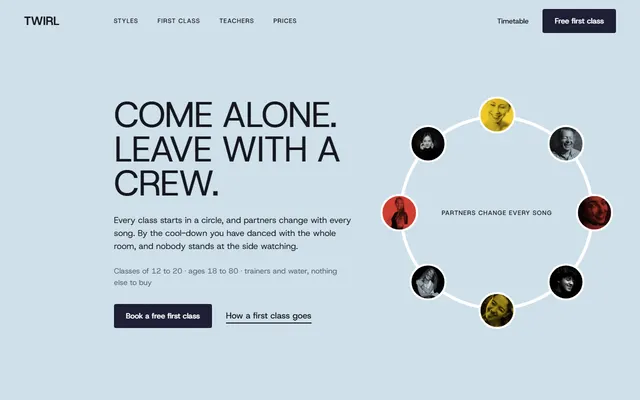
A dance studio that teaches adult beginners six styles.
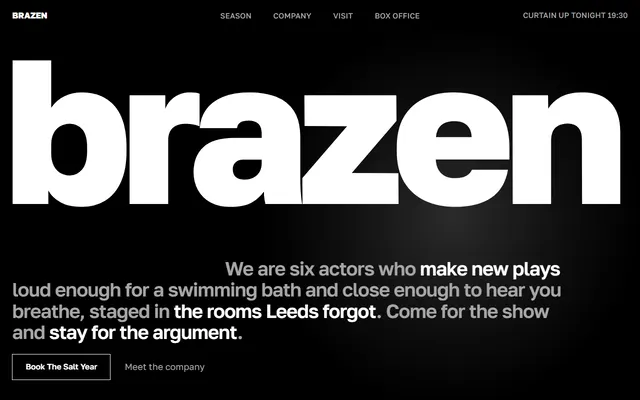
Theater company: current show, season board, company, rehearsal weeks, venues and box office.
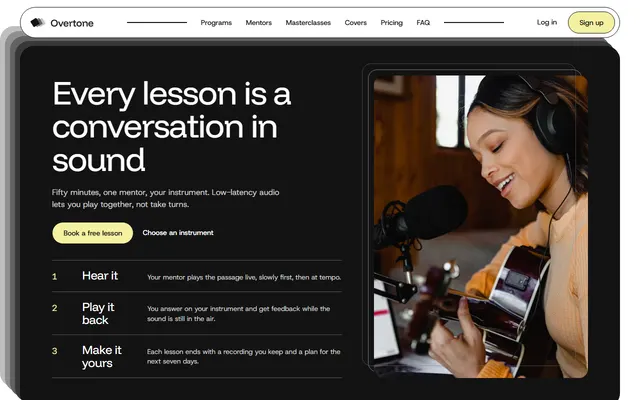
A music school with a lesson screen, instrument programs and steps to start.
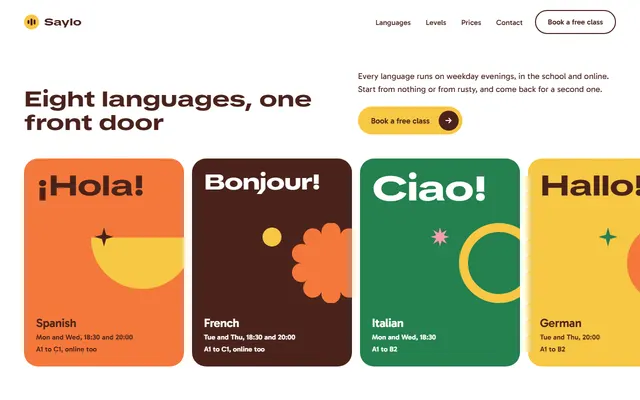
A language school with a track of languages and five levels as rising bars.
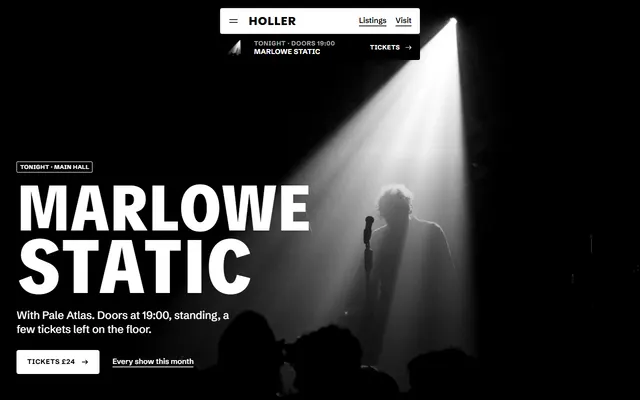
Music venue: tonight's running order, upcoming nights with ticket tags, two rooms, hall hire and a members list.
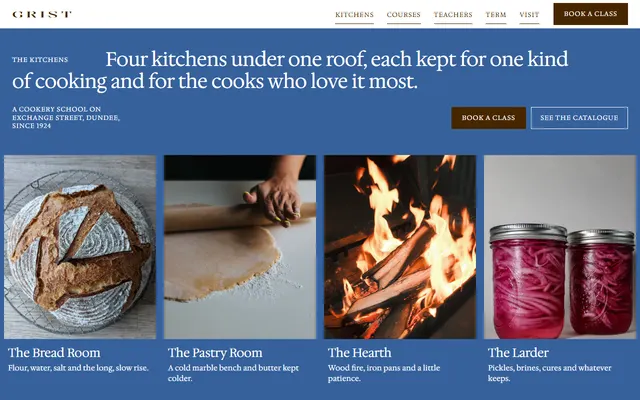
A cookery school with kitchens, its history and a catalogue of courses.
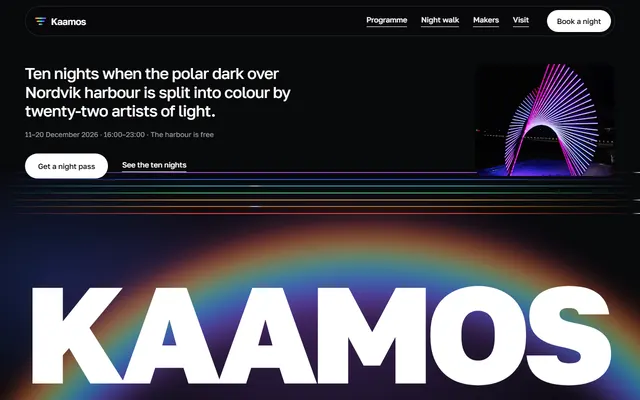
Light festival: ten nights programme, night walk route, makers, passes and an office form.