
What comes with the theater company website template
- index.html: the pure HTML and CSS version, one single HTML file, 102 KB.
- index.gsap.html: the same design built with GSAP, ScrollTrigger and Lenis, for scroll motion in every browser, Firefox included.
- AGENTS.md: what a coding agent must keep and what to replace, so Claude Code, Codex or Cursor edit it without breaking the scenes.
- DESIGN.md: every colour, font, spacing and motion rule of this theater company website design.
- PROMPTS.md: the agent prompt and the design prompt below.
- CREDITS.md and LICENSE.md: the photos and fonts with their licenses, and the 8B license.
- Updates to this template, at no extra cost.
Yours to edit: one index.html with no build step, so you or a coding agent can change the words, prices and photos and upload it to any static host. Not a coder? Describe your business in one sentence to 8B's AI website builder and it designs a new site for you, with more pages when you need them. Designing is free; publishing with hosting is $9 a month, billed yearly. It also works inside Claude and ChatGPT.
Premium template · $39, one-time license · Made by 8B, an AI website builder · Updated November 2026 · Plain text: brazen-theatre-company.md
About this theater company website template
Theater company website template for an ensemble or a fringe company that makes new plays: one HTML file with the current show, a season of four productions on a rotating board, the first page of a script, the company, six weeks of rehearsal, found venues, press quotes, a youth company, access details and a box office. It opens on a black house with a giant lowercase wordmark where the lead dims until only its lit phrases remain, then the stage rises with a red-lit performer and the bill for tonight. It is a single HTML file in pure HTML and CSS, and a GSAP version of the same page comes with it.
At a glance, November 2026. One 102 KB index.html: a single HTML file in pure HTML and CSS with a few lines of built-in JavaScript, 12 sections, 18 Unsplash photos, Besley and Golos Text. A GSAP build of the same page, 73 KB, comes with it.
It suits a new-writing company, a devised or site-specific ensemble, a fringe or touring theatre, a small repertory with a youth company, or a performance collective that plays in unusual rooms. Theater company websites mostly need four things on one scroll: what is on and where, who makes it, how to book and how to get in, and this page gives each its own section, with access performances and pay what you can nights written in rather than hidden in a footnote. A theatre company website built from it also keeps what makes a company memorable: a page of the script itself, the rehearsal process and the odd rooms you play in.
The demo business is Brazen, an invented company of six actors in Leeds that stages new plays in a drained swimming bath, a chapel, a mill and a bus depot. Every show, date, venue, quote, name and price is demo copy to replace. The season shows title, author, dates and venue, so a company in any city fills in its own productions; the pounds, the access types and the pay what you can night follow British habits, which you change to your own market.
If you would rather not edit HTML at all, 8B, the AI website builder designs a site from one sentence about your company, with more pages when you need them. This template is for people who want this exact design in their own hands: one index.html with its CSS and its motion inside, which you or a coding agent can edit and host anywhere, next to the ticketing page you already use.
Good for:
What a theater company website needs
A theatre company's website has to tell a visitor what is on, where, how to book and how to get in. Here is how this template covers each of them.
- What is on tonight. The first screens show the current production with its author, run dates and a Book seats button, and the header carries tonight's curtain time.
- The whole season in one place. Four productions on a board of one large tile and three small ones, each with credit, dates, venue and a booking link, and a red marker for the show on stage.
- A sense of the work itself. Page one of a new play is set as a script, with stage directions and short lines of dialogue, so a visitor reads the voice of the company.
- Who makes the shows. Six company members with a portrait, name and role, and a statement about how the company works.
- How a show is made and where it plays. Six weeks of rehearsal in numbered rows, and four venues with a note about how each room is used.
- Access and a way in for everyone. A list of captioned, BSL-interpreted, audio described and relaxed performances, pay what you can seats, a youth company with application dates, and four questions about step-free access, lateness, children and the bar.
- A box office. Phone, email, opening hours and an email field for news of each show. Connect the field before you go live.
What it does not have is online ticketing, a seat map, a calendar or a cast database: it is built for a company that plays four productions in a season and sells through the box office or a ticket seller it links to.
Theater company website design and motion
Palette
#000 page ground, the house, and the type of the box office#fff text, lit phrases and the box office ground#a6a6a6 grey: unlit copy, captions, secondary text and the light press quote boxes#1c1c1c dark grey: the dark press quote boxes and the ground behind photos#3a3a3a dim grey: copy before it is lit, hairlines and the labels and links of the box office#e5251c stage red: the marker for the show on stage now and the focus ringsFonts
- Golos Text: the giant wordmark and headings, body text, labels, navigation, buttons and the form field
- Besley: the script dialogue and the press quotes
A black page with white type, three greys for panels and rules and one red for what is on stage now. Every section opens with a giant heading set across the full width like a title card, most of them followed by a lead paragraph in grey with a few phrases in white. The season is one large tile with three small ones beside it and a list of the four productions; the company is a row of six portraits; the venues are four frames that each take their room's shape; the press quotes sit in staggered boxes of two greys. The box office is the one white section. On phones the season tiles stack above the listings, the company becomes a grid of two columns by three and the venue frames run full width, the chapel a little narrower.
The idea behind the page is stage lighting: copy that is unlit is grey, and what matters is lit. So the opening dims the house until only the lit phrases remain, headings fly in letter by letter like battens lowered from above, text rises from dark to its resting tone as you read it, and the box office turns the house lights up by changing the section from black to white. All colour comes from red-lit photographs and a single red marker.
What is on the theater company website page
- NavigationHeader with the wordmark, four links and tonight's curtain time, hiding on the way down
The header sits over the opening, hides as you scroll down and comes back when you scroll up.
- brazenTwo screens: a black house with the giant wordmark brazen and a lead with lit phrases, then a red-lit stage with the current show's bill
On load the wordmark rises and the lead slides in under it, while a soft pool of light drifts behind the wordmark. As you scroll, the house is held on screen: the unlit words and the wordmark dim, the wordmark lifts a little, the actions fade and only the lit phrases remain. Then the stage rises over the house, its masking opens from the sides to full width, the photo settles from slightly enlarged, a pool of light grows from the performer into a full wash and the bill lights last.
- This seasonFour shows in repertory on a board of one large tile and three small ones, with dates, venues and booking links
On desktop the board is held on screen while the repertory turns four times: the next show grows into the large tile, the one on stage shrinks to the end of the queue and a red marker moves to the matching listing, until the board is back where it began. On phones the same turns are scrubbed while the board crosses the screen. The heading flies in and the lead lights up.
- Page onePage one of a new play set as a script, with stage directions and six lines of dialogue between two characters
The heading flies in letter by letter, and the stage directions and each line of dialogue rise from dark to their resting tone as they reach the reading zone.
- The companySix company members with a portrait, name and role, and a statement about sharing every decision
The six portraits start scattered at different heights and depths, step into one straight line as the row reaches the middle of the screen and the whole line dips together in a bow.
- Six weeksSix weeks of rehearsal from read-through to press night, in numbered rows beside two rehearsal photos
The heading flies in, each week rises from dark as it arrives and the two rehearsal photos open from a thin horizontal band to their full height.
- Found roomsFour found venues, a swimming bath, a chapel, a mill and a depot, each with a photo, a note and the show played there or its use
Every frame starts as the same wide stage window and opens into its room's shape as it crosses the screen, sideways for the pool and the mill, upwards and downwards for the chapel and the depot, while the photo settles and the room's name slides in from the opposite side.
- What they saidFour press quotes in staggered boxes of two greys
The heading flies in and two of the four quotes rise from dark as they arrive.
- Young CompanyA youth company for fourteen to nineteen year olds with a group photo, session times and an application link
The photo of the young company arrives cut into vertical slats at different heights that slide into one picture as the frame reaches the middle of the screen; the heading flies in and the lead rises from dark.
- VisitThe studio address, pay what you can nights, four kinds of access performance and four questions
The heading flies in, and the address and access columns rise from dark as they arrive.
- Box officeBox office with phone, email, opening hours and an email field for news of each show, on a white ground
The heading flies in and the section's ground rises from black to white while its type turns from white to black, like the house lights coming up.
- FooterFooter with the name in two heavy lines, navigation and social links, a back to top button and the charity line
The name in two heavy lines flies in letter by letter.
Before you publish the theater company website site
- Replace social preview image, favicon, phone number, email address, contact form (sends nothing yet) and social media links and the invented demo facts (names, prices, areas, quotes). AGENTS.md lists them.
- Book seats, Book The Salt Year, the Curtain up tonight link and the Join the waiting list link lead to
#season or #contact on the same pagenow; point them to your ticketing page, one link per show. - Apply for autumn in the Young Company section lead to
#contactnow; point them to your application form or page. - Season, Company, Visit and Box office in the header and the footer lead to
#season, #company, #visit and #contactnow; point them to keep them. - Brazen in the header, Meet the company in the opening and the back to top button in the footer lead to
#opening and #companynow; point them to keep them. - Join the list button of the box office email field lead to
submits the form to # (sends nothing)now; point them to your form service or mailing list. - Instagram, TikTok and YouTube links in the footer lead to
the networks' home pagesnow; point them to your own profiles, or remove them. - Scroll-driven animation runs when the browser supports it (Chrome, Edge and Safari today; Firefox does not yet) and the visitor has not asked for reduced motion. Otherwise each section shows its finished layout; the GSAP build, index.gsap.html, also plays the scroll motion in Firefox.
- The email field in the box office sends nothing: connect it to your mailing list or a form service. Without a page script there is no thank-you line after sending; add one or send the visitor to a thank-you page.
- It is one page: every Book seats link points to the box office section or the season, and there is no ticket checkout, seat map or calendar. Link each show to your ticketing page.
- The season board is built for four productions, the company line for six people and the venue list for four rooms: a different count needs its layout and scene adjusted. The rehearsal list is six weeks long; its rows can change freely.
- The venues, shows, dates, quotes and prices are for an invented Leeds company: replace them with your own.
Questions about this theater company website template
What do I get for $39?
The theater company website template as a single HTML file, index.html, in pure HTML and CSS, a GSAP build of the same page as index.gsap.html, a DESIGN.md with every colour, font and motion rule, an AGENTS.md for coding agents, the agent prompt and the design prompt from this page, and CREDITS.md for the photos and fonts. Updates to this template are included.
Can I use this theater company template for client sites?
Yes. One purchase lets you build as many sites as you like with it, for your own company or for clients, and change anything. What it does not allow is selling or giving away the template itself, as a template, theme or kit, or putting its source in a public repository.
How do I change the season and sell tickets?
Each production is one block of HTML with a photo, a title, a credit line, dates and a venue, and the season board is built for four. With Claude Code, Codex or Cursor you say it in a sentence, such as replace Nightshift with our autumn tour and change the dates, and the agent edits the block; by hand you change the words in each block. The Book seats links point to the season or the box office section, so set each one to your ticketing page, whether that is your box office system or a link to a ticket seller. The page has no checkout, seat map or calendar. If you want a site with more pages that you edit without code, 8B's AI website builder makes one from a sentence about your company.
Where do access performances and the newsletter go?
The visit section lists four kinds of access performance, a captioned, a BSL-interpreted, an audio described and a relaxed performance, in a plain list, plus four questions in disclosure boxes, so you rewrite the lines with your own dates and services. The box office has one email field for news of each show. It sends nothing until you connect a form service such as Formspree or Netlify Forms, or your mailing list, and the pure HTML and CSS version shows no thank-you line after sending, so point it at a thank-you page or add one.
Will it work with Claude Code, Codex or Cursor?
Yes. Put index.html and AGENTS.md in your project and give the agent the prompt that comes with the template. AGENTS.md says which attributes the scroll motion reads, what to keep and what to replace, so the agent swaps shows, dates, venues and photos without breaking the scenes.
What do visitors see in Firefox or with reduced motion?
Firefox does not support scroll-driven animations yet, so it shows every section in its finished layout, as does any browser when the visitor asks for reduced motion. If the scroll motion must also play in Firefox, use the GSAP build, index.gsap.html, which loads GSAP, ScrollTrigger and Lenis from a CDN.
More templates for stages, screens and nights out
Other designs for venues and live events.
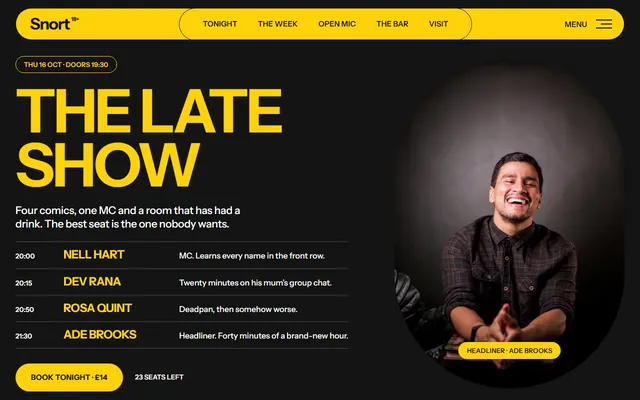
Comedy club in a railway arch: tonight's line-up, a seven-night programme, house rules, an open-mic sign-up and the address.
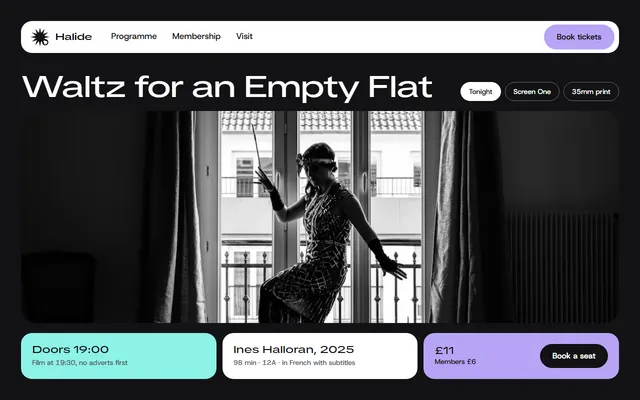
Independent cinema: tonight's film, a six-day programme, two rooms, a bar menu and a visit form.
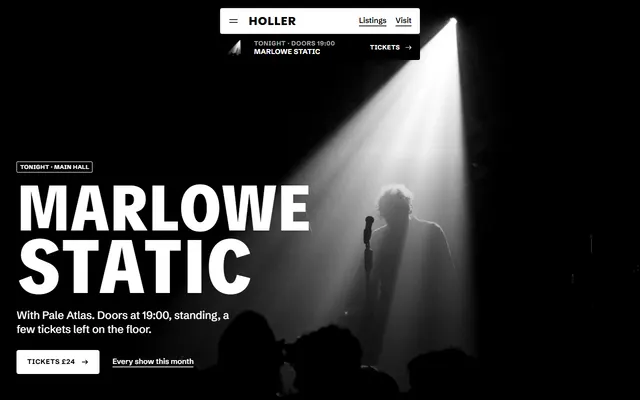
Music venue: tonight's running order, upcoming nights with ticket tags, two rooms, hall hire and a members list.

Short film festival: featured films, a jury, how to submit, three venues and two passes.
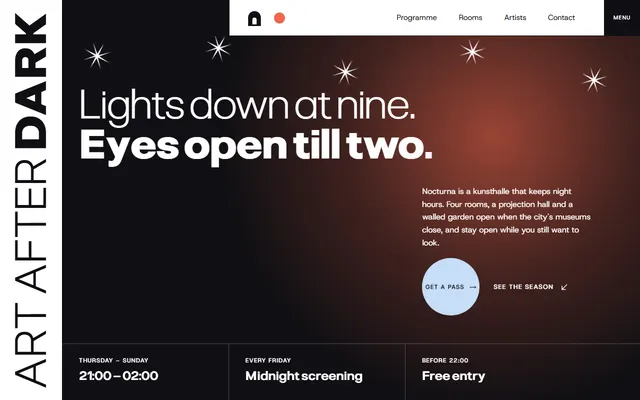
Kunsthalle that opens after dark: a six-night programme, four rooms, resident artists and three passes.
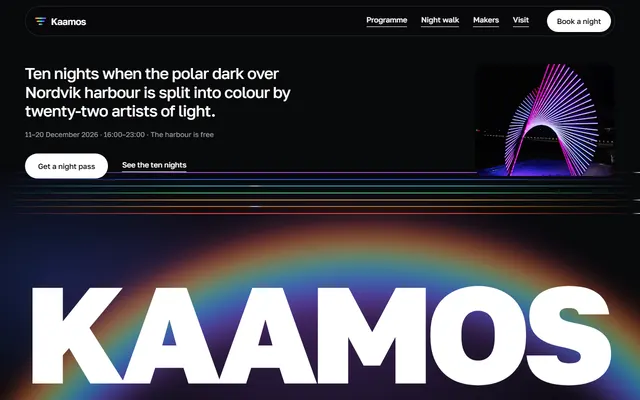
Light festival: ten nights programme, night walk route, makers, passes and an office form.
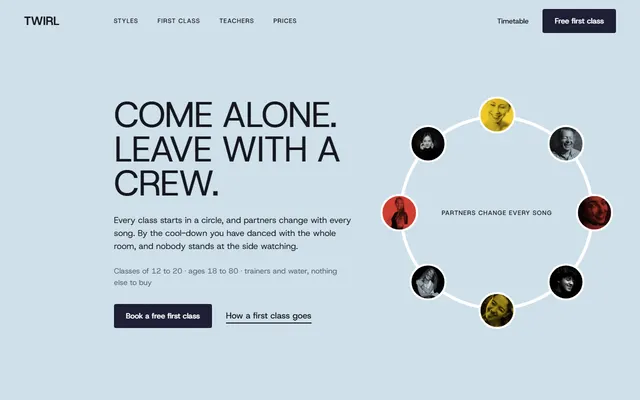
Dance studio for adult beginners: six styles, a first class step by step, a timetable, teachers and a booking form.
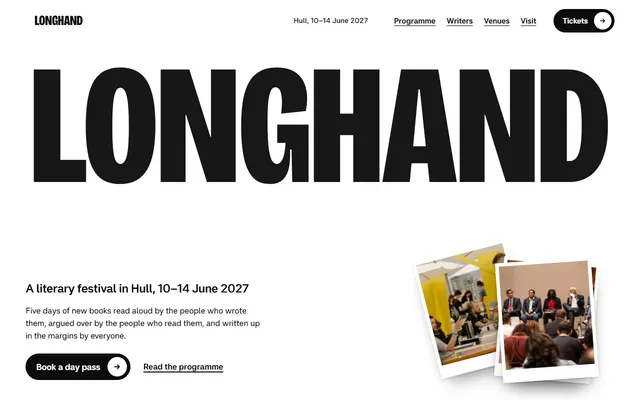
Literary festival: five-day programme, featured writers, prize shortlist, venues and passes.