What comes with the olive oil website template
- index.html: the pure HTML and CSS version, one single HTML file, 108 KB.
- index.gsap.html: the same design built with GSAP, ScrollTrigger and Lenis, for scroll motion in every browser, Firefox included.
- AGENTS.md: what a coding agent must keep and what to replace, so Claude Code, Codex or Cursor edit it without breaking the scenes.
- DESIGN.md: every colour, font, spacing and motion rule of this olive oil website design.
- PROMPTS.md: the agent prompt and the design prompt below.
- CREDITS.md and LICENSE.md: the photos and fonts with their licenses, and the 8B license.
- Updates to this template, at no extra cost.
Yours to edit: one index.html with no build step, so you or a coding agent can change the words, prices and photos and upload it to any static host. Not a coder? Describe your business in one sentence to 8B's AI website builder and it designs a new site for you, with more pages when you need them. Designing is free; publishing with hosting is $9 a month, billed yearly. It also works inside Claude and ChatGPT.
Premium template · $39, one-time license · Made by 8B, an AI website builder · Updated November 2026 · Plain text: orvena.md
About this olive oil website template
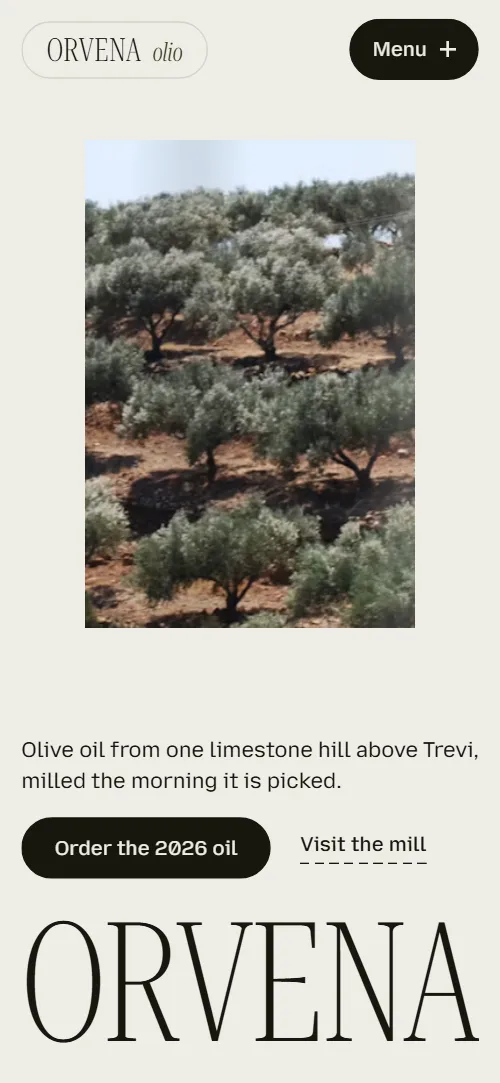
Olive oil website template for an estate or a small mill that sells its own oil: one HTML file with six oils and their prices, the four hours from branch to bottle, a tasting guide, a harvest diary, tree adoption, farm visits, a chef's quote and a reservation form. It opens on a framed grove photo that grows to fill the screen and then turns, slat by slat, into the oil it becomes, with the estate's name in thin capitals across the bottom. It is a single HTML file in pure HTML and CSS, and a GSAP version of the same page comes with it.
At a glance, November 2026. One 108 KB index.html: a single HTML file in pure HTML and CSS with a few lines of built-in JavaScript, 13 sections, 27 Unsplash photos, Mozilla Text and Roboto Serif. A GSAP build of the same page, 100 KB, comes with it.
It suits an olive estate, an olive farm with its own mill, a small producer of wine, honey, cheese or preserves, or a farm shop that sells by the season and welcomes visitors. Olive oil websites mostly need the same few things on one scroll: the oils with what each tastes like and what it costs, how the oil is made, a reason to trust the harvest, and a way to reserve or order. An olive oil estate website built from this page also gets what a shop shelf cannot show: the hill, the dated harvest, the mill and the people who pick.
The demo business is Orvena, an invented estate above Trevi in Umbria. Every name, price, date, restaurant, address and phone number is demo copy to replace. The oils show a size, a price and a taste line, so a producer in Tuscany, Andalusia, Crete or California fills in its own varieties, harvest window, currency and shipping terms, and the visits, adoptions and trade offers change to match what the estate really sells.
If you would rather not edit HTML at all, 8B, the AI website builder designs a site from one sentence about your business, with more pages when you need them. This template is for people who want this exact design in their own hands: one index.html with its CSS and its motion inside, which you or a coding agent can edit and host anywhere, next to the shop or payment link you already use.
Good for:
What an olive oil website needs
Olive oil estates that sell direct answer the same questions quickly. Here is how this template covers each of them.
- The oils with prices and taste. Six oils in two columns, each with a photo, an italic name, size and price on one line, a taste line and a Reserve a bottle link.
- How the oil is made. Four steps from the first net at 06:40 to bottling in the afternoon, each with the time, a title and a short text beside a photo that changes.
- Proof of the harvest. A diary of seven dated snapshots from 14 October to 22 November, each with a note, dealt from a pile into a contact sheet.
- A way to taste and understand it. Four steps (Warm, Breathe, Slurp, Swallow), each with a sentence and what to look for, so a visitor learns what a fresh oil does.
- Gifts and visits. A ledger of three tree adoptions with what arrives and the yearly price, and three visits with when, how long and what they cost.
- Trade and restaurants. A chef's quote with his portrait, a row of nine restaurants that pour the oil, and a trade and restaurant prices link in the oils section.
- A reservation or order request. A form with name, email, the oil and a message, next to the mill's address, phone, email and shop hours. Connect the form before you go live.
What it does not have is a cart, stock levels or a checkout: it takes reservations through the form and links, and the honest way to sell online is to point those links at your payment page or shop while this page tells the estate's story.
Olive oil website design and motion
Palette
#eeede6 page ground, plates over photos and light text on the dark band#17170f near-black ink: text, the dark pill buttons and focus rings#363a1c deep olive: the reservation band, the one italic accent word and the italic olio beside the logo#cdb13f oil gold: button hover slats, the band travelling down the tasting list and the lines on the reservation band#5c5b51 secondary text: notes, labels, prices and captions#d4d3c8 hairlines, pill borders and quiet fills on the groundFonts
- Roboto Serif: the thin condensed display capitals for the name and headings, and its italic for the names of oils, steps, visits and questions, the accent word and some of the restaurant names
- Mozilla Text: body text, small tracked labels, buttons, links and form fields
A stone-coloured page with near-black text and one deep olive band for the reservation form. Headings are thin, condensed serif capitals set large, with a single italic word in the opening promise; small tracked labels sit beside the headings, and pill-shaped buttons, photo capsules and the chef's round portrait are the only rounded shapes against square photos. The six oils are two columns, tall photos on the left and wide ones on the right, each with an italic name, size and price on one line, a taste line and a link. The mill is a held photo frame on the left beside four steps; the harvest diary is a contact sheet of four and three snapshots; the adoptions are a ledger of three rows beside one tall tree; the visits are three wide panels. The estate's name returns across the full width in the footer. On phones the oils become one column, the mill frame is held under the header with the steps below it, the diary becomes two columns and the visits stack.
The idea behind the page is the lamella: a band of thin vertical slats. Photos and colour fields open and turn through slats, the oil highlight is a single gold that appears on button hovers, the band that travels down the tasting list and the lines on the reservation band, and a framed photo that grows to the whole screen is the opening move. Everything else stays quiet and light so the photographs and the oils carry the page.
What is on the olive oil website page
- NavigationHeader with the wordmark, four links in a pill, Reserve the new oil and a Menu button that opens a full-screen list with the address
The header slides out of view on the way down once you are past the top of the page and comes back as soon as you scroll up; on phones the links sit in a Menu button that opens a full-screen list.
- Orvena, olive oil estate and mill, Trevi, UmbriaTwo screens: a framed grove photo with ORVENA in thin capitals, a line, two actions and the harvest window, then Picked at dawn, pressed by noon over a full-bleed oil photo
On load the framed grove photo opens from a vertical slit, the name rises from below its line and the side texts lift in, while soft bands of light drift across the grove. On scroll the frame opens to the whole screen as the photo settles to full bleed, the side texts lift away and the name is pressed down under the photo; the second screen rises over it and its oil photo turns open through vertical slats from left to right.
- We press olives that keep the light of one hill.A headline with three photo capsules set as words, one italic word, a paragraph about the family and the hill, and a link
Each of the three photo capsules in the headline opens through slats as it comes into view, and the paragraph beside it rises.
- OilsOILS and six oils in two staggered columns, each with a photo, name, size, price, taste line and Reserve a bottle link
The two columns slide past each other as you scroll, the right column coming up from below and each card resting in its place through the middle of its pass, so the stagger flips; each photo drifts inside its frame. On phones the cards settle from alternate sides.
- Four hours, branch to bottleFour hours, branch to bottle: a held photo frame beside four steps with the time of day, title and text
The photo frame is held while the four steps scroll beside it; as each next step comes up toward the middle, the photo on top turns away through vertical slats and uncovers the next one, and turns back when you scroll up.
- How to taste a new oilHow to taste a new oil: four big verbs (Warm, Breathe, Slurp, Swallow), each with a sentence and what you should find
A gold band travels down the four verbs following the middle of the screen, holding on each row for most of its pass and sliding to the next between them; the text stays ink on the band.
- Harvest diaryHarvest diary: seven dated snapshots with a note each, shown as a tilted pile and then a contact sheet
On desktop the section is held while seven snapshots lie in a tilted pile, are dealt out one by one and end as a straight contact sheet with their captions. On narrower or shorter screens each snapshot starts tilted and pushed toward the centre and straightens into its place as it crosses the screen.
- Adopt a treeAn old olive tree photo beside a ledger of three adoptions with what arrives and a yearly price, an Adopt a tree button and a Give one as a present link
The tall tree photo opens through vertical slats from left to right as it comes into view, and each ledger row rises as it comes into view.
- Come up the hillCome up the hill: three wide panels (Grove walk, Mill tasting, Harvest week) with when, length and price
On desktop the section is held and the three panels move sideways on a walk while each photo drifts against the motion; on smaller screens there is no walk, the panels sit in a row or stack on phones, and each photo drifts up inside its frame.
- What cooks sayA chef's sentence with his portrait, name and restaurant, and a slow row of nine restaurants that pour the oil
The chef's sentence lights word by word, from faint to full, as it rises toward the middle of the screen; below it the restaurant names run in a slow continuous row that pauses on hover or focus and when off screen.
- Questions we getFive questions as native details beside the heading and the mill's email
Each question row rises into place as it comes into view; the answers open with the browser's own details element.
- Reserve the November oilReserve the November oil on a deep olive band: a form with name, email, oil and a message, the mill's address, phone, email and shop hours
Light slats lie over the deep olive band and turn edge-on one after another from left to right, uncovering the form and the gold lines like shutters opening.
- FooterFooter with four columns (index, elsewhere, the mill, shop hours) and ORVENA across the full width
The letters of the estate's name rise from below their line at staggered speeds as the footer comes in.
Before you publish the olive oil website site
- Replace social preview image, favicon, email address, contact form (sends nothing yet), phone number and social media links and the invented demo facts (names, prices, areas, quotes). AGENTS.md lists them.
- Order the 2026 oil button on the first screen lead to
#oilsnow; point them to your shop or order page, or keep #oils. - Visit the mill and How the mill works links lead to
#visit and #millnow; point them to keep as they are. - Reserve the new oil in the header and the menu, every Reserve a bottle link, Trade and restaurant prices, Adopt a tree, Give one as a present, the three visit links and Harvest letter lead to
#contactnow; point them to your shop, payment link or booking page, or keep #contact once the form is connected. - Trade list in the footer and the email links in the questions and contact section lead to
mailto: frantoio@orvena.example and tel:+390000000000now; point them to your own email and phone, in the link and in the visible text. - Instagram link in the footer lead to
the network's home pagenow; point them to your own profile, or remove it. - Scroll-driven animation runs when the browser supports it (Chrome, Edge and Safari today; Firefox does not yet) and the visitor has not asked for reduced motion. Otherwise each section shows its finished layout; the GSAP build, index.gsap.html, also plays the scroll motion in Firefox.
- The reservation form sends nothing: connect it to a form service, your email or your shop. Without a page script there is no thank-you line after sending; add one or send the visitor to a thank-you page. There is no cart: every Reserve a bottle link goes to the form.
- The oils list is built for six oils, the harvest diary for seven snapshots, and the visits walk for three panels: a different count needs its layout and scene adjusted.
- The harvest pile is held only on screens at least 1001 by 660 pixels, and the visits walk is held from 1001 pixels wide; smaller screens get a simpler version of the same motion. The prices are in euros and the dates, places and restaurants are demo copy to replace.
Questions about this olive oil website template
What do I get for $39?
The olive oil website template as a single HTML file, index.html, in pure HTML and CSS, a GSAP build of the same page as index.gsap.html, a DESIGN.md with every colour, font and motion rule, an AGENTS.md for coding agents, the agent prompt and the design prompt from this page, and CREDITS.md for the photos and fonts. Updates to this template are included.
Can I use this olive oil template for client sites?
Yes. One purchase lets you build as many sites as you like with it, for your own estate or for clients, and change anything. What it does not allow is selling or giving away the template itself, as a template, theme or kit, or putting its source in a public repository.
Can I sell oil online with this template?
It is built for reserving, not for a cart. Each oil has a size, a price and a Reserve a bottle link that goes to the form at the end, where the visitor picks the oil, writes how much and sends the request. The form sends nothing until you connect it to a form service such as Formspree or Netlify Forms, or to your email. If you take payment online, point the links at your payment page or your shop, and keep this page as the estate's front door. If you want a site with more pages that you edit without code, 8B's AI website builder makes one from a sentence about your business.
How do I change the oils, prices and harvest dates?
Each oil is one block of HTML with a photo, a name, a size and price, a taste line and a link, and the dates and prices are plain text. With Claude Code, Codex or Cursor you say it in a sentence, such as rename Frantoio to Coratina and set it at 14 dollars for 250 ml, and the agent edits the block; by hand you change the words. The page is built for six oils, seven diary snapshots and three visits, so a different number of any of them needs its layout adjusted too. Euros, the harvest window and the shipping answers are demo copy to replace with your own.
Will it work with Claude Code, Codex or Cursor?
Yes. Put index.html and AGENTS.md in your project and give the agent the prompt that comes with the template. AGENTS.md says which attributes the scroll motion reads, what to keep and what to replace, so the agent swaps oils, prices, dates, places and photos without breaking the scenes.
What do visitors see in Firefox or with reduced motion?
Firefox does not support scroll-driven animations yet, so it shows every section in its finished layout, as does any browser when the visitor asks for reduced motion. If the scroll motion must also play in Firefox, use the GSAP build, index.gsap.html, which loads GSAP, ScrollTrigger and Lenis from a CDN.
More templates for food, farms and makers
Other designs for producers and shops that sell what they make.
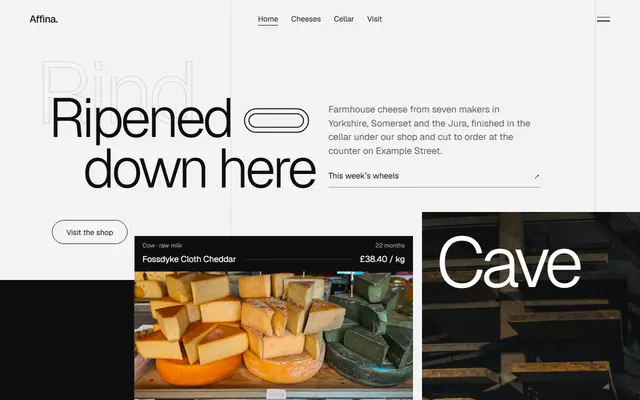
Cheesemonger: this week's cheeses with prices, a cellar in five steps, seven farms, a monthly club and a visit form.
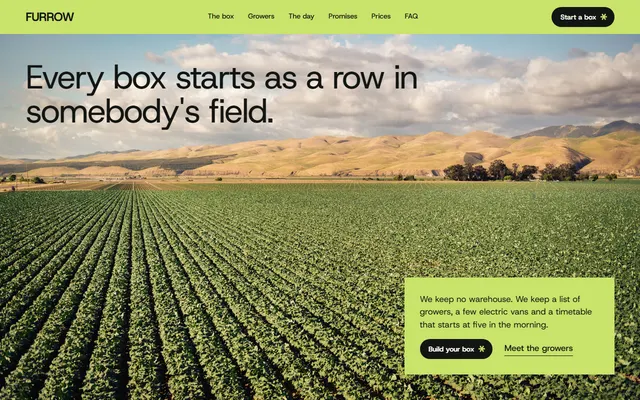
Veg box scheme: this week's vegetables, the growers, a delivery day from field to door, a box builder and a postcode check.
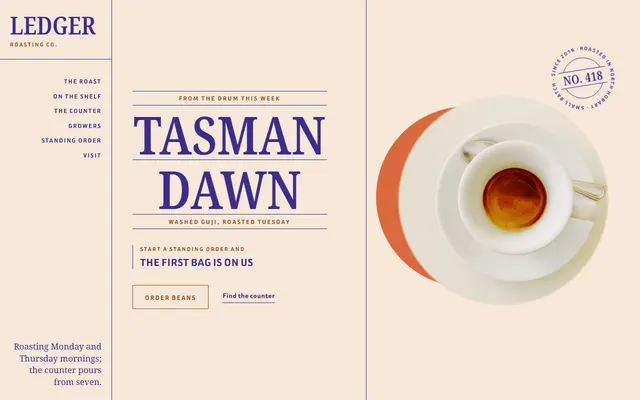
Coffee roaster and espresso counter: the week's batch, a roast timeline, bags, a drinks board, cupping and orders.
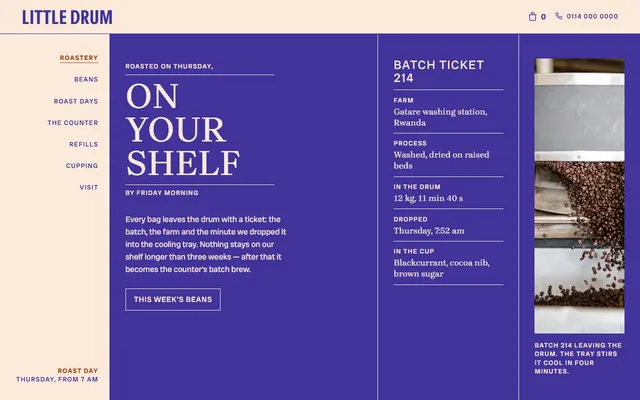
Micro-roastery: a roast-day ticket, five bean listings, the steps of roast day, partner farms and visit details.
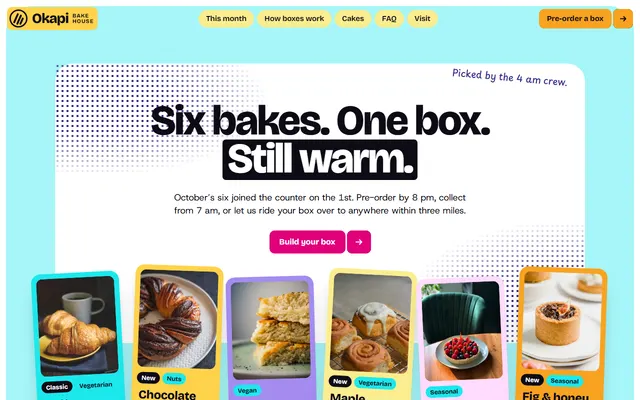
Bakery: a monthly box of six bakes with prices, morning bakes, pre-order steps, gift cards and an order form.
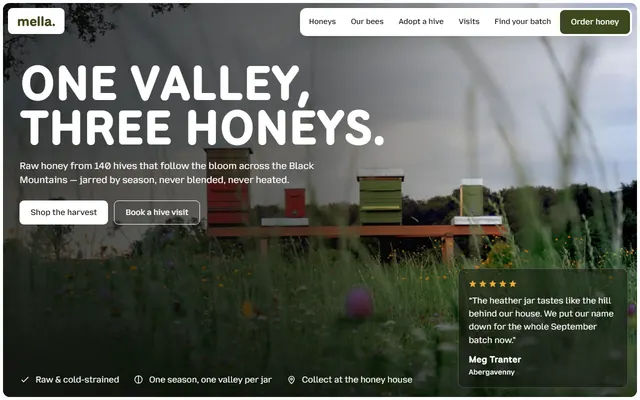
Beekeeper or honey producer: seasonal honeys, how a jar is made, batch codes, hive visits and an order form.
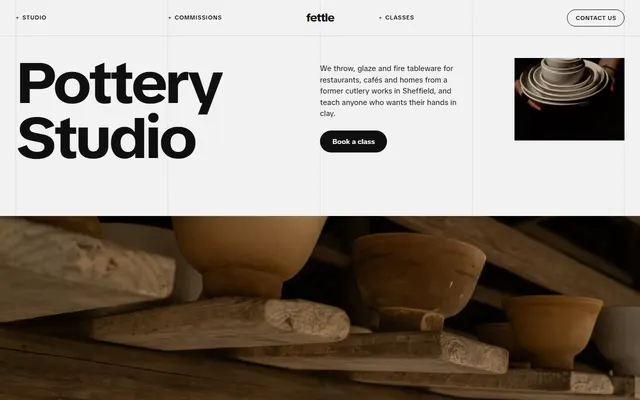
Pottery studio: commissions, a six-step process, glazes, classes with prices, a small shop and a contact form.
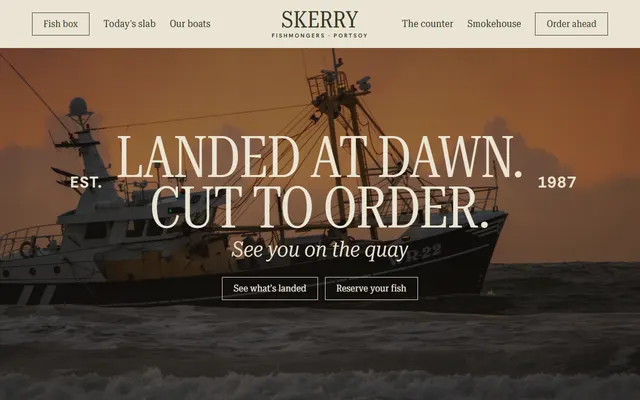
Fishmonger or fish market: daily catch prices, day boats, counter jobs, smokehouse and a Friday box.