What comes with the fish market website template
- index.html: the pure HTML and CSS version, one single HTML file, 97 KB.
- index.gsap.html: the same design built with GSAP, ScrollTrigger and Lenis, for scroll motion in every browser, Firefox included.
- AGENTS.md: what a coding agent must keep and what to replace, so Claude Code, Codex or Cursor edit it without breaking the scenes.
- DESIGN.md: every colour, font, spacing and motion rule of this fish market website design.
- PROMPTS.md: the agent prompt and the design prompt below.
- CREDITS.md and LICENSE.md: the photos and fonts with their licenses, and the 8B license.
- Updates to this template, at no extra cost.
Yours to edit: one index.html with no build step, so you or a coding agent can change the words, prices and photos and upload it to any static host. Not a coder? Describe your business in one sentence to 8B's AI website builder and it designs a new site for you, with more pages when you need them. Designing is free; publishing with hosting is $9 a month, billed yearly. It also works inside Claude and ChatGPT.
Premium template · $39, one-time license · Made by 8B, an AI website builder · Updated November 2026 · Plain text: skerry.md
About this fish market website template
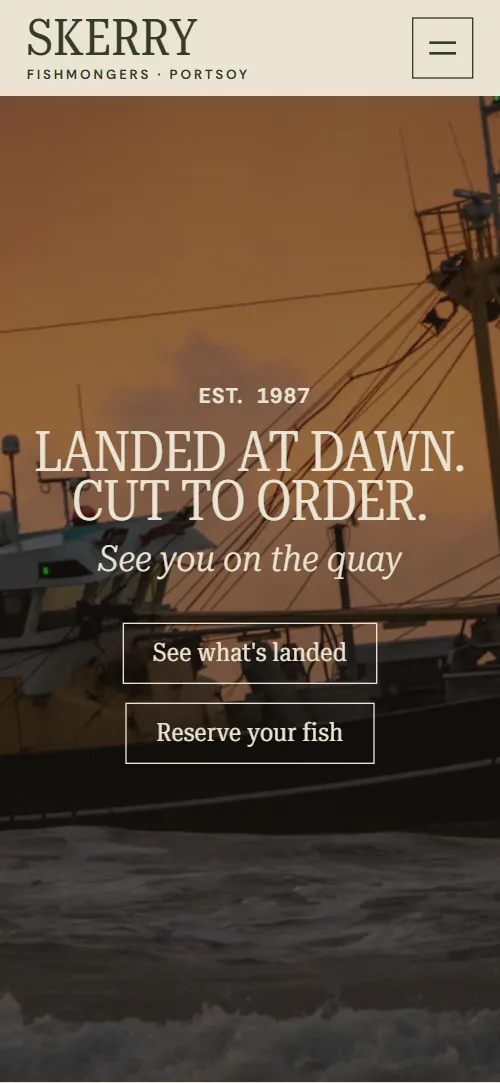
Fish market website template for a fishmonger, seafood shop or smokehouse that sells the morning's catch: one HTML file with a board of today's fish and prices, the day boats it buys from, kitchen notes with recipes, the knife jobs done at the counter, a smokehouse, trade orders for kitchens, a Friday box and an order slip. It opens on a poster of a trawler at dawn with the slogan Landed at dawn. Cut to order., and a sage tide rises through the giant letters and recolours them as the second screen arrives. It is a single HTML file in pure HTML and CSS, and a GSAP version of the same page comes with it.
At a glance, November 2026. One 97 KB index.html: a single HTML file in pure HTML and CSS with a few lines of built-in JavaScript, 12 sections, 25 Unsplash photos, Rethink Sans and Roboto Serif. A GSAP build of the same page, 89 KB, comes with it.
It suits a family fishmonger, a harbour fish market, a seafood shop with a counter, a smokehouse or any food seller who knows which boat or farm each product came from and takes orders the day before. Fish market websites mostly need four things on one scroll: what is in today and what it costs, where it comes from, what you will prepare for the customer and how to order. This page gives each its own section, and a fishmonger website built from it also gets the parts that set a small shop apart from a supermarket: named boats, landing times, free knife work and a recipe wrapped with every parcel.
The demo business is Skerry, an invented fishmonger on the harbour at Portsoy in Scotland. Every boat, price, landing time, hour, address and recipe is demo copy to replace. The board lists species with origin, landing time and price per kilo or per piece, so a seafood market in any region fills in its own catch; the prices are in pounds, the boats carry Scottish registrations and the trade kitchens are on the Moray coast, all of which you change to your own waters and currency.
If you would rather not edit HTML at all, 8B, the AI website builder designs a site from one sentence about your business, with more pages when you need them. This template is for people who want this exact design in their own hands: one index.html with its CSS and its motion inside, which you or a coding agent can edit and host anywhere, next to the till or ordering tool you already use.
Good for:
What a fish market website needs
Fish market and fishmonger websites that bring in customers answer the same questions quickly. Here is how this template covers each of them.
- What is in today and what it costs. A board of six species, each with the boat, the landing time and the price per kilo or per piece, with a photo window that follows the row you are reading.
- Where the fish comes from. Four named day boats with registration, crew, gear and catch, an origin line on every row of the board, and a question that says which fish and shellfish come from elsewhere.
- What you will prepare. Five numbered knife jobs at the counter, from scaled and gutted to crab picked and dressed, and three kitchen notes with recipes and times.
- Smoked and prepared products. A smokehouse section with the wood, the hours, the temperature and how it is sold, with a button to order a whole side.
- Trade customers and a regular box. A section for local kitchens with the morning list and delivery time, and a Friday box with six tiles, a price and how it is collected or delivered.
- Questions people ask at the counter. Six questions on keeping, freezing, delivery, origin and party orders, as native disclosure rows.
- Hours, address and a way to order ahead. A board of opening days and hours, the address, phone and email, and an order slip with a collection day. Connect the slip before you go live.
What it does not have is a basket, live stock or online payment: it is built for a shop that sells by the morning's landing and takes orders by slip, phone or email. Prices and species are text you or a coding agent change, and the order slip can be connected to a form service or your own ordering tool.
Fish market website design and motion
Palette
#ebe4d4 cream: page ground and text on the dark sections#353a28 dark olive: text, rules and frames, the smokehouse and footer grounds, the fill of a button on hover#a7ad8b sage: the second screen of the opening, the Friday box ground and the tide behind the order slip#cfc4ab tan: the order slip#17140f near-black: the shade over the dawn, sea and market photos#585c45 mid olive: secondary text on cream, such as intros, origins, recipe times and step notes, and the board rows other than the one being readFonts
- Roboto Serif: the huge condensed capitals, the statement, the italic tagline and button labels
- Rethink Sans: body text, the board's spaced capitals, labels and form fields
A cream page with dark olive text, broken by flat bands of dark olive and sage, a tan order slip and two full-width photo bands of the sea and a market hall. Headings are huge condensed serif capitals; species names, prices, opening days and hours are set in bold spaced capitals like a market board. The slab is a board of six rows on the right of a sticky photo window; the boats are four lanes of giant names divided by thin rules; the counter is a tall photo beside five numbered steps; the Friday box is a grid of six framed tiles; the order slip has a solid outer frame and a dotted inner frame. On phones the slab window becomes a band under the header, the counter photo a band above the steps and the box grid two columns.
The idea behind the page is the tide and the knife: the slogan is taken by the tide as the second screen rises, and the counter cuts one photo into the five portions it describes. The same sage rises again behind the order slip at the end, so the page opens and closes with the water. The catch photos, recipe photos and box tiles are framed with thin offset outlines, and the italic appears only in the tagline under the slogan.
What is on the fish market website page
- NavigationHeader with the wordmark and Fishmongers, Portsoy line, four links, two outlined buttons and a menu button on phones and tablets
The header bar sits over the first screen, hides when you scroll down past the top and comes back when you scroll up; on phones and tablets the links open from a menu button.
- Landed at dawn. Cut to order.Two screens: a trawler at dawn with the slogan Landed at dawn. Cut to order. between Est. and 1987, then a sage band with five small catch photos and a statement about the harbour shop
On load the dawn photo settles from slightly larger, each slogan line rises out of its own clip, the Est. and 1987 marks, the tagline and the two buttons lift into place, and the photo pans slowly from side to side. On scroll the second screen's sage rises through the poster and recolours the giant letters as the water line passes, the photo darkens, the two lines drift apart and fade, and the five small catch photos rise one by one.
- On the slab todayOn the slab today: a board of six species with origin, landing time and price, beside a sticky photo window
The photo window holds six stacked photos. As the board scrolls, the photo of the row at the reading line opens upward over the previous one while it settles from a slight enlargement, and that row's name darkens while the other rows stay in mid olive.
- Four boats, home by breakfastFull-width sea photo with four day boats as lanes of huge names, each with registration, crew, gear and catch
The four boat names sail in from alternating sides, each at its own speed, and berth in one left-aligned column as the section reaches the middle of the screen; the sea photo drifts slowly behind them.
- Kitchen notesKitchen notes: three framed photo and text rows, each a recipe with its time
The heading rises line by line and each photo's offset outline settles onto it while the photo eases from a slight enlargement.
- Cut while you waitCut while you wait: a photo of a red mullet being filleted beside five numbered knife jobs
The photo stays in view while the steps scroll. The step at the reading line darkens while the others stay in mid olive, and by the fifth step the photo of the red mullet stands as five offset slices cut by lines drawn down it.
- Smoked out the backDark olive band with the heading, a wide photo of mackerel on a rail and three facts about the smoking
The heading rises, and the wide photo of mackerel on the rail turns from cold grey and dark to warm, sepia-toned and brighter as the band crosses the screen.
- At your back door by eightFull-width market hall photo with a heading, a paragraph about morning deliveries to kitchens and a trade account button
The heading rises and the market hall photo drifts slowly behind the text.
- The Friday boxThe Friday box: a sage band with six framed tiles of what goes in the box, a price and a join button
The six tiles start scattered and tilted around the grid and are packed one by one into their places as the section scrolls into view.
- Asked at the counterAsked at the counter: six native disclosure rows
The heading rises; each question opens and closes as a native disclosure row.
- Order the day beforeOpening hours board, the shop address, phone and email, and the order slip in a double frame
A sage field rises from the bottom edge to fill the section while the order slip's solid and dotted frames close onto it.
- The morning listDark olive footer with a morning list email field, the company line and Instagram, Facebook and Privacy links
Before you publish the fish market website site
- Replace social preview image, favicon, phone number, email address, contact form (sends nothing yet) and social media links and the invented demo facts (names, prices, areas, quotes). AGENTS.md lists them.
- Fish box and Order ahead buttons in the header and the menu, Reserve your fish, Order a whole side, Open a trade account and Join the Friday round lead to
#contact or #box on the same pagenow; point them to keep them once the order slip is connected, or your own ordering page. - See what's landed, How we cut it and the menu links lead to
#slab, #counter, #boats and #smokehouse on the same pagenow; point them to keep as they are. - Phone and email links in the contact section lead to
tel:+441260000000 and counter@skerry.examplenow; point them to your counter's number and email, in the link and in the visible text. - Privacy link in the footer lead to
#privacy, an anchor the page does not containnow; point them to your privacy page, or remove the link. - Instagram and Facebook links in the footer lead to
the networks' home pagesnow; point them to your own profiles, or remove them. - Scroll-driven animation runs when the browser supports it (Chrome, Edge and Safari today; Firefox does not yet) and the visitor has not asked for reduced motion. Otherwise each section shows its finished layout; the GSAP build, index.gsap.html (GSAP 3.13), also plays the scroll motion in Firefox.
- The order slip and the morning list field send nothing: connect them to a form service, your email or your ordering system. Without a page script there is no thank-you line after sending.
- It is one page: the Privacy link points to an anchor the template does not contain. There is no basket, stock count or online payment; prices on the board are text you update by hand.
- Built for a shop with a short daily board, a few named boats and a fixed list of knife jobs: each slab row pairs with one photo in the window, each boat lane has its own starting offset, and the counter photo is cut into as many slices as there are knife jobs (five), so adding a step means changing that count.
Questions about this fish market website template
What do I get for $39?
The fish market website template as a single HTML file, index.html, in pure HTML and CSS, a GSAP build of the same page as index.gsap.html, a DESIGN.md with every colour, font and motion rule, an AGENTS.md for coding agents, the agent prompt and the design prompt from this page, and CREDITS.md for the photos and fonts. Updates to this template are included.
Can I use this fish market template for client sites?
Yes. One purchase lets you build as many sites as you like with it, for your own shop or for clients, and change anything. What it does not allow is selling or giving away the template itself, as a template, theme or kit, or putting its source in a public repository.
How do I change today's fish and prices?
Each species is one row of the board with a name, the boat and landing time, and a price, plus one photo in the window beside it. With Claude Code, Codex or Cursor you say it in a sentence, such as swap the red bream for sea bass at 22 pounds a kilo and move langoustines to the top, and the agent edits the row and its photo; by hand you change the words in the row and the photo link. The board is text, not a stock system: there is no basket, stock count or online payment, so customers see the day's list and send the order slip or ring the counter, which suits a shop that sells by the morning's landing and fills orders by hand.
Does the order slip send orders?
Not yet. The slip asks for name, phone, collection day and what the customer would like, but it sends nothing until you connect a form service such as Formspree or Netlify Forms, or your own email or ordering tool. The morning list field in the footer is the same. The pure HTML and CSS version shows no thank-you line after sending, so point the form at a thank-you page or add one.
Will it work with Claude Code, Codex or Cursor?
Yes. Put index.html and AGENTS.md in your project and give the agent the prompt that comes with the template. AGENTS.md says which attributes the scroll motion reads, what to keep and what to replace, so the agent swaps species, boats, prices and photos without breaking the scenes.
What do visitors see in Firefox or with reduced motion?
Firefox does not support scroll-driven animations yet, so it shows every section in its finished layout, as does any browser when the visitor asks for reduced motion. If the scroll motion must also play in Firefox, use the GSAP build, index.gsap.html, which loads GSAP, ScrollTrigger and Lenis from a CDN.
More templates for food shops and kitchens
Other designs for businesses that sell what they make or grow.
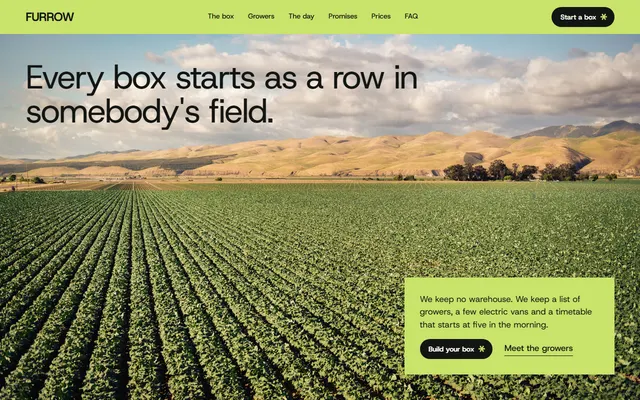
Veg box scheme: this week's seven vegetables, the growers, one delivery day, a box builder with a live price and recipes.
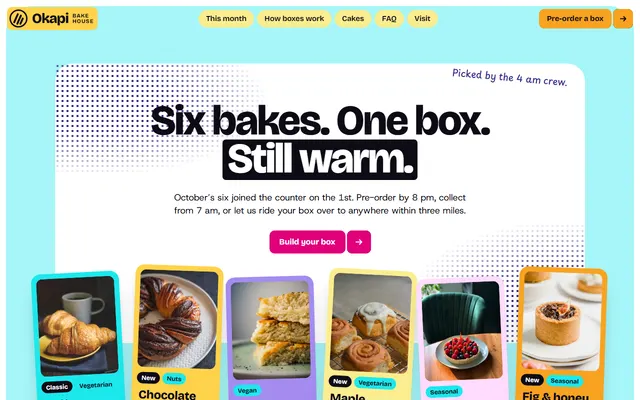
Bakery: a monthly box of six bakes with prices, a long list of morning bakes and four pre-order steps.

Coffee roaster and espresso counter: the week's batch, a roast timeline, bags, a drinks board, cupping and orders.
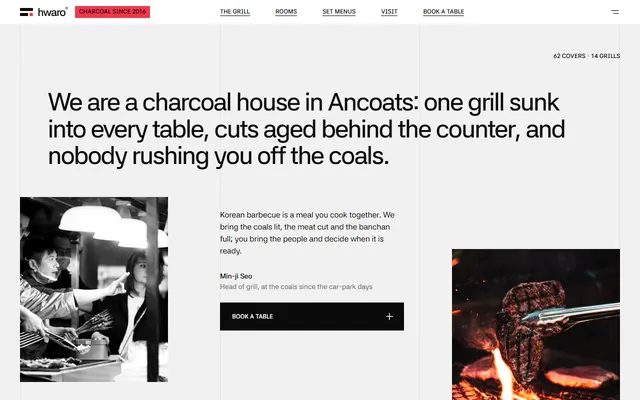
Korean charcoal barbecue: four fires on the menu, set menus, grilling steps and a booking form.
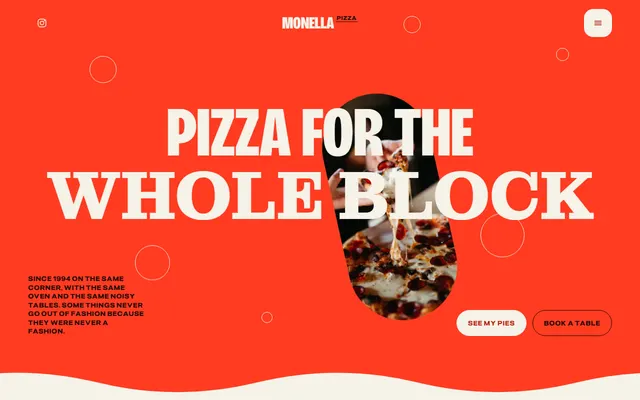
Neighbourhood pizzeria: the dough in five steps, four pies, opening hours and a request form.
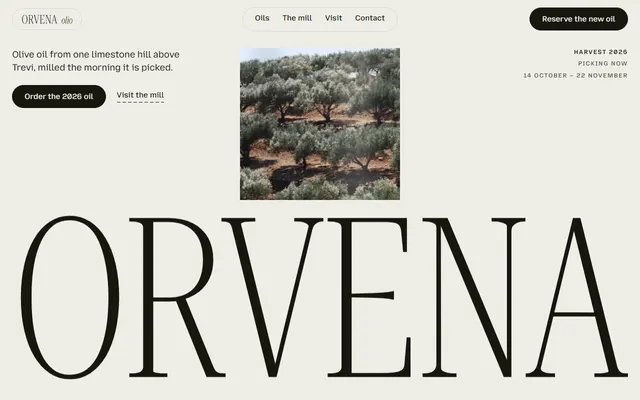
Olive oil estate or mill: six oils with prices, the mill in four steps, tasting, tree adoption and visits.
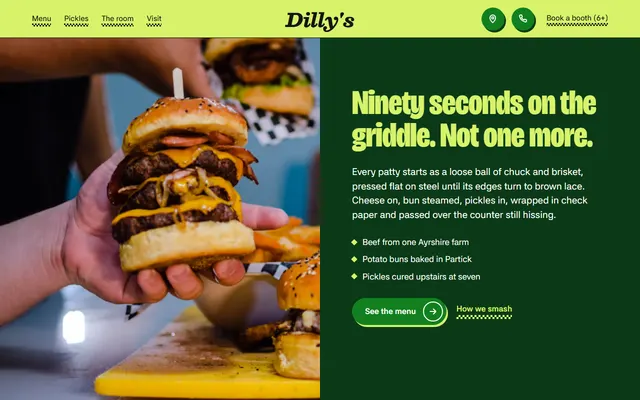
Smash-burger bar: a photo opening with the griddle method, a menu of six burgers and six sides.
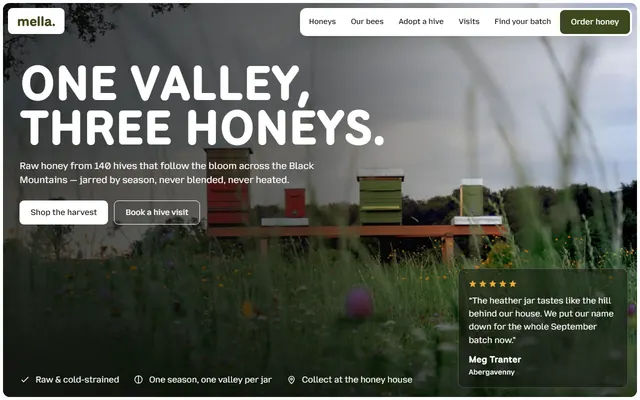
Beekeeper or honey producer: seasonal honeys, how a jar is made, batch codes, hive visits and an order form.