What comes with the curtain maker website template
- index.html: the pure HTML and CSS version, one single HTML file, 96 KB.
- index.gsap.html: the same design built with GSAP, ScrollTrigger and Lenis, for scroll motion in every browser, Firefox included.
- AGENTS.md: what a coding agent must keep and what to replace, so Claude Code, Codex or Cursor edit it without breaking the scenes.
- DESIGN.md: every colour, font, spacing and motion rule of this curtain maker website design.
- PROMPTS.md: the agent prompt and the design prompt below.
- CREDITS.md and LICENSE.md: the photos and fonts with their licenses, and the 8B license.
- Updates to this template, at no extra cost.
Yours to edit: one index.html with no build step, so you or a coding agent can change the words, prices and photos and upload it to any static host. Not a coder? Describe your business in one sentence to 8B's AI website builder and it designs a new site for you, with more pages when you need them. Designing is free; publishing with hosting is $9 a month, billed yearly. It also works inside Claude and ChatGPT.
Premium template · $39, one-time license · Made by 8B, an AI website builder · Updated November 2026 · Plain text: linfold-workroom.md
About this curtain maker website template
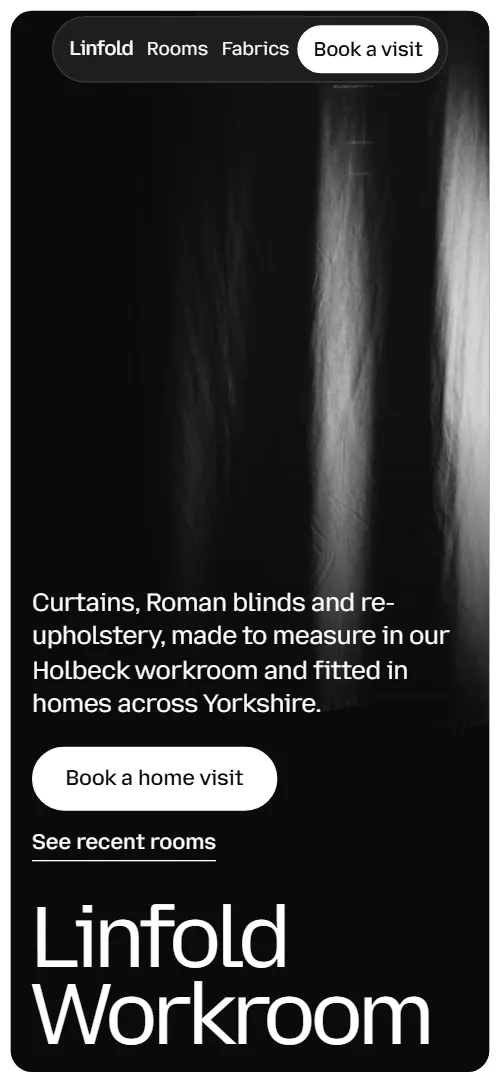
Curtain maker website template for a made-to-measure workroom that also re-covers chairs: one HTML file with six recent rooms, a close look at hand finishing, a library of eight fabrics, re-upholstery, four steps from measuring to hanging, four linings, questions and a home visit form. It opens on a black stage with a drape photo and the name across the bottom, and the next screen draws a pleated room photo flat like a curtain. It is a single HTML file in pure HTML and CSS, and a GSAP version of the same page comes with it.
At a glance, November 2026. One 96 KB index.html: a single HTML file in pure HTML and CSS with a few lines of built-in JavaScript, 12 sections, 25 Unsplash photos, Mozilla Text. A GSAP build of the same page, 85 KB, comes with it.
It suits a curtain and blind maker, an upholsterer, a soft furnishings business or any small workshop that measures, makes and fits in customers' homes. Curtain maker websites mostly need the same things on one scroll: jobs that look like the customer's own rooms, proof that the work is done by hand, the cloths on offer, how a job runs and a way to book a visit. A curtain and upholstery website built from this page gives each of them its own section, so the visitor reaches the booking form already convinced.
The demo business is Linfold Workroom, an invented workroom in Holbeck, Leeds, with five makers. Every room, place, price, date and quote is demo copy to replace. The rooms carry a place and the work done, and the questions carry demo prices and distances, so a workroom in any town swaps in its own jobs and terms; the photos are stock interiors and cloths to replace with your own.
If you would rather not edit HTML at all, 8B, the AI website builder designs a site from one sentence about your business, with more pages when you need them. This template is for people who want this exact design in their own hands: one index.html with its CSS and its motion inside, which you or a coding agent can edit and host anywhere.
Good for:
What a curtain maker website needs
Customers of a curtain and upholstery workroom want to see real rooms, trust the hands and know what happens next. Here is how this template covers each of them.
- Rooms that look like theirs. Six recent rooms in a mosaic, each captioned with the place and the work: linen wave curtains, interlined velvet, two chairs re-covered.
- Proof of hand finishing. One full-length curtain with a loupe that stops on four details: the heading, the folds, the leading edge and the hem, each named.
- The cloths on offer. Eight fabric drops with a name and a short spec at each hem, and a line about the larger library that comes to the customer's window.
- Re-upholstery as a second service. Eight chips of what is re-covered and three steps, strip, rebuild and cover, beside two chair photos.
- How a job runs. Four panels from measuring to hanging, with the free visit radius in the first step and one small team throughout.
- Answers about lining, timing and cost. Four linings from unlined to blackout, and six questions on weeks to make, visit fees, customers' own fabric, fitting, chair prices and cleaning.
- A way to book a visit. A contact card with phone, email, workroom address and hours, and a form for name, phone, postcode, the work and the room.
What it does not have is an online shop, a fabric search or a quote calculator: it is built to bring a customer to a home visit, and the form can be connected to a form service or your email so every request arrives in one place.
Curtain maker website design and motion
Palette
#ffffff page ground and text on the black cards#0b0b0b near black: the opening stage, the contact card, caption chips and the main text#efefef light grey: chips and quiet surfaces#646464 mid grey: secondary text#1e1e1e raised dark grey: the navigation pill and the form fields on the contact cardFonts
- Mozilla Text: everything: the huge name, headings, body text, captions, labels, navigation, buttons and form fields
A tight frame of 8 px around everything, with one corner radius for every card and photo and black cards at the start and the end of the page. The opening is a black card with a drape photo on the right and the name across the bottom, followed by a white statement and a room photo. The rooms are a mosaic of rounded photos in alternating wide and narrow spans with caption chips; the details sit as a hairline list beside one tall curtain; the fabrics are eight tall drops above a thin sill; re-upholstery is copy with grey chips beside two overlapping chair photos; the process is four panels on a rail; the contact is a black card in two halves. On phones the mosaic becomes one column and the fabrics two columns by four rows.
The idea behind the page is the act of drawing a curtain: a gathered strip becomes a full flat room, panels are drawn out of a bunch along a rail, and two black halves close like curtains meeting. The interface stays black, white and grey so that all the colour comes from the cloth and the rooms in the photos.
What is on the curtain maker website page
- NavigationSmall centred pill with the brand, four links and Book a visit; it hides on the way down
The small header pill hides as you scroll down and returns when you scroll up.
- Linfold WorkroomTwo screens: a black stage with the drape photo and Linfold Workroom across the bottom, then a white statement with a room photo that unfolds from pleats
On load the two words of the name rise through a clip, the drape eases in from slightly larger and the intro copy rises; then the drape sways sideways and a sheen of light travels down the satin. On scroll the name parts to the sides, and the room photo below arrives gathered into narrow pleats at the right edge and unfolds flat across its frame while the statement blocks are drawn in from the right.
- Recent roomsSix recent rooms in a mosaic of rounded photos with place and work on caption chips, and a Book a home visit pill
Each photo is lowered from its top edge like a blind, the cards of a row following one after another.
- Look closerOne full-length curtain beside four hand-finished details, with a loupe that travels to each one
The section holds one full-length curtain while a round loupe opens on the heading at the top, then travels to the folds, the leading edge and the hem, the rest of the photo dimming and a black label naming the detail while its item in the list turns black.
- The fabric libraryEight tall fabric drops with a name and a short note at each hem, falling to one sill
The eight drops start hanging at different lengths; their hems fall at different rates, the name tags riding down with them, until every hem rests on the same sill line.
- Re-upholsteryRe-upholstery: eight chips of what is re-covered, three steps, and two chair photos
The heading is drawn in from the right along its line and both chair photos are lowered from their top edge.
- From measure to hangingFour panels, measure, choose, make and hang, drawn out of a bunch along a rail
The section holds one screen while the four panels, bunched at the end of the rail like gathered fabric, are drawn out one by one into an even row in order, each uncovering the next.
- The workroomWho makes it: a paragraph, the record by year and a portrait
The heading is drawn in from the right and the portrait is lowered from its top edge.
- What goes behind the clothA sunlit window that darkens as three dark layers are lowered, with a card listing four linings
The section holds a sunlit window photo while three dark layers are lowered over it one by one for cotton, interlined and blackout, and the matching lining in the card turns active.
- Asked at the doorSix questions in native details elements, with the phone line beside them
The heading is drawn in from the right along its line.
- Book a home visitBlack card whose halves slide together: phone, email, address and hours, and a home visit form
The two halves of the black card start apart at the sides and slide in until they close into one card.
- FooterCompany line and four links
The company line is drawn in from the right at the end of the page.
Before you publish the curtain maker website site
- Replace social preview image, favicon, phone number, email address, contact form (sends nothing yet) and social media links and the invented demo facts (names, prices, areas, quotes). AGENTS.md lists them.
- Book a visit in the header, Book a home visit buttons and Ask about a chair lead to
#contactnow; point them to keep them once the form is connected. - Navigation, See recent rooms and footer links lead to
#opening, #rooms, #closer, #fabrics, #workroom, #process and #faq on the same pagenow; point them to keep, or point to your own pages. - Phone and email links in the questions note and the contact card lead to
tel: and mailto: links with demo contactsnow; point them to your own phone and email. - Send request button of the home visit form lead to
the form's action is #, so it sends nothingnow; point them to your form service or email endpoint. - Instagram link in the footer lead to
the network's home pagenow; point them to your own profile, or remove it. - Scroll-driven animation runs when the browser supports it (Chrome, Edge and Safari today; Firefox does not yet) and the visitor has not asked for reduced motion. Otherwise each section shows its finished layout; the GSAP build, index.gsap.html (GSAP 3.13), also plays the scroll motion in Firefox.
- The home visit form sends nothing: connect it to a form service or your email. The eight fabric drops, the four loupe details, the four process panels and the four linings are scenes built for those counts, and the rooms mosaic is laid out in sets of six; a different number needs its layout and scene adjusted.
- It is one page: the Instagram link points to the network's home page, and there is no fabric search, online order or quote calculator.
- The prices and distances in the questions (the visit fee beyond twenty miles, seat and armchair prices, weeks to make) are demo copy for you to replace with your own terms.
Questions about this curtain maker website template
What do I get for $39?
The curtain maker website template as a single HTML file, index.html, in pure HTML and CSS, a GSAP build of the same page as index.gsap.html, a DESIGN.md with every colour, font and motion rule, an AGENTS.md for coding agents, the agent prompt and the design prompt from this page, and CREDITS.md for the photos and fonts. Updates to this template are included.
Can I use this curtain maker template for client sites?
Yes. One purchase lets you build as many sites as you like with it, for your own workroom or for clients, and change anything. What it does not allow is selling or giving away the template itself, as a template, theme or kit, or putting its source in a public repository.
How do I change the rooms, fabrics and prices?
Each room is one photo with two caption chips, each fabric is one drop with a name and a short spec, and the prices sit in the questions as plain text. With Claude Code, Codex or Cursor you say it in a sentence, such as replace the Ilkley sunroom with our Otley bay window and set a full armchair at 700 pounds, and the agent edits the blocks; by hand you change the words and the photo addresses. The fabric library is built for eight drops and the mosaic for six rooms, so keep those counts or ask the agent to adjust the scene for a different number. There is no online shop or quote calculator: the page takes the customer to a home visit, which is how made-to-measure work is sold.
Does the home visit form send requests?
Not yet. The form asks for name, phone, postcode, what the work is for (curtains, Roman blinds, re-upholstery or something else) and a few words about the room, but it sends nothing until you connect a form service such as Formspree or Netlify Forms, or your email. Add a thank-you line or page for after sending.
Will it work with Claude Code, Codex or Cursor?
Yes. Put index.html and AGENTS.md in your project and give the agent the prompt that comes with the template. AGENTS.md says which attributes the scroll motion reads, what to keep and what to replace, so the agent swaps rooms, fabrics, steps and photos without breaking the scenes.
What do visitors see in Firefox or with reduced motion?
Firefox does not support scroll-driven animations yet, so it shows every section in its finished layout, as does any browser when the visitor asks for reduced motion. If the scroll motion must also play in Firefox, use the GSAP build, index.gsap.html, which loads GSAP 3.13 from a CDN.
More templates for home, interiors and building
Other designs for businesses around the home.
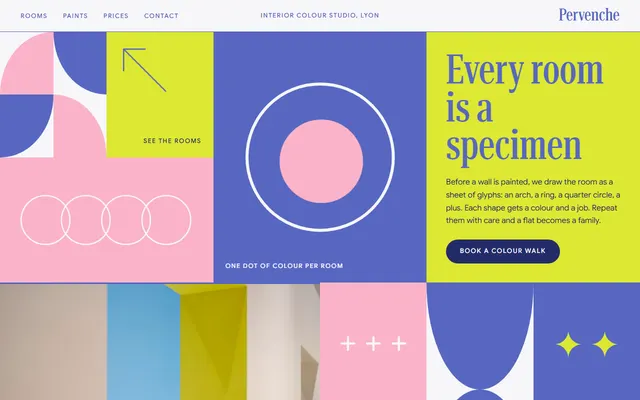
Interior colour studio: a glossary, six projects, a price list, house paints and meeting steps.
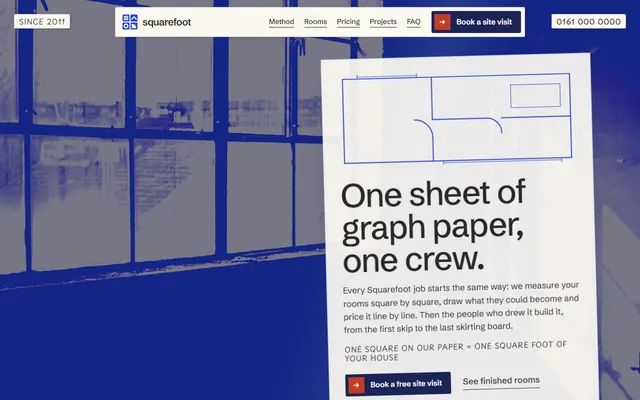
Home renovation: a four-stage method, services as rooms of a plan and prices per square foot.
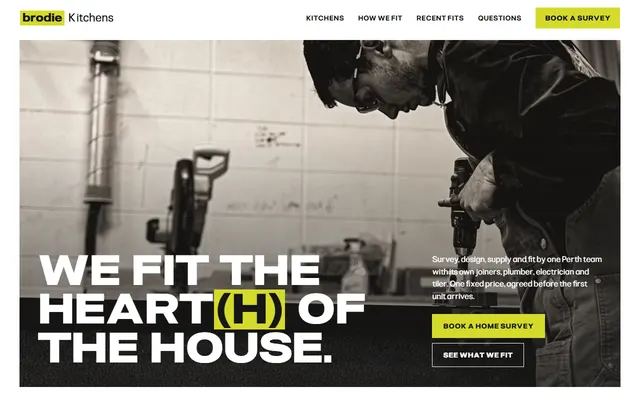
Kitchen company: five kinds of job, in-house trades, a five-step fit, recent fits and a survey form.
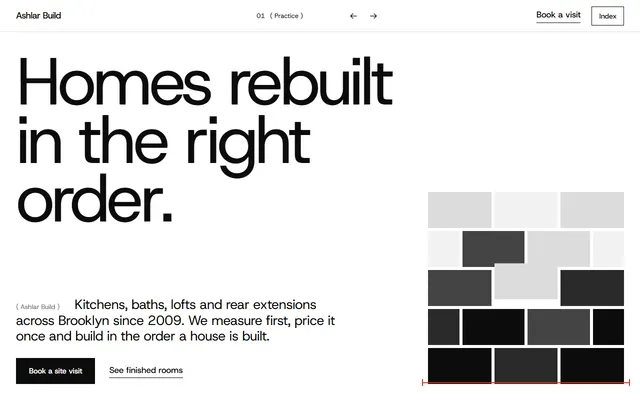
Construction company: services with prices, finished work, crew and a site-visit form.
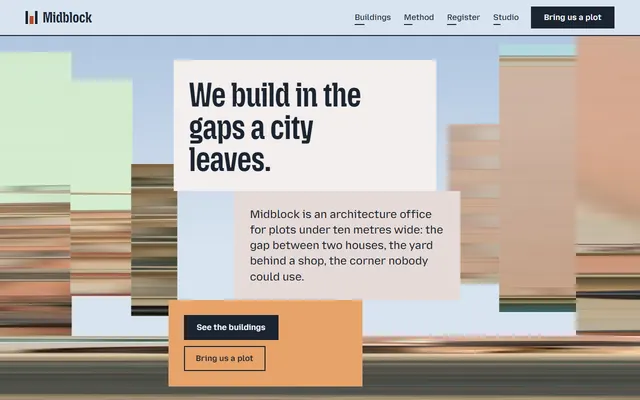
Architecture office: buildings on narrow city plots, method, team and an enquiry form.
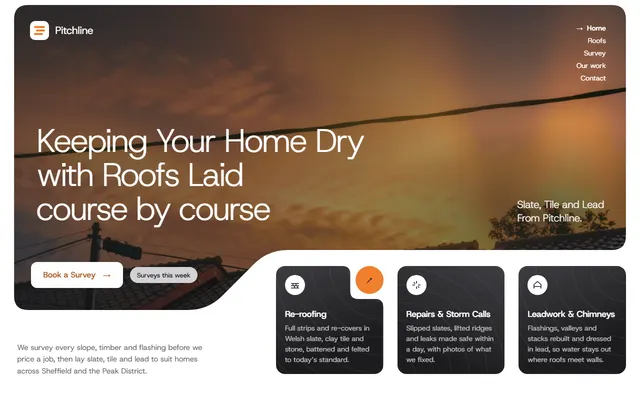
Roofing company: the roofs you lay, a four-step survey, finished jobs, in-roof solar and a survey form.
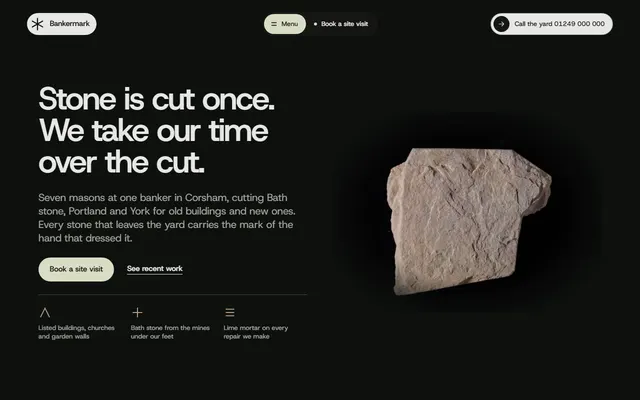
Stonemason for stone yards and masons, lettering prices.
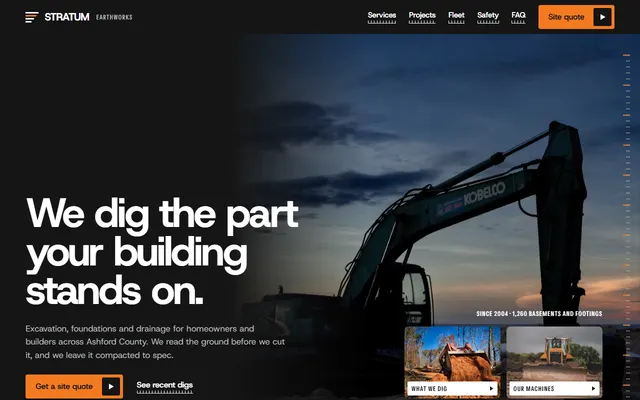
Excavation contractor: services with depths, recent digs, fleet, service area and a site-visit form.