What comes with the film lab website template
- index.html: the pure HTML and CSS version, one single HTML file, 100 KB.
- index.gsap.html: the same design built with GSAP, ScrollTrigger and Lenis, for scroll motion in every browser, Firefox included.
- AGENTS.md: what a coding agent must keep and what to replace, so Claude Code, Codex or Cursor edit it without breaking the scenes.
- DESIGN.md: every colour, font, spacing and motion rule of this film lab website design.
- PROMPTS.md: the agent prompt and the design prompt below.
- CREDITS.md and LICENSE.md: the photos and fonts with their licenses, and the 8B license.
- Updates to this template, at no extra cost.
Yours to edit: one index.html with no build step, so you or a coding agent can change the words, prices and photos and upload it to any static host. Not a coder? Describe your business in one sentence to 8B's AI website builder and it designs a new site for you, with more pages when you need them. Designing is free; publishing with hosting is $9 a month, billed yearly. It also works inside Claude and ChatGPT.
Premium template · $39, one-time license · Made by 8B, an AI website builder · Updated November 2026 · Plain text: latent.md
About this film lab website template
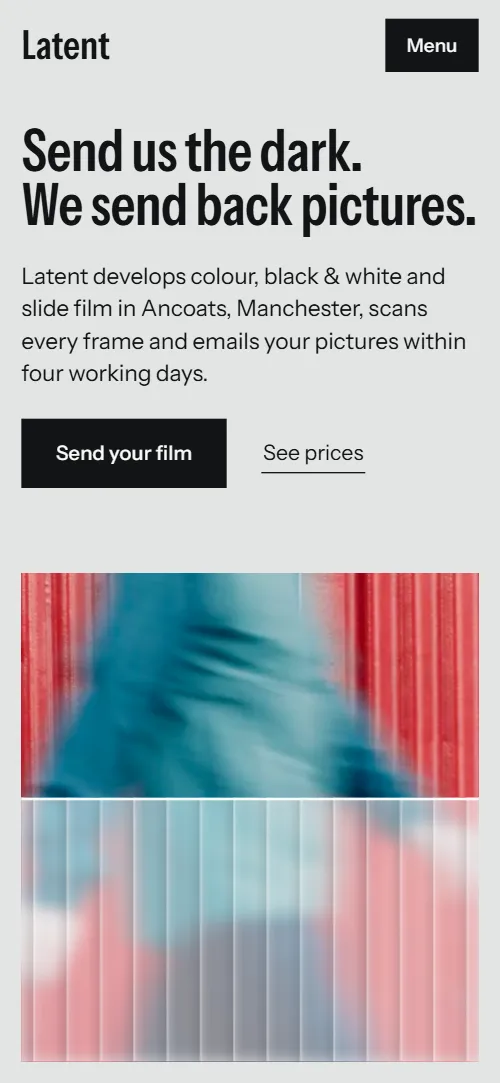
Film lab website template for a lab that develops and scans film: one HTML file with the journey of a roll in four steps, three chemistries and a push, three scan sizes, five film formats, a roll of the month, a mail-in guide, a price table, questions and a contact form. It opens on a headline split around a photo behind a sheet of fluted glass that rises over the whole screen, then drops to give the photo back sharp above its edge. It is a single HTML file in pure HTML and CSS, and a GSAP version of the same page comes with it.
At a glance, November 2026. One 100 KB index.html: a single HTML file in pure HTML and CSS with a few lines of built-in JavaScript, 13 sections, 20 Unsplash photos, Instrument Sans. A GSAP build of the same page, 90 KB, comes with it.
It suits a film developing and scanning lab, a darkroom or photo lab that works by post and over the counter, and a camera shop that sells developing and scans by the roll. Film lab websites mostly need the same few things on one scroll: what you develop and how long it takes, what a scan is and what it costs, which formats you take, how to send film and where to find you. This page gives each its own section, and its price table puts every film type against develop only and three scan sizes, so a customer finds the cost of a roll without writing to you.
The demo business is Latent, an invented lab in Ancoats, Manchester. Every price, turnaround, address, opening hour, format and frame in the roll of the month is demo copy to replace. The prices are in pounds with VAT included and the formats are 35 mm, half frame, two 120 shapes and sheet film, so a lab in another city or country changes the currency, the film types it takes and its own turnaround and post details.
If you would rather not edit HTML at all, 8B, the AI website builder designs a site from one sentence about your business, with more pages when you need them. This template is for people who want this exact design in their own hands: one index.html with its CSS and its motion inside, which you or a coding agent can edit and host anywhere, next to the order system or booking tool you already use.
Good for:
What a film lab website needs
A film lab website answers the same questions before anyone posts a roll. Here is how this template covers each of them.
- What you develop and how long it takes. Three chemistries and a push in four rows: C-41 colour, black and white, E-6 slide and push or pull, with working days and a starting price for each chemistry and a price per stop for the push.
- What a scan is and what it costs. Three scan sizes, Web, Print and Full, with their pixel size, file type and use, shown by a loupe and a detail window that magnify for each size.
- Which formats you take. Five film formats, from 35 mm to 4 by 5 sheet film, each with its size and frame count beside one frame that changes shape.
- Prices per roll in one place. A table of seven film types against develop only and three scan sizes, with push, next-day and return post notes under it and VAT included.
- How to send film. The mail-in section sets the postal address large and gives three steps, so a customer knows what to write, how to pack and when to expect the files.
- Reasons to trust the lab. Three lab photos and four standards, such as control strips every morning and dust removed by hand, plus a roll of the month by a customer.
- Hours, address and a way to ask. The contact section has the opening hours, address, phone, email and a short question form. Connect the form before you go live.
What it does not have is an online order form, a file upload, payment or a price calculator: it is built for a lab that takes film by post and at the counter. Link the Send film buttons to your own order page if you add one.
Film lab website design and motion
Palette
#e3e5e5 page ground, a cool studio grey, and the milky wash inside the glass#131415 ink: text, and the ground of the process, lab and contact sections and the footer#fafbfb white: the scans and questions sections and text on the dark sections#d9472b vermilion: the loupe and detail window outlines, the current scan size and the current film format#22b3aa turquoise: the mail-in ground, the step times in the process section and the band behind a link on hoverFonts
- Instrument Sans: the only family: condensed width for headings, the wordmark, item names and the prices in the table, normal width for text, uppercase labels, buttons and form fields
A cool grey page with near-black sections and two white sections, and vermilion and turquoise used only as fills and highlights. Headings are set in a tall condensed width of one grotesque, text in its normal width. The first screen splits its headline around a central photo; the process section keeps one frame fixed on the right while four steps scroll on the left; developing is four full-width rows like a spec sheet; the scan sizes sit beside a beach photo, under a detail window; the formats list scrolls beside one fixed frame; the roll is a horizontal strip of seven frames; the mail-in address is set large on a turquoise ground; the price table has a name column and four price columns. On phones the first screen stacks, the frames stay at the top while the steps and lists scroll below, and the whole price table fits the screen.
The idea behind the page is the lab's job: a roll holds a latent image that stays invisible until the chemistry brings it out. So the page works with a sheet of fluted glass, a pane with vertical ribs that refracts a photo into bands of colour and then gives it back sharp. Photos arrive cut into ribs that settle into the plain picture, one frame is developed in front of you, and the roll of the month runs under glass with one clear window.
What is on the film lab website page
- NavigationHeader with the wordmark, five links, a Send film button and a Menu button that opens the section list with the lab's address
- Send us the dark. We send back pictures.Two screens: the headline Send us the dark. We send back pictures. around a photo behind fluted glass, then A latent image is already on your roll. with three service lines written on the glass
On load the two halves of the headline lift from behind their own edges, the lead and buttons follow, the photo settles and a line draws along the glass edge, while the photo drifts slowly up and down in its frame. On scroll the photo opens to the full screen as the glass rises over it and over the headline, refracting both, then the glass edge drops to a little above the middle of the screen and gives the photo back sharp above it, with the second screen's text written on the glass.
- From canister to inboxFrom canister to inbox: one frame on the right developed from latent to negative to positive to a scan, four steps on the left
The heading rises while one frame stays fixed beside the steps: it starts almost black, an orange negative grows out of the dark, the negative turns into the positive, and the finished scan pulls back inside a white border. The step being read is full and the others dim.
- Three chemistries and a pushThree chemistries and a push: four full-width rows with turnaround and price (a price per stop for push and pull), a short description and a photo
The heading rises and each of the four photos arrives cut into vertical ribs that settle into the plain picture.
- Scanned to the grainScanned to the grain: a beach photo with a loupe, a detail window and three scan sizes, Web, Print and Full
The heading rises, then a square loupe travels over the beach photo from the people on the sand to the ships on the horizon to the crowd at the water. The detail window magnifies 1.5, 2.2 and 3 times in step, and the matching scan size turns vermilion.
- Whatever your camera tookWhatever your camera took: one frame and a list of five film formats with sizes and frame counts
The heading rises while one photo stays fixed and changes its proportions as the list scrolls past: 3 by 2, 3 by 4, square, 7 by 6 and 4 by 5. The name of the current format turns vermilion.
- Six people, one long room in AncoatsSix people, one long room in Ancoats: three lab photos and four standards
The heading rises and the three lab photos arrive cut into ribs that settle into the plain picture.
- Roll of the monthRoll of the month: seven captioned frames of one seaside roll running under fluted glass
The heading rises, then the seven frames run right to left under two sheets of fluted glass that leave one clear window in the middle, so each frame comes out sharp in the window and goes back into the ribs.
- Post it to usPost it to us: the postal address set large on a turquoise ground, a photo of boxed film and three numbered steps
The heading rises and the photo of boxed film arrives cut into ribs that settle into the plain picture.
- Prices, per rollPrices, per roll: a table of seven film types against develop only and three scan sizes, with the extras below it
The heading rises, and the three scan columns start stacked under the develop-only column and slide out to their places one after another as the table comes into view.
- Questions people ask at the counterSix questions people ask at the counter as native details beside the heading
The heading rises; the six answers open and close as native details.
- Drop it in, or ask firstDrop it in, or ask first: a shop window photo behind a pane of fluted glass, address, opening hours, phone, email and a question form
The heading rises, and a pane of fluted glass slides across the shop window from the right edge to the left as the section scrolls, refracting the cameras behind it before it comes to rest over the left part of the window.
- FooterFooter with the wordmark across the full width, address, phone, email, section links and the company line
Before you publish the film lab website site
- Replace social preview image, favicon, phone number, email address and contact form (sends nothing yet) and the invented demo facts (names, prices, areas, quotes). AGENTS.md lists them.
- Send film in the header, the menu and the footer, and Send your film on the first screen lead to
#mailinnow; point them to keep it, or your online order page if you take orders on a form. - See prices on the first screen lead to
#pricingnow; point them to keep as it is. - Ask before you post button in the mail-in section lead to
#contactnow; point them to keep it once the question form is connected. - Process, Developing, Scans, Prices and Contact in the header, the menu and the footer lead to
#process, #chemistry, #scans, #pricing and #contactnow; point them to keep as they are. - Phone and email links in the contact section and the footer lead to
tel:+441610000000 and hello@latent.examplenow; point them to your lab's number and email, in the link and in the visible text. - Scroll-driven animation runs when the browser supports it (Chrome, Edge and Safari today; Firefox does not yet) and the visitor has not asked for reduced motion. Otherwise each section shows its finished layout; the GSAP build, index.gsap.html, also plays the scroll motion in Firefox.
- The question form sends nothing: connect it to a form service or your email. There is no thank-you line after sending; add one or send the visitor to a thank-you page. The price table is a plain table of text, so a different price list means editing its cells.
- It is one page and every link stays on it. Orders come by post or at the counter: there is no online order form, upload or payment, and the Send film button leads to the mail-in steps.
- The process scene is built for four steps, the scans scene for three sizes with a loupe point and zoom each, and the formats scene for five formats with their frame shapes: a different count needs the scene adjusted. The roll of the month takes any number of frames. Prices, turnaround, hours and formats are those of a Manchester lab: replace them with your own.
Questions about this film lab website template
What do I get for $39?
The film lab website template as a single HTML file, index.html, in pure HTML and CSS, a GSAP build of the same page as index.gsap.html, a DESIGN.md with every colour, font and motion rule, an AGENTS.md for coding agents, the agent prompt and the design prompt from this page, and CREDITS.md for the photos and fonts. Updates to this template are included.
Can I use this film lab template for client sites?
Yes. One purchase lets you build as many sites as you like with it, for your own lab or for clients, and change anything. What it does not allow is selling or giving away the template itself, as a template, theme or kit, or putting its source in a public repository.
How do I change the prices, turnaround and formats?
The price table is plain HTML: each row is one film type and each cell one price, so you edit the words, or add a row by copying one. The four developing rows, the three scan sizes and the five formats are short blocks of text. With Claude Code, Codex or Cursor you say it in a sentence, such as change C-41 to 3 working days from $9 and add a 220 film row to the price table, and the agent edits the cells. Two scenes are tied to counts: the scan sizes are built for three, each with its own loupe point and zoom, and the formats for five, each with its own frame shape, so a different number needs the scene adjusted too. There is no shopping cart or price calculator: the table is read by the customer, and the order arrives by post or at the counter.
Does the question form send messages, and can customers order online?
Not yet. The form asks for a name, an email and a question, and it sends nothing until you connect a form service such as Formspree or Netlify Forms, or your own email. It also shows no thank-you line, so point it at a thank-you page or add one. The order itself is the mail-in section: the postal address, three steps and a button to ask a question first. If you take orders on a form, a booking tool or an upload link, put its address on the Send film buttons.
Will it work with Claude Code, Codex or Cursor?
Yes. Put index.html and AGENTS.md in your project and give the agent the prompt that comes with the template. AGENTS.md says which attributes the scroll motion reads, what to keep and what to replace, so the agent swaps prices, formats, photos and the address without breaking the scenes.
What do visitors see in Firefox or with reduced motion?
Firefox does not support scroll-driven animations yet, so it shows every section in its finished layout, as does any browser when the visitor asks for reduced motion. If the scroll motion must also play in Firefox, use the GSAP build, index.gsap.html, which loads GSAP, ScrollTrigger and Lenis from a CDN.
More templates for print, film and the counter
Other designs for makers and shops that sell by the job.
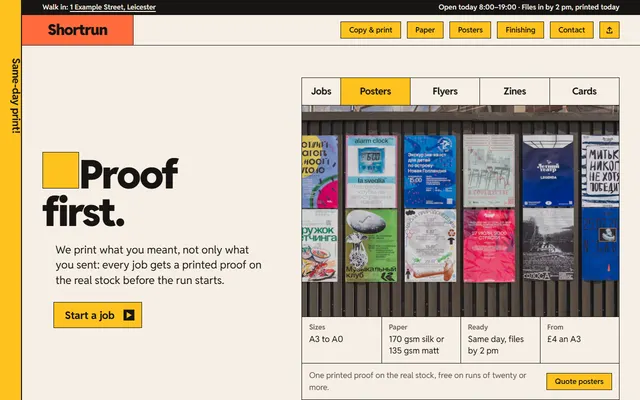
Print and copy shop: job tabs, a paper table, a poster size demo, finishing and a quote form.
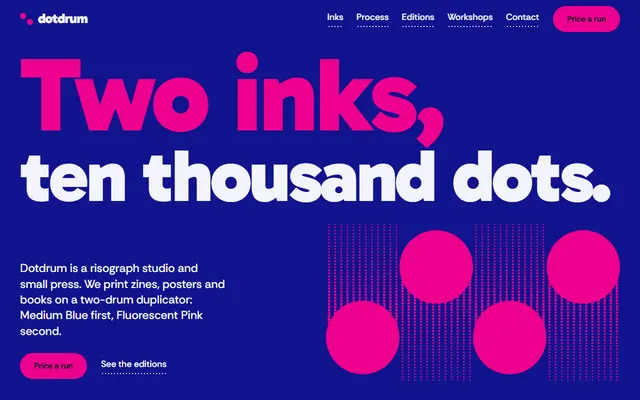
Risograph print studio: zines, posters and books, its own editions and workshop dates.
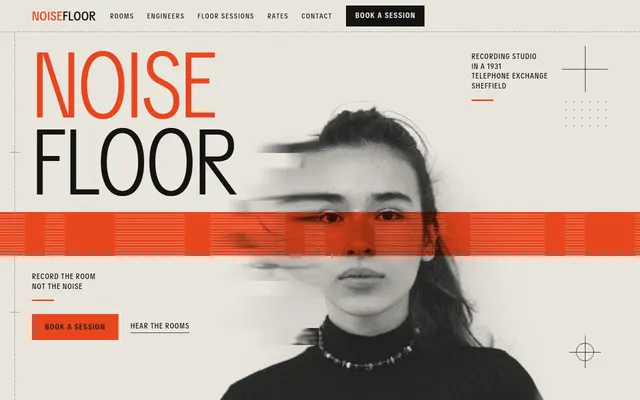
Recording studio: four rooms, engineers, records made, live sessions, a rate sheet and a booking form.
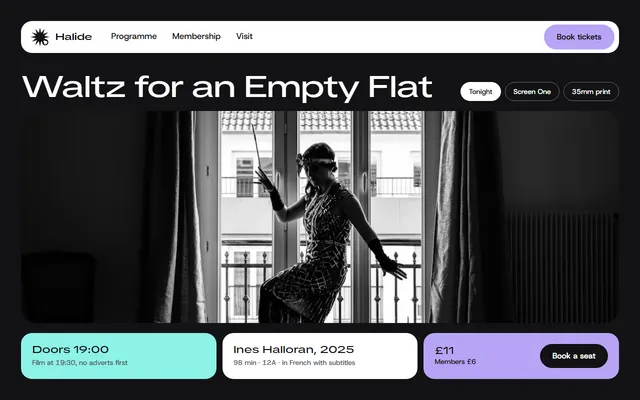
Independent cinema: tonight's film, a six day programme, a 35mm projection section and a visit form.
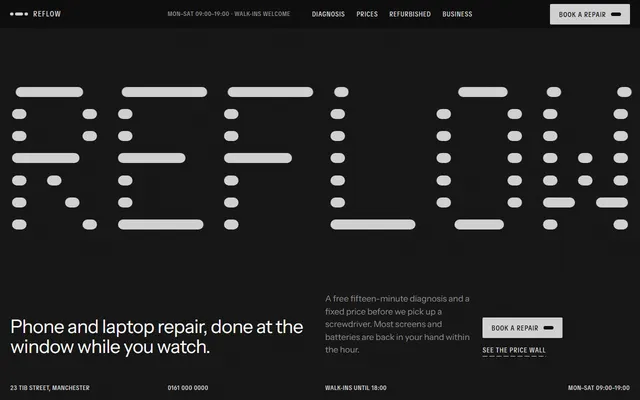
Repair shop: a free diagnosis, a price list, business pickups and repairs by post.
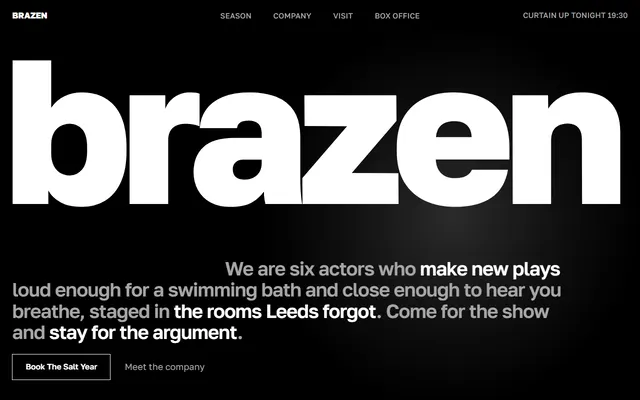
Theater company: current show, season board, company, rehearsal weeks, venues and box office.
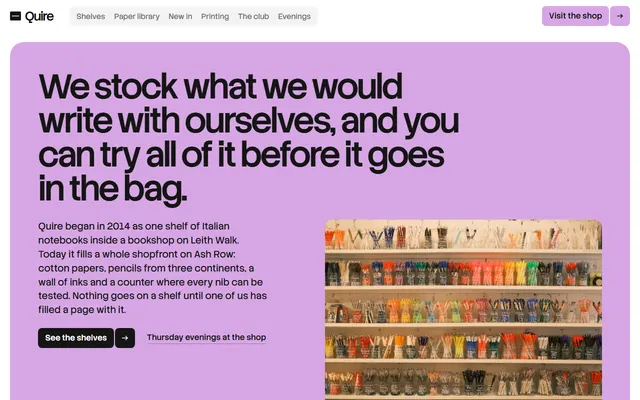
Stationery shop: five shelves, a paper library in tabs, a letterpress service and workshops.
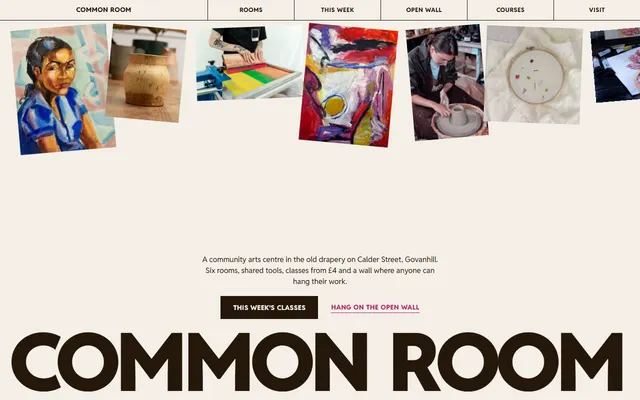
Community arts centre: rooms, weekly classes, a members' open wall, courses and visiting details.