What comes with the recording studio website template
- index.html: the pure HTML and CSS version, one single HTML file, 125 KB.
- index.gsap.html: the same design built with GSAP, ScrollTrigger and Lenis, for scroll motion in every browser, Firefox included.
- AGENTS.md: what a coding agent must keep and what to replace, so Claude Code, Codex or Cursor edit it without breaking the scenes.
- DESIGN.md: every colour, font, spacing and motion rule of this recording studio website design.
- PROMPTS.md: the agent prompt and the design prompt below.
- CREDITS.md and LICENSE.md: the photos and fonts with their licenses, and the 8B license.
- Updates to this template, at no extra cost.
Yours to edit: one index.html with no build step, so you or a coding agent can change the words, prices and photos and upload it to any static host. Not a coder? Describe your business in one sentence to 8B's AI website builder and it designs a new site for you, with more pages when you need them. Designing is free; publishing with hosting is $9 a month, billed yearly. It also works inside Claude and ChatGPT.
Premium template · $39, one-time license · Made by 8B, an AI website builder · Updated November 2026 · Plain text: noisefloor.md
About this recording studio website template
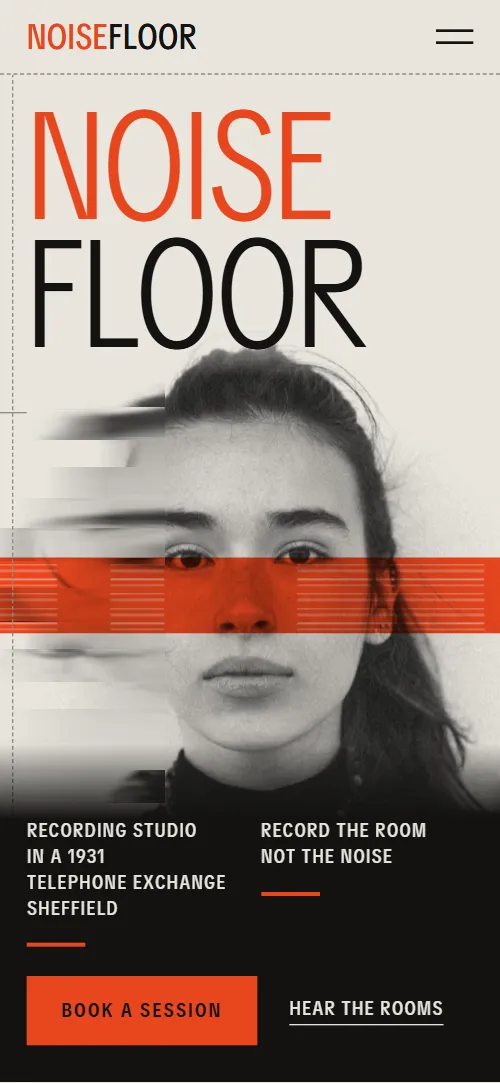
Recording studio website template for a tape, mixing or mastering studio that sells its rooms and its engineers: one HTML file with four rooms, three engineers, the story of the building, a table of records, monthly live sessions, a rate sheet, a signal chain and a booking form. It opens like a poster, with the title over a portrait smeared by horizontal streaks and an orange band at eye level that grows until it fills the second screen. It is a single HTML file in pure HTML and CSS, and a GSAP version of the same page comes with it.
At a glance, November 2026. One 125 KB index.html: a single HTML file in pure HTML and CSS with a few lines of built-in JavaScript, 13 sections, 14 Unsplash photos, TikTok Sans. A GSAP build of the same page, 104 KB, comes with it.
It suits a recording studio, a tape or analogue studio, a mixing and mastering room, a rehearsal space with a live room, or a production or voice-over studio with a few rooms and named engineers. Recording studio websites mostly need the same things on one scroll: what each room is for, who will sit at the desk, the gear, records you have made, what a day costs and a way to ask for dates, and this page gives each its own section. A recording studio website built from it also gets what separates a studio from a rental listing: the history of the building, a monthly live night and a plain rate sheet.
The demo business is Noisefloor, an invented studio in a former telephone exchange in Sheffield. Every room size, engineer, record, artist, date, rate and address is demo copy to replace. Prices are in pounds and the address and phone are British, so a studio in another city or market swaps in its own rooms, rates, currency, house gear and local acts.
If you would rather not edit HTML at all, 8B, the AI website builder designs a site from one sentence about your studio, with more pages when you need them. This template is for people who want this exact design in their own hands: one index.html with its CSS and its motion inside, which you or a coding agent can edit and host anywhere, next to the booking tool or the ticket page you already use.
Good for:
What a recording studio website needs
Recording studio websites that fill the diary answer the same questions quickly. Here is how this template covers each of them.
- What each room is for. Four rooms, each with its specs (floor and ceiling, window or desk and tape), what it is for and a photo: a live hall, a dead room for close drums, a vocal booth and the control room.
- Who you will work with. Three engineers with a role and a line on what each has ears for, and a promise that every booking comes with one.
- The gear, in plain words. A five-stop signal chain from microphone to monitors, with the desk, the tape machine and the preamps named.
- Proof you make records. A table of eight records with artist, year, room and format, so a visitor sees which room made which sound.
- What it costs. A rate sheet of six prices with what each includes and a note that prices exclude VAT, then a button to ask for a quote.
- A reason to come back and a way in for new bands. A monthly live session with three dated nights and a panel for acts that want to apply to play.
- A way to ask for dates. A booking form with the project type and preferred dates, the address, phone, email and hours, and a deposit answer in the questions. Connect the form before you go live.
What it does not have is a booking calendar, online payment, an audio player or a gallery of recorded tracks. Requests arrive through the form and are answered by a person; keep your calendar or ticket page where it is and point the Book a session, Request a seat and Ask for a quote buttons to it.
Recording studio website design and motion
Palette
#e9e5de warm paper ground of the opening, method, engineers, records, rates, questions and footer#141312 near-black ink: text, and the grounds of the rooms, building, sessions and contact sections#e8461e hot orange: one word of each big title, the band, the statement screen, the signal chain, session dates, prices and the short rules#5a564f grey-brown for secondary text on paper: leads, roles, table headings, rate notes and answers#a9a49b light grey for secondary text and labels on the dark sectionsFonts
- TikTok Sans: everything: narrow uppercase for the huge titles, captions, room names, table rows, prices, navigation and buttons, normal width for body copy and form fields
A warm paper page with near-black sections for contrast and one hot orange for the opening, the chain and every price. All type is one face, set narrow and uppercase for huge two-line titles, short stacked captions each closed by a short orange rule, and at normal width for body copy, with small crosshair marks, dotted grids and dashed margin lines like a printed test sheet. The first screen puts NOISE in orange and FLOOR in ink over a portrait on the right, with a full-width orange band across the eyes and a button and a link below it. The rooms sit on one held stage with the index at the top left, the active room's text at the bottom left and a large photo on the right; the engineers are three tall strips side by side; the records are a table with dashed rules; the rates are rows with dotted leaders and orange prices. On phones the title sits on top, the face below it and an ink base holds the captions, the button and the link, the records become an artist and a line of details, and the strips narrow.
The idea behind the page is the noise floor: every room has one, and the studio's sits below hearing, so what reaches the tape is the music and the room. The look follows from it. Streaks smear the portrait and then clear, headings arrive out of a horizontal smear, an orange band cleans the face to a duotone, and the page is drawn as a calibrated instrument with marks and dashed rules rather than as a gallery of stock studio photos.
What is on the recording studio website page
- NavigationHeader with the wordmark, five links and a Book a session button; on phones a menu button opens a full-screen list of the five links with the address
The header is a paper bar with a dashed lower edge; it slides away as you scroll down and returns when you scroll up. On phones the links give way to a menu button that opens a full-screen overlay with large links and the address.
- Noise FloorTwo screens: the poster with NOISE / FLOOR over a smeared portrait and an orange band, then the statement Every room has a noise floor on a full orange field
On load the orange band wipes in from the left, the title lines rise out of their masks, the caption rules draw and the portrait settles from slightly larger. The band's dashed scan lines drift sideways and fourteen streak rows over the face jitter at different rates. On scroll the stage is held for one screen: the band grows over the screen, the streaks tear and lengthen, NOISE and FLOOR smear apart as they leave, and the portrait turns into a clean orange duotone while the statement resolves out of a smear.
- Four rooms. Four silences.Four rooms (the Hall, the Dead Room, the Booth, Control), each with two specs (floor and ceiling, window or desk and tape), what it is for, a short text and a photo, printed one after another by a scan head
The heading arrives out of a smear, then a stage is held while an orange scan head moves across it from left to right, printing each room over the previous one: behind the head the room is sharp, ahead of it a stretched column of the photo streaks sideways. The room index turns the room in view orange, each room's text replaces the last and the room names arrive out of a smear.
- Filter the noiseFilter the noise: a lead and three captioned statements (record the room, fewer takes, decide early)
The heading slides in out of a smear and a short orange rule draws under each of the three captions.
- Three pairs of earsThree engineer portraits as tall channel strips under one orange band, each with role and what they have ears for
The three portrait strips start at different heights with the band empty; as you scroll their offsets shrink and the orange band draws across them, until the eyes sit on one line inside it.
- Built for 4,000 lines. Now it carries one.The story of the 1931 telephone exchange, three facts and two photos, with forty faint lines that fold into one orange line
Forty faint lines are spread over the section, fold toward the heading's rule as you scroll and end as one orange line, while the two photos are wiped in left to right behind a thin orange line.
- Made below the floorA track-sheet table of eight records with artist, record, year, room and format
The heading and each row of the table arrive out of a smear.
- Floor SessionsMonthly live-to-tape Floor Sessions: a held intro panel and three dated session panels plus an apply panel travelling past it
The section is held while the three session panels and the apply panel travel from right to left under the intro panel, each photo shifting inside its frame as it travels.
- Rates, in plain numbersA rate sheet of six prices with dotted leaders, a quote button and a link to how deposits work
The heading and each rate row arrive out of a smear and a short orange rule draws under the note beside the heading.
- The signal chainThe signal chain in five numbered stops (microphone, preamp, console, tape, monitors) down a wire an ink line follows
The stages start smeared and shifted left; an ink line runs down the wire with its head at a fixed height on the screen, and each stage sharpens and slides into place and its number box turns ink while the line passes it.
- Before you bookFive questions as native details beside the heading and the desk's phone
The heading arrives out of a smear and a short rule draws.
- Book the quietBOOK THE QUIET in six slices on ink, with address, phone, email, hours and the booking form
BOOK THE QUIET starts as six horizontal slices torn sideways and slides into register as you scroll.
- FooterPaper footer with the wordmark filling the width, address, links, social links, a book button, contacts and the company line
The wordmark arrives out of a smear across the full width and the short rule under the address draws.
Before you publish the recording studio website site
- Replace social preview image, favicon, phone number, email address, contact form (sends nothing yet) and social media links and the invented demo facts (names, prices, areas, quotes). AGENTS.md lists them.
- Book a session buttons in the header, the first screen and the footer lead to
#contactnow; point them to your online booking page, or keep #contact once the form is connected. - Rooms, Engineers, Floor Sessions, Rates and Contact links in the header and the menu overlay, the same links in the footer with Questions in place of Contact, the wordmark and Back to the top lead to
#rooms, #engineers, #sessions, #rates, #contact, #faq and #openingnow; point them to keep as they are. - Hear the rooms link on the first screen lead to
#roomsnow; point them to keep as it is. - Request a seat links and the Apply to play button in the live sessions section lead to
#contactnow; point them to your ticket page, or a form for acts that apply. - Ask for a quote button and How deposits work link in the rates section lead to
#contact and #faqnow; point them to keep as they are. - Phone and email links in the questions, contact section and footer lead to
tel:+441140000000 and book@noisefloor.examplenow; point them to your studio's number and email, in the link and in the visible text. - Instagram, Bandcamp and YouTube in the footer lead to
the platforms' home pagesnow; point them to your own profile pages. - Scroll-driven animation runs when the browser supports it (Chrome, Edge and Safari today; Firefox does not yet) and the visitor has not asked for reduced motion. Otherwise each section shows its finished layout; the GSAP build, index.gsap.html, also plays the scroll motion in Firefox.
- The booking form sends nothing: connect it to a form service or your booking system. Without a page script there is no thank-you line after sending; add one or send the visitor to a thank-you page.
- The rooms scene is built for four rooms, the engineers scene for three people, the sessions track for three dated sessions plus the apply panel and the chain for five stops: a different count needs its layout and scene adjusted.
- The dates, rates, records, backline and artists are for a Sheffield studio, and prices are in pounds: replace them with your own. The streak rows over the opening portrait show only while the motion runs, so with scripts off, with reduced motion or in Firefox the first screen shows the portrait and the band without them.
Questions about this recording studio website template
What do I get for $39?
The recording studio website template as a single HTML file, index.html, in pure HTML and CSS, a GSAP build of the same page as index.gsap.html, a DESIGN.md with every colour, font and motion rule, an AGENTS.md for coding agents, the agent prompt and the design prompt from this page, and CREDITS.md for the photos and fonts. Updates to this template are included.
Can I use this recording studio template for client sites?
Yes. One purchase lets you build as many sites as you like with it, for your own studio or for clients, and change anything. What it does not allow is selling or giving away the template itself, as a template, theme or kit, or putting its source in a public repository.
Can visitors book a session on the page?
They can send a request, not reserve a slot. The form asks for a name or band, email, the kind of project (tracking a record, mixing, mastering, a live session or something else), preferred dates and a few lines about it, and it sends nothing until you connect a form service such as Formspree or Netlify Forms, or your own booking tool. Every Book a session button goes to the form, so you can point them at your booking page instead. If you want a site with more pages and a booking tool you edit without code, 8B's AI website builder makes one from a sentence about your studio.
How do I change the rooms, rates and records?
Each room, rate row and record is a short block of HTML with its words and, for rooms, a photo. With Claude Code, Codex or Cursor you say it in a sentence, such as change the day rate to 650 and add a ninth record from 2026, and the agent edits the block; by hand you change the words in the block. The rooms scene is built for four rooms, so a studio with two or three rooms asks the agent to adjust the scene as well. There is no calendar, shop or audio player: the records are a table of names, and you can link a record to Bandcamp or Spotify.
Will it work with Claude Code, Codex or Cursor?
Yes. Put index.html and AGENTS.md in your project and give the agent the prompt that comes with the template. AGENTS.md says which attributes the scroll motion reads, what to keep and what to replace, so the agent swaps rooms, engineers, rates, dates and photos without breaking the scenes.
What do visitors see in Firefox or with reduced motion?
Firefox does not support scroll-driven animations yet, so it shows every section in its finished layout, as does any browser when the visitor asks for reduced motion. If the scroll motion must also play in Firefox, use the GSAP build, index.gsap.html, which loads GSAP, ScrollTrigger and Lenis from a CDN.
More templates for music, studios and venues
Other designs for businesses around music and making things.
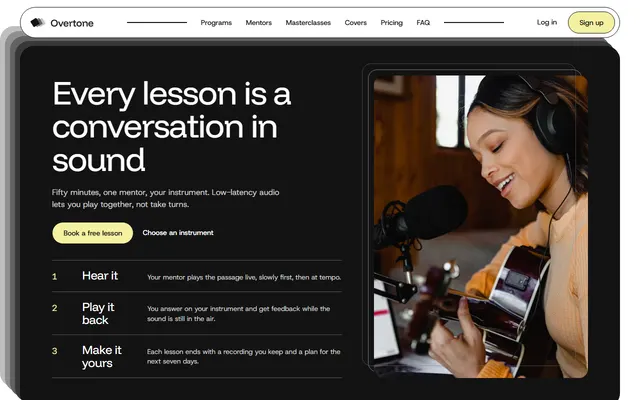
Online music school: a lesson screen, five instrument programs, mentors and a masterclass.
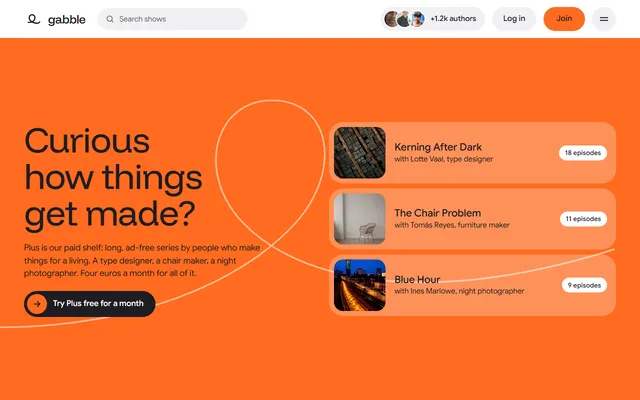
Podcast network: a paid shelf, a featured episode with a scrolling transcript and a horizontal show list.
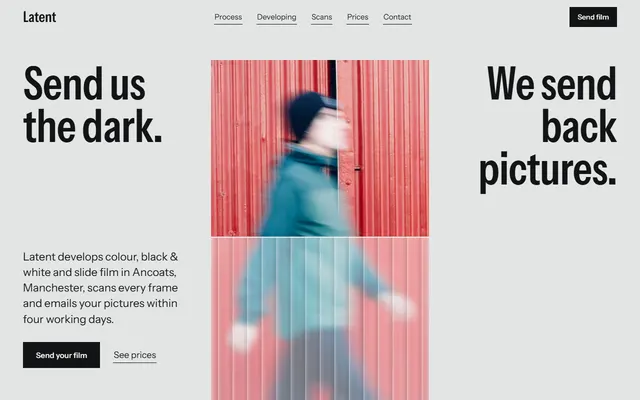
Film lab: how a roll is developed, scan sizes, film formats, a price table and a mail-in guide.
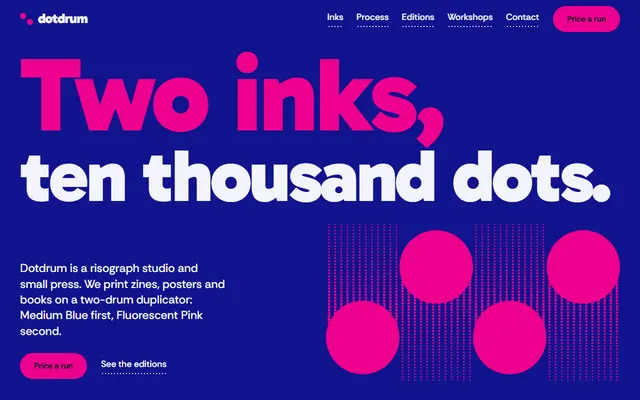
Two-ink print studio: zines, posters and books, its own editions and workshops.
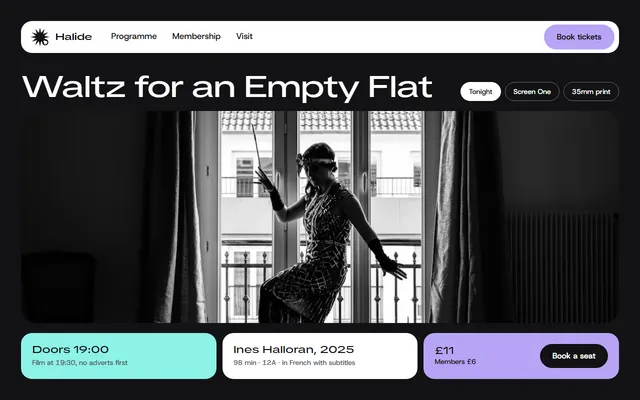
Independent cinema: tonight's film, a six-day programme, the two rooms and a bar menu.
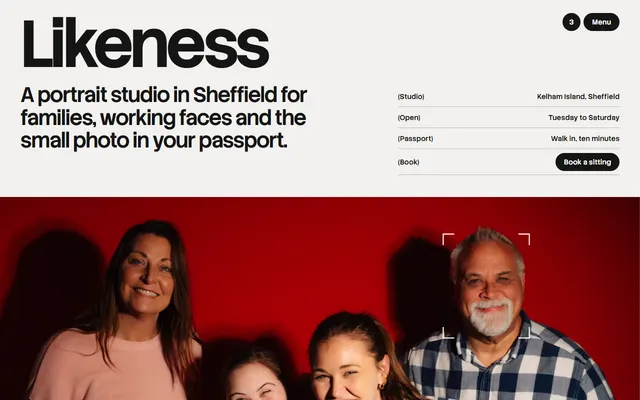
Portrait photography studio: family, headshot and passport sittings, backdrops, print prices and a booking form.
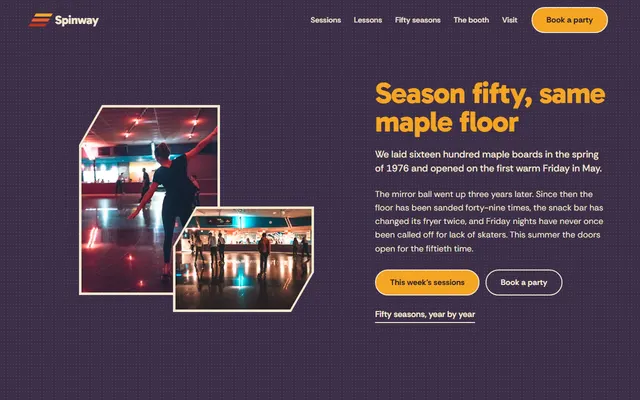
Family roller rink: a weekly session list, lessons, rental sizes and a pro shop.
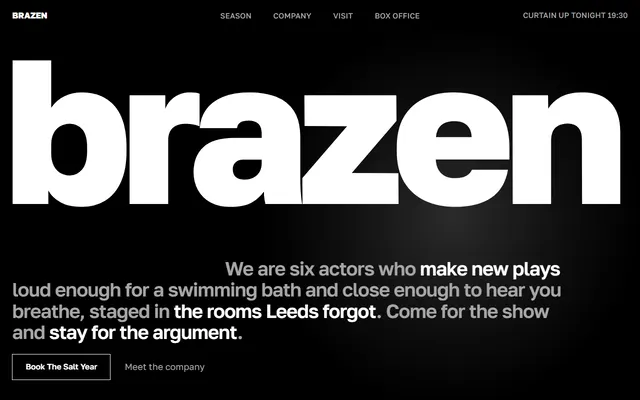
Theater company: current show, season board, company, rehearsal weeks, venues and box office.