What comes with the record store website template
- index.html: the pure HTML and CSS version, one single HTML file, 114 KB.
- index.gsap.html: the same design built with GSAP, ScrollTrigger and Lenis, for scroll motion in every browser, Firefox included.
- AGENTS.md: what a coding agent must keep and what to replace, so Claude Code, Codex or Cursor edit it without breaking the scenes.
- DESIGN.md: every colour, font, spacing and motion rule of this record store website design.
- PROMPTS.md: the agent prompt and the design prompt below.
- CREDITS.md and LICENSE.md: the photos and fonts with their licenses, and the 8B license.
- Updates to this template, at no extra cost.
Yours to edit: one index.html with no build step, so you or a coding agent can change the words, prices and photos and upload it to any static host. Not a coder? Describe your business in one sentence to 8B's AI website builder and it designs a new site for you, with more pages when you need them. Designing is free; publishing with hosting is $9 a month, billed yearly. It also works inside Claude and ChatGPT.
Premium template · $39, one-time license · Made by 8B, an AI website builder · Updated November 2026 · Plain text: hiss-and-crackle.md
About this record store website template
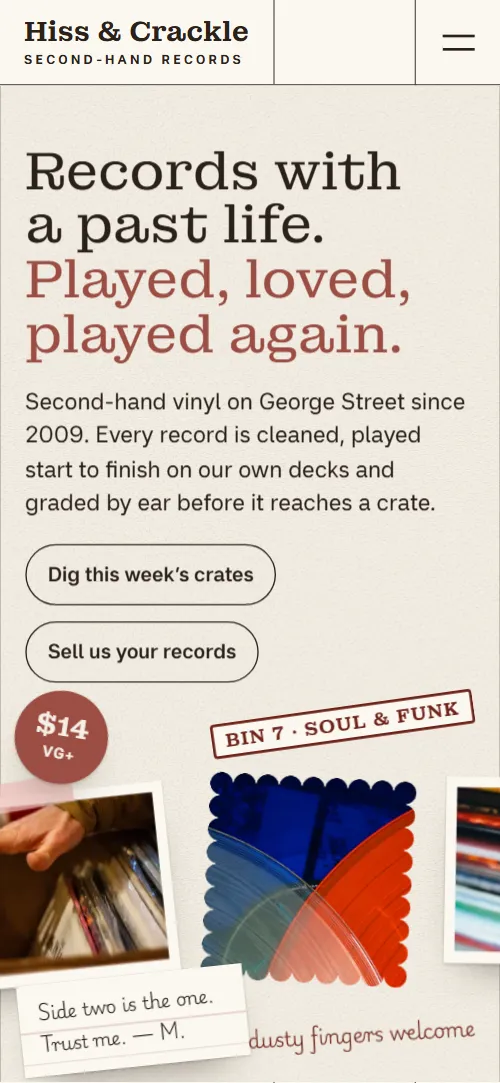
Record store website template for an independent second-hand shop: one HTML file with this week's arrivals in a ruled ledger, things found inside sleeves, a record grading guide, a section for buying collections, staff picks, a listening booth, Sunday swaps and sessions, a newsletter list and a visit section. It opens on a paper first screen where a ribbon of tilted prints drifts sideways under a two-tone heading, and tips back like a sleeve flipped forward in a crate while an ink screen rises over it. It is a single HTML file in pure HTML and CSS, and a GSAP version of the same page comes with it.
At a glance, November 2026. One 114 KB index.html: a single HTML file in pure HTML and CSS with a few lines of built-in JavaScript, 13 sections, 29 Unsplash photos, Miranda Sans, Montagu Slab and Playwrite US Modern. A GSAP build of the same page, 107 KB, comes with it.
It suits an independent second-hand record shop, a dealer who sells used LPs and 45s, a shop that buys collections and runs swaps or listening nights, or a vintage store with a crate-and-counter feel. Record store websites mostly need the same things on one scroll: what came in this week with its grade and price, how you grade, what you buy and how you pay, who works the counter, when the events are and how to find the door. This page gives each of them its own section, and a second-hand record store website built from it also keeps what makes a shop worth the trip: the pencilled prices, the things found between the grooves and the handwritten notes from the people at the counter.
The demo business is Hiss & Crackle, an invented shop in Peterborough, Ontario. Every record, artist, price, staff name, event date and address is demo copy to replace. The arrivals show the bin, title, artist, year, pressing, grade and price, so a shop in any city or country lists its own stock, writes its own grading sentences and sets its own currency, buying terms and opening hours.
If you would rather not edit HTML at all, 8B, the AI website builder designs a site from one sentence about your business, with more pages when you need them. This template is for people who want this exact design in their own hands: one index.html with its CSS and its motion inside, which you or a coding agent can edit and host anywhere, next to the online store or the Discogs page you already use.
Good for:
What a record store website needs
A second-hand record shop website has to answer the same questions as the counter does, fast. Here is how this template covers each of them.
- What came in this week. A ruled ledger of six records, each with its bin, title, artist, year and pressing, a grade stamp and a price sticker, right after the first screen.
- A grading system people trust. Five grades from Mint to Good, each with a stamp and a plain sentence about what you will hear, beside a close-up of grooves that wears down as you scroll.
- Selling a collection. Three steps for bringing boxes in, with the time it takes, how the offer is paid and a button to call about a whole collection.
- The people behind the counter. Four staff picks with a portrait, a handwritten name, the record, artist, year and a note on why to play it.
- Reasons to come in. A listening booth with three decks, and five swaps, sessions and a live night as typed slips with date, title and time.
- Answers on holds, shipping and returns. Five questions in native details rows, covering CDs and cassettes, holds, shipping, skipping records and turntables.
- Hours and a way to find the door. The visit section has the address, directions, a photo of the shop floor, opening hours, phone, email and access, and a button for directions.
What it does not have is a cart, stock search, a Discogs feed or an admin panel: it is built for a shop that shows a handful of new arrivals each week and links to wherever its full stock is sold online.
Record store website design and motion
Palette
#f4efe4 warm paper ground of the first screen and the calm sections#2b211c dark brown ink: text, hairlines and the ink sections such as the second screen, grading and the booth#9c4d44 brick red: the accent line of headings on paper, the price stickers, the top edge of the event slips and the selling and newsletter grounds#6e2219 deep maroon: stamps, grades, bins, dates and labels on light grounds, the staff names and the accent line of the heading on the pink found section#edbfba pink: the found section ground and the accent line of headings on ink and brickFonts
- Montagu Slab: the two-line headings, record and step titles and the brand name
- Miranda Sans: body text, labels, details, buttons, navigation and form fields
- Playwrite US Modern: the handwritten notes, staff names, captions and times
A warm paper page that alternates with dark brown ink, brick red and pink sections. Every heading is two lines in a slab serif, the second in an accent colour. Content sits in ruled rows and columns with hairlines: the arrivals ledger with a sleeve photo, details, a grade stamp and a price sticker on each row; the grade list; the selling steps; four staff columns; a ruled list of questions. Photos are tilted prints with tape or scalloped edges, and handwritten notes sit beside them. On phones the ledger rows keep small sleeve slots, the found wall becomes two columns, the staff columns form two rows of two and the event slips take three quarters of the screen width.
The idea behind the page is the shop's own paper trail: price stickers, grade stamps, typed sleeve cards and handwritten slips. So the first screen carries a sticker, a stamp and a note pinned over the drifting prints, every grade is a stamp that presses on, the found things are tucked behind typed sleeve cards, and the notes beside photos are written in as if by hand.
What is on the record store website page
- NavigationHeader with the shop name and a Second-hand records line, six links (Crates, Found, Grading, Selling, Sundays, Visit) and a Menu button on phones
The header hides as you scroll down the page and comes back as soon as you scroll up.
- Records with a past life. Played, loved, played again.Two screens: a paper first screen with the two-line heading, two buttons and a ribbon of six tilted prints with a price sticker, a stamp and a handwritten slip, then an ink screen with a two-tone heading and three prints
On load the heading lines rise into place, the lead and buttons follow and the ribbon slides in from the right; the ribbon of prints then drifts sideways without stopping and the margin note sways. On scroll the first screen tips back on its bottom edge and darkens while its prints, sticker, stamp and slip lift off toward you, and the ink screen rises over it with its three prints climbing at different speeds as its two heading lines slide together.
- Fresh in the crates.This week's crates: six records in a ruled ledger with bin, title, artist, year and pressing, a grade stamp and a price sticker, beside a heading column with a button to the newsletter
The sleeve on the row at the middle of the screen stands upright; the rows below lean back and sink into their slots and the rows above lean forward, so a wave travels up the list as you scroll. The grade stamps and price stickers press on, and the note is written in.
- Things people left between the grooves.Six things found inside sleeves (a letter, a snapshot, pressed violets, a train ticket, a jazz flyer, a family portrait), each tucked behind a typed sleeve card with genre, year and title
The section holds one screen on desktop while you scroll; the six finds are pulled up out of their sleeve cards one after another, each turning to its own tilt as its caption appears, and slide back when you scroll up. On phones each find is pulled up as its own row comes into view.
- We grade by ear, then by eye.A close-up of record grooves beside the five grades, Mint, Near Mint, Very Good Plus, Very Good and Good, each with a stamp and a sentence
The section holds one screen on desktop: a pink bar walks down the five grades from Mint to Good, a big stamp of the current grade presses onto the photo, and the grooves photo loses contrast and yellows while dust and scratches rise over it. On phones the photo stays at the top while the list passes under it, with the same bar, stamp and wear.
- Bring us your boxes. We’ll play every one.Buying collections: three steps (bring them in, we listen, you choose), a photo of a box of records and a call button
The photo of the box of records arrives lifted and over-tilted and settles to its tilt, the three step numbers press on like stamps and the handwritten note is written in.
- Behind the counter: four ears, four picks.Four staff picks in ruled columns, each with a portrait, a handwritten name, the record, artist, year and a note
The four columns start at different heights and level out as the section reaches the middle of the screen, while the portraits turn from a steep angle to their own tilt.
- Play it before you pay.Play it before you pay: a photo of a deck, a paragraph and three facts about the decks, the time and the rule
The deck photo arrives lifted and settles to its tilt, and the handwritten note is written in.
- Sundays at the back: swaps and sessions.Five typed slips, four Sunday swaps and sessions and a Saturday live night, each with date, title, a line and a handwritten time
The section holds one screen while the board of five typed slips travels sideways to the left as you scroll; each slip straightens and lifts as it passes the middle of the screen and settles back to its tilt as it moves on.
- Counter questions, straight answers.Five questions in native details rows: CDs and cassettes, holds, shipping, skips and returns, turntables
The handwritten note under the heading is written in; the questions open and close as native details rows.
- Get the Tuesday list before the crates do.The Tuesday list: a form with first name, email and a checkbox for Sunday news, beside a typed slip of twelve records with grades and prices
The twelve lines of the typed slip scroll up inside a window as the section passes.
- 318 Example Street North, Peterborough, Ontario.Address heading, directions text, a photo of the shop floor, and facts for opening hours, phone, email and access
The photo of the shop floor arrives lifted and settles to its tilt, and the handwritten note is written in.
- FooterFooter with six links around the centred wordmark, an Instagram link, a line about the shop and the small print
Before you publish the record store website site
- Replace social preview image, favicon, phone number, contact form (sends nothing yet), map, email address and social media links and the invented demo facts (names, prices, areas, quotes). AGENTS.md lists them.
- Dig this week's crates, Get the whole list and See what we've found buttons lead to
#arrivals, #newsletter and #foundnow; point them to keep as they are. - Sell us your records button on the first screen lead to
#sellingnow; point them to keep as it is. - Call about a collection button and the phone link in the visit section lead to
tel:+17050000000now; point them to your shop's number, in the link and in the visible text. - Email link in the visit section lead to
hello@hissandcrackle.examplenow; point them to your shop's address, in the link and in the visible text. - Get directions button lead to
a Google Maps search for the demo addressnow; point them to a search for your own address or your map pin. - Instagram link in the footer lead to
Instagram's home pagenow; point them to your own profile, or remove it. - Shop name in the header, the footer wordmark and Back to the top lead to
#openingnow; point them to keep as they are. - Menu links in the header and footer lead to
#arrivals, #found, #grading, #selling, #sessions and #visitnow; point them to keep as they are. - Scroll-driven animation runs when the browser supports it (Chrome, Edge and Safari today; Firefox does not yet) and the visitor has not asked for reduced motion. Otherwise each section shows its finished layout; the GSAP build, index.gsap.html, also plays the scroll motion in Firefox.
- The newsletter form sends nothing: connect it to a form service or your mailing list. The pure HTML and CSS version shows no thank-you line after sending (only the GSAP version shows one, and it sends nothing either); add one or send the visitor to a thank-you page.
- There is no cart or online shop: the six arrivals are a showcase, and the Tuesday list is a form. A shop that sells online links the arrivals to its own store or listings.
- The grading scene is built for five grades, the found wall for six finds, the selling steps for three and the staff picks for four columns: a different count there needs its layout and scene adjusted. The arrivals ledger and the Sunday board take more or fewer rows and slips as they are.
- The dates, prices, artists, records, staff and the Peterborough address are demo content to replace; the photos are stock photos standing in for your own.
Questions about this record store website template
What do I get for $39?
The record store website template as a single HTML file, index.html, in pure HTML and CSS, a GSAP build of the same page as index.gsap.html, a DESIGN.md with every colour, font and motion rule, an AGENTS.md for coding agents, the agent prompt and the design prompt from this page, and CREDITS.md for the photos and fonts. Updates to this template are included.
Can I use this record store template for client sites?
Yes. One purchase lets you build as many sites as you like with it, for your own shop or for clients, and change anything. What it does not allow is selling or giving away the template itself, as a template, theme or kit, or putting its source in a public repository.
How do I change the arrivals, grades and prices?
Each arrival is one row of HTML with a photo, the bin, title, artist and pressing, a grade stamp and a price sticker. With Claude Code, Codex or Cursor you say it in a sentence, such as replace the folk record with a 1969 jazz LP, VG+, $34, and the agent edits the row; by hand you copy a row and change the words. The page has six arrivals and a typed list of twelve for the newsletter, and there is no cart, search or stock feed: if you sell online, link the rows to your shop or your Discogs listings and use this page as the shop's front door. If you want a site with more pages that you edit without code, 8B's AI website builder makes one from a sentence about your shop.
Does the newsletter form work, and can people put records on hold?
Not yet. The form asks for a first name, an email address and whether the person wants Sunday news, but it sends nothing until you connect a form service such as Formspree or Netlify Forms, or your mailing list. The pure HTML and CSS version shows no thank-you line after sending, so point the form at a thank-you page or add one; only the GSAP version shows a thank-you line, and it sends nothing either. Holds are written as a rule in the questions section, by phone or at the counter, so change that answer to the rule your shop follows.
Will it work with Claude Code, Codex or Cursor?
Yes. Put index.html and AGENTS.md in your project and give the agent the prompt that comes with the template. AGENTS.md says which attributes the scroll motion reads, what to keep and what to replace, so the agent swaps records, grades, staff, events and photos without breaking the scenes.
What do visitors see in Firefox or with reduced motion?
Firefox does not support scroll-driven animations yet, so it shows every section in its finished layout, as does any browser when the visitor asks for reduced motion. If the scroll motion must also play in Firefox, use the GSAP build, index.gsap.html, which loads GSAP, ScrollTrigger and Lenis from a CDN.
More templates for independent shops and music
Other designs for small shops and for businesses around music.
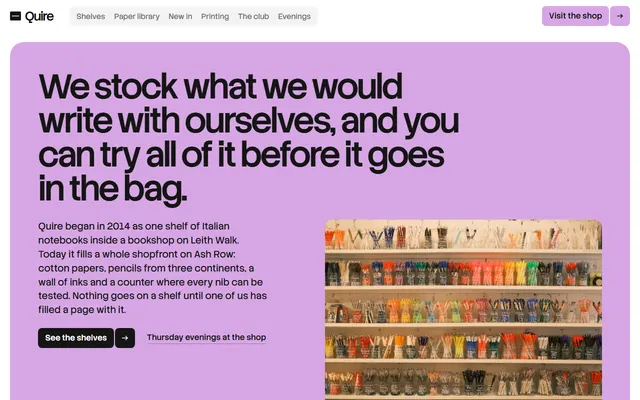
Independent stationer: an opening statement, five shelves, a paper library and Thursday workshops.
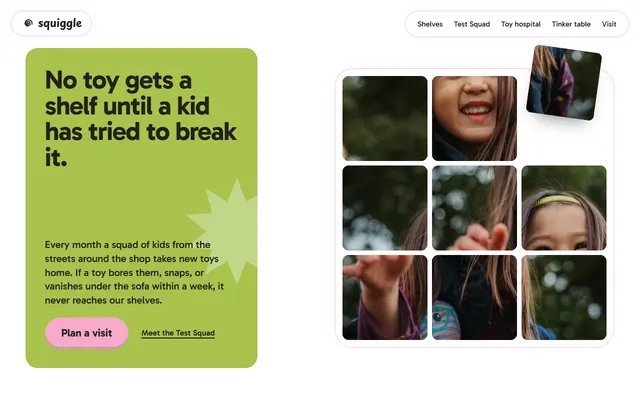
Independent toy shop: a promise and a sliding photo puzzle, six shelves sorted by question and a repair counter.
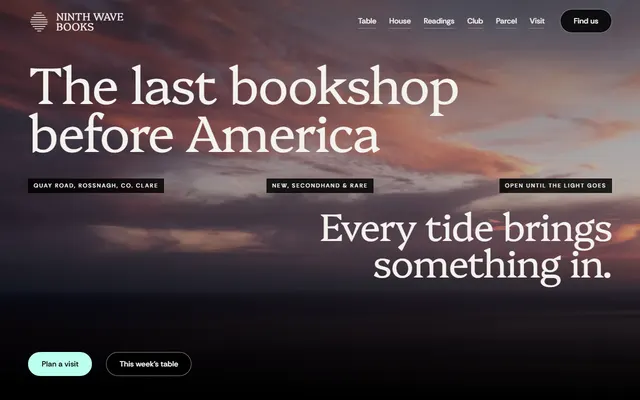
Bookshop: this week's books, readings, a monthly book parcel, booksellers and a visit section.
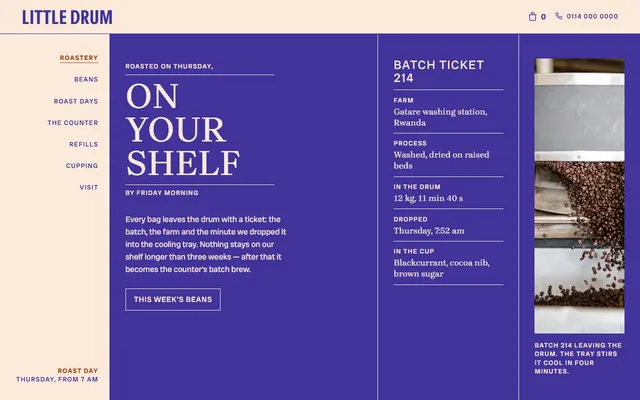
Micro-roastery with a coffee counter: the roast-day ticket and five bean listings.
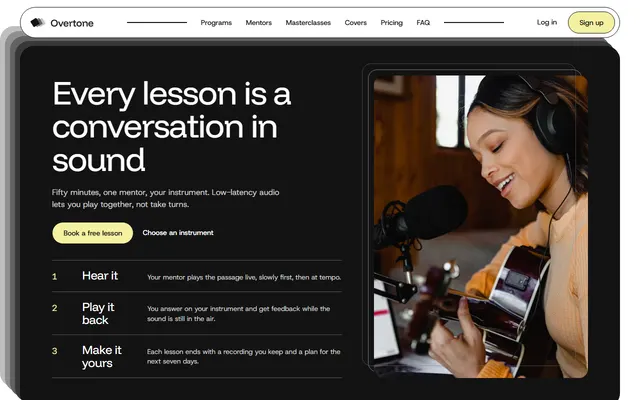
Online music school: a lesson screen with three steps, five instrument programs and five mentors.

Theater company: current show, season board, company, rehearsal weeks, venues and box office.
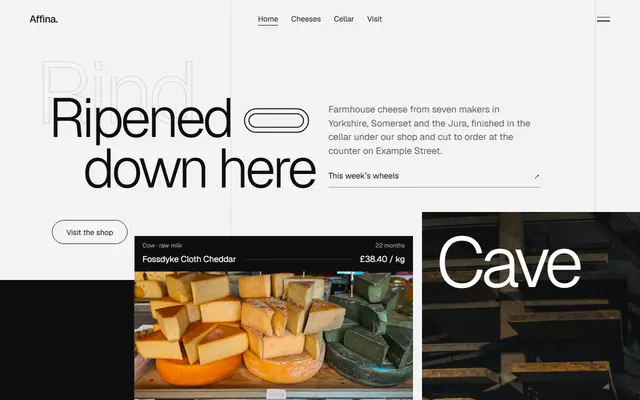
Cheese shop for cheesemongers and delis: counter, cellar, tastings, club.
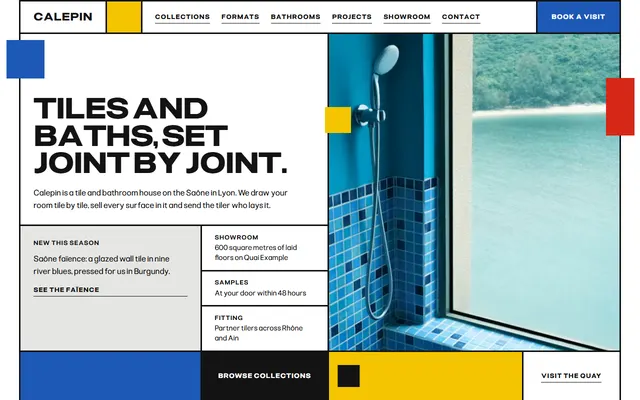
Bathroom or tile showroom: tile collections, formats, a fittings sheet, process, projects and a plan request form.