What comes with the packaging company website template
- index.html: the pure HTML and CSS version, one single HTML file, 122 KB.
- index.gsap.html: the same design built with GSAP, ScrollTrigger and Lenis, for scroll motion in every browser, Firefox included.
- AGENTS.md: what a coding agent must keep and what to replace, so Claude Code, Codex or Cursor edit it without breaking the scenes.
- DESIGN.md: every colour, font, spacing and motion rule of this packaging company website design.
- PROMPTS.md: the agent prompt and the design prompt below.
- CREDITS.md and LICENSE.md: the photos and fonts with their licenses, and the 8B license.
- Updates to this template, at no extra cost.
Yours to edit: one index.html with no build step, so you or a coding agent can change the words, prices and photos and upload it to any static host. Not a coder? Describe your business in one sentence to 8B's AI website builder and it designs a new site for you, with more pages when you need them. Designing is free; publishing with hosting is $9 a month, billed yearly. It also works inside Claude and ChatGPT.
Premium template · $39, one-time license · Made by 8B, an AI website builder · Updated November 2026 · Plain text: low-relief.md
About this packaging company website template
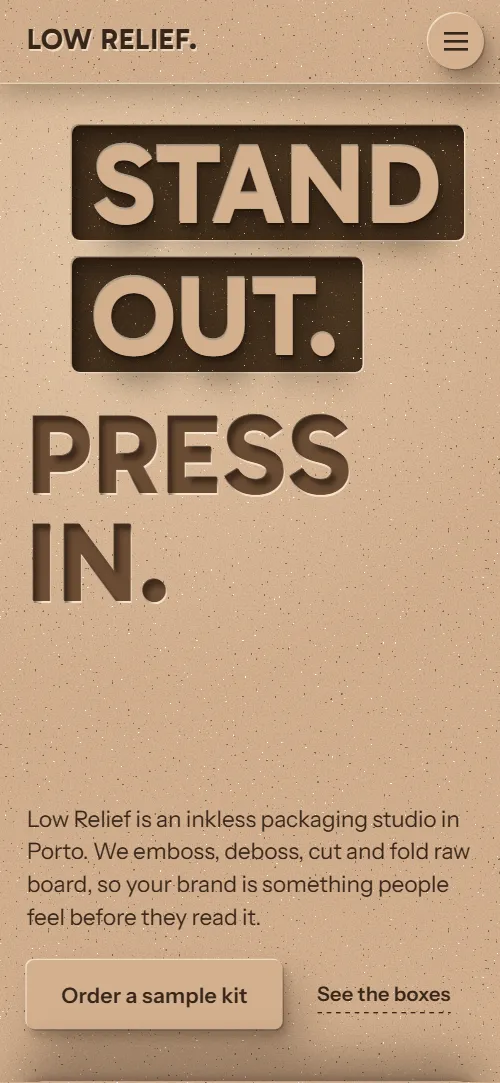
Packaging company website template for a box maker or packaging studio that sells touch rather than ink: one HTML file with six finishes, a four-step production line, four client boxes, five boards with their specs, a sample kit with three price tiers and a brief form. It opens on raised and cut capitals staggered across a kraft board, so the page shows what the studio does before it says it. It is a single HTML file in pure HTML and CSS, and a GSAP version of the same page comes with it.
At a glance, November 2026. One 122 KB index.html: a single HTML file in pure HTML and CSS with a few lines of built-in JavaScript, 12 sections, 7 Unsplash photos, Gabarito and Instrument Sans. A GSAP build of the same page, 113 KB, comes with it.
It suits a custom box maker, a packaging design studio, a print and finishing shop that embosses and die-cuts, or a supplier of sustainable packaging with sample kits and pilot runs. Packaging company websites mostly need four things on one scroll: what you can do to a box, how a job runs, proof from client work and a low-risk way to start, and this page gives each its own section. A packaging website built from it also gets a way to show touch on a screen: finishes drawn as same-tone swatches, boards shown as cross-sections and a sample kit slip with real prices.
The demo business is Low Relief, an invented studio in Porto with eleven people and four client boxes. Every name, price, board, run size, address and quote is demo copy to replace. Prices are in euros with a pilot run from 250 boxes and production from 2,500; set your own minimums and your own currency, and swap the boards and finishes for the ones you press, cut or print.
If you would rather not edit HTML at all, 8B, the AI website builder designs a site from one sentence about your business, with more pages when you need them. This template is for people who want this exact design in their own hands: one index.html with its CSS and its motion inside, which you or a coding agent can edit and host anywhere, next to the shop or quote system you already use.
Good for:
What a packaging company website needs
Packaging company websites that win quotes answer the same questions quickly. Here is how this template covers each of them.
- What you can do to a box. Six finishes shown as swatches with a caption each: blind emboss, deboss, die-cut window, score and fold, texture plate and burnish.
- How a job runs and how long it takes. A four-step production strip from dieline to fold, with the promise of a prototype in a week and production in four.
- Proof from client work. Four client boxes with a photo, a short story, the finish, the board and the run size.
- Materials and specs. Five boards with a drawn cross-section, thickness or weight, best uses and the finishes each takes.
- A low-risk way to start. A sample kit, a pilot run and production as three tiers with prices and minimum runs, right after the boards.
- Answers to the usual objections. Five questions on ink-free branding, the smallest run, how long a die lasts, recycling and shipping outside the EU.
- A way to send a brief. A form for name, email and what to pack, with email, phone, address and opening hours beside it. Connect the form before you go live.
What it does not have is a cart, an online quote calculator or a product catalogue: it is built for a studio that sells by sample kit and brief, and a shop or quote tool can sit behind the buttons.
Packaging company website design and motion
Palette
#d4b08f the kraft board ground of every page section#f7e8d2 pale cream: the lit rims and edges of raised things#6b4c34 mid brown: cut display letters, the flutes in the board cross-sections and the burnish swatch#47331f dark brown: the dark ply, routed channels behind raised letters, die-cut holes, the studio tray and the footer#36261a deep brown: body text, labels and small titles on the board#1f140b near black: cast shadows and the dark wash on the heroFonts
- Gabarito: the raised and cut display capitals, headings and the wordmark
- Instrument Sans: body text, captions, specs, navigation, buttons and form fields
A kraft board page where depth is the only ink: everything is the same warm brown, and relief carries the design. Headings are huge rounded capitals either raised in a dark routed channel or cut into the board; on the first screen and in the contact section they are staggered across the screen in a diagonal. Buttons are raised plates, form fields are cut wells, and the dark ply shows in the routed channels, the process channel, the studio tray and the footer. The finishes are a grid of square swatches, the boxes are matchbox sleeves with a photo tray beside the specs, the boards are rows with drawn cross-sections, and the kit is a lid beside a slip with three rows. On phones the capitals stack, the swatches go two across, the production strip keeps sliding sideways with about one plate on screen at a time and the sleeves sit beside their trays with the specs below.
The idea behind the page is that board can carry a brand with no ink: light falls from the upper left, raised things cast a shadow to the lower right, cut things hold it inside, and the deeper a surface lies the darker it is. So the hero is a specimen of raised and cut words, the statement is pressed by a roller, the production line ends with a flat net standing up as a box, and a punched disc leaves one section and lands in the next.
What is on the packaging company website page
- NavigationFixed header with the wordmark, five links and Order a kit, and a full-screen menu on phones
- Stand out. Press in.STAND OUT. in raised capitals and PRESS IN. cut into the board, staggered on kraft, with a lede, a sample kit button and a link to the boxes
On load the raised lines lift into place and the cut lines settle into the board; a soft pool of light drifts across the board and the shadows of the words sway to the opposite side on the same slow loop. On scroll the hero panel stays in place, shrinks back and darkens inside a frame of dark board while the next sheet rides up over it.
- Ink fades. Foil peels. Pressure stays.A four-line statement, Ink fades. Foil peels. Pressure stays., that a roller presses from standing to cut, with two short paragraphs
The next sheet arrives as a round-topped card that widens to the full width. Then a roller crosses the four-line statement and each line it passes flips from standing on the board to cut into it, until every line is pressed in and the roller is gone.
- Six ways to say it without inkSix finishes as board swatches with a caption each: blind emboss, deboss, die-cut window, score and fold, texture plate, burnish
The six swatches start as one tilted pile at the centre of the first row and are dealt to their places as you scroll, while the heading rises out of the board.
- Flat to finished in four movesA sideways production strip: dieline, press, cut and fold in four steps in a dark channel, ending on a line and a link to the sample kit
The section holds still while the strip of four steps travels sideways. As each step passes the middle it is worked on: the dieline draws itself, the seal is pressed from raised to cut, the arch window is punched and the flat net folds its walls up into an open box.
- Boxes we have pressedFour client boxes as matchbox sleeves with a photo tray, finish, board and run size
Each photo tray starts inside its sleeve, seen through the die-cut window, and slides out beside it as the row rises, leaving the window dark.
- A small press in PortoA dark tray with the studio story, two photos and a founder quote
A quiet pause: the heading and the quote rise out of the board as their shadows grow.
- Five boards we pressFive boards with a drawn cross-section, thickness, best uses and the finishes each takes, and a punched disc
Each cross-section starts compact and splits into its plies as its row reaches the middle of the screen, with score lines pressed in between rows. At the end a disc rises out of its hole, leaving it dark, and travels down the page towards the sample kit.
- Feel it before you orderA sample kit lid beside a slip with three tiers: sample kit, pilot run, production, with prices
The disc lands flush in the socket of the kit lid, which rises out of the board to meet it; the prices on the slip press in as you scroll.
- Before you askFive questions in details rows, with a marker that sinks when a row opens
A quiet pause: the heading rises out of the board, creases press in between rows and the round marker sinks when a row opens.
- Let's press something.LET'S PRESS SOMETHING. with a brief form cut into the board, email, phone, address and opening hours
As the section rises, a pool of light crosses the board from the right and settles, and the shadows of the two heading lines swing with it until they rest in the page's upper left light.
- FooterDark footer with the full-width wordmark, pages, contact, address and the company line
As the full-width wordmark scrolls up, its shadow swings to the settled light, the divider presses in and the columns rise out of the board.
Before you publish the packaging company website site
- Replace social preview image, favicon, contact form (sends nothing yet), email address and phone number and the invented demo facts (names, prices, areas, quotes). AGENTS.md lists them.
- Order a kit in the header, Order a sample kit and Start with a sample kit buttons, the Sample kit menu and footer links lead to
#kit, the sample kit sectionnow; point them to keep them while the kit is sold on the page, or point them to your shop or order form. - See the boxes, Finishes, Process, Work, Boards and Contact links in the header, menu and footer lead to
#work, #finishes, #process, #materials and #contact, sections of the pagenow; point them to keep them. - Order a sample kit and Ask about a pilot run buttons in the kit section lead to
#contactnow; point them to keep them once the brief form is connected. - Email and phone links in the contact section and the footer lead to
mailto: and tel: linksnow; point them to your own email and number. - The Low relief. wordmark in the header and Back to the top in the footer lead to
#heronow; point them to keep them. - The brief form lead to
a mailto: action to the studio address, which opens the visitor's email app with the fields filled innow; point them to a form service such as Formspree or Netlify Forms, or your quote system. - Scroll-driven animation runs when the browser supports it (Chrome, Edge and Safari today; Firefox does not yet) and the visitor has not asked for reduced motion. Otherwise each section shows its finished layout; the GSAP build, index.gsap.html, also plays the scroll motion in Firefox (GSAP 3.13).
- The brief form's action is a mailto: address: on submit it opens the visitor's email app with the fields filled in, and the brief goes out only when they press send there. Connect it to a form service or your quote system to receive briefs directly. There is no thank-you line.
- There is no cart or checkout: the Order a sample kit and Ask about a pilot run buttons on the price slip lead to the brief form. The page has no sub-pages, so a catalogue or case studies are added as new sections or your own pages.
- The finishes are built for six swatches, the production strip for four steps and the boards for five cross-sections: a different count there needs its layout and scene adjusted. Client boxes and price tiers can be added or removed as they are.
Questions about this packaging company website template
What do I get for $39?
The packaging company website template as a single HTML file, index.html, in pure HTML and CSS, a GSAP build of the same page as index.gsap.html, a DESIGN.md with every colour, font and motion rule, an AGENTS.md for coding agents, the agent prompt and the design prompt from this page, and CREDITS.md for the photos and fonts. Updates to this template are included.
Can I use this packaging template for client sites?
Yes. One purchase lets you build as many sites as you like with it, for your own company or for clients, and change anything. What it does not allow is selling or giving away the template itself, as a template, theme or kit, or putting its source in a public repository.
How do I change the finishes, boards and prices?
Each finish, board, client box and price tier is one short block of HTML with its words and numbers, and the swatches and cross-sections are drawn with CSS. With Claude Code, Codex or Cursor you say it in a sentence, such as change the sample kit to 30 euros and the pilot run to start at 500 boxes, and the agent edits the blocks; by hand you change the text in place. The finishes, the production steps and the boards are built for six, four and five, so a different count there also needs its layout and scene adjusted; client boxes and price tiers can be added or removed as they are. If you want a site with more pages that you edit without code, 8B's AI website builder makes one from a sentence about your company.
Can customers order a sample kit or a quote here?
The Order a sample kit and Ask about a pilot run buttons on the price slip lead to the brief form, which asks for a name, an email and what should be packed. The form's action is a mailto: address, so submitting it opens the visitor's email app with the brief filled in, and it goes out only when they press send there; to receive briefs directly, connect a form service such as Formspree or Netlify Forms, or your quote system. There is no cart or payment: if you sell kits online, point the buttons to your shop and keep this page as the front door.
Will it work with Claude Code, Codex or Cursor?
Yes. Put index.html and AGENTS.md in your project and give the agent the prompt that comes with the template. AGENTS.md says which attributes the scroll motion reads, what to keep and what to replace, so the agent swaps finishes, boards, client boxes, prices and photos without breaking the scenes.
What do visitors see in Firefox or with reduced motion?
Firefox does not support scroll-driven animations yet, so it shows every section in its finished layout, as does any browser when the visitor asks for reduced motion. If the scroll motion must also play in Firefox, use the GSAP build, index.gsap.html, which loads GSAP, ScrollTrigger and Lenis from a CDN.
More templates for print, craft and making
Other designs for businesses that make things.
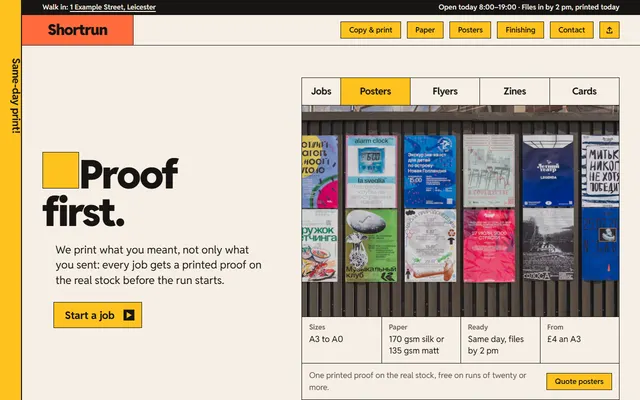
Print and copy shop: job tabs, a paper table, poster sizes, finishing and a quote form.
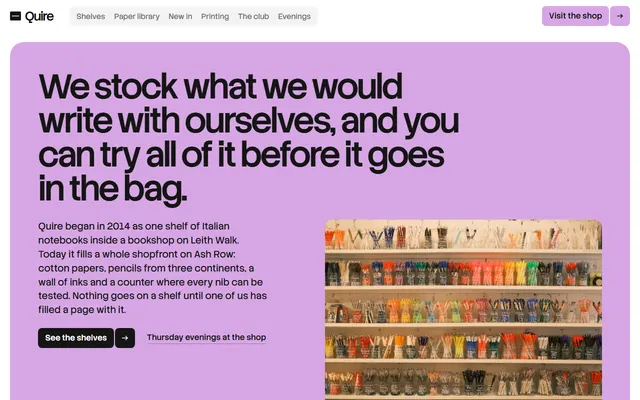
Independent stationer: shelves, a paper library, a letterpress service and workshops.
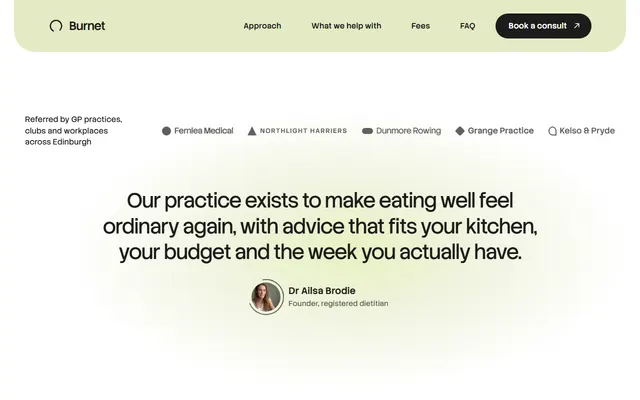
Nutrition or dietetics clinic: a food diary, six areas of help, first visit steps, team, fees and a booking form.
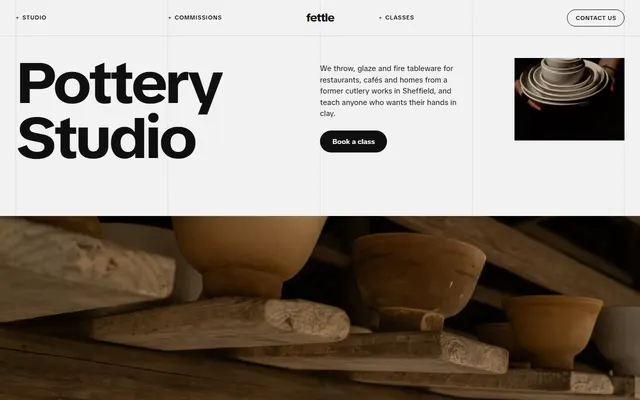
Pottery studio: commissions, a six-step process, glazes, classes and an open studio.
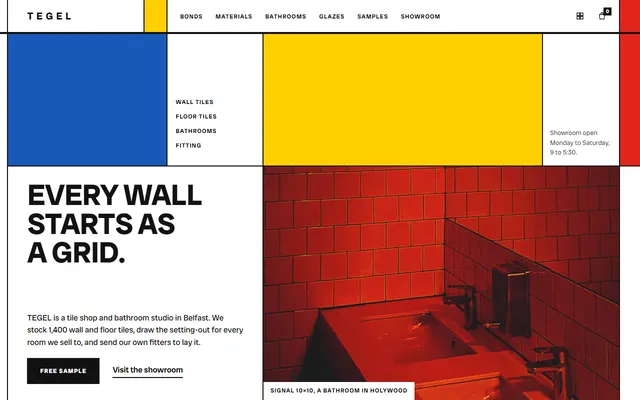
Tile shop: three tile bonds, a materials table, finished bathrooms and a free-sample form.
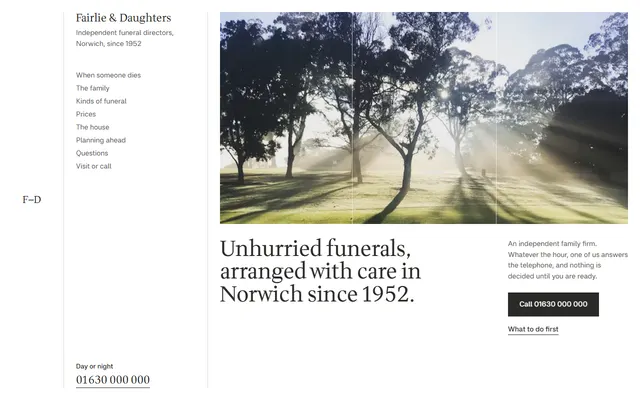
Funeral home: what to do first, the team, kinds of funeral, a full price list and a call-back form.
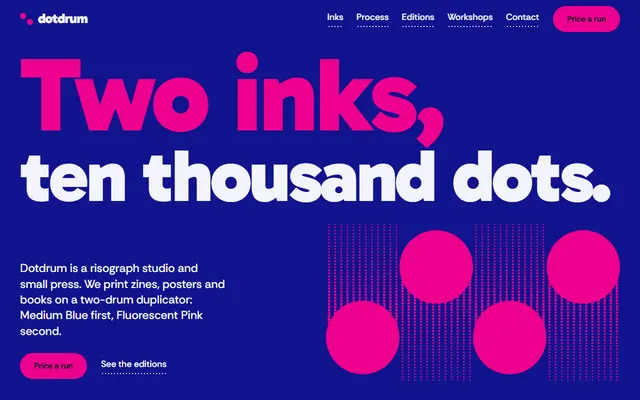
Print studio for risograph studios and print shops: price calculator, a third of the code.
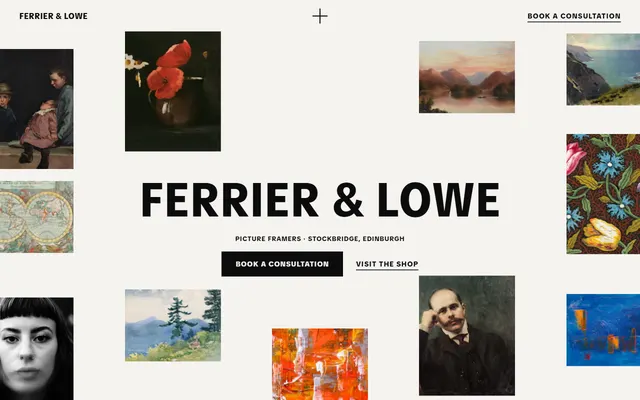
Picture framer: a wall of framed work, mounts, mouldings, glass, workshop steps and a print room.