What comes with the literary festival website template
- index.html: the pure HTML and CSS version, one single HTML file, 116 KB.
- index.gsap.html: the same design built with GSAP, ScrollTrigger and Lenis, for scroll motion in every browser, Firefox included.
- AGENTS.md: what a coding agent must keep and what to replace, so Claude Code, Codex or Cursor edit it without breaking the scenes.
- DESIGN.md: every colour, font, spacing and motion rule of this literary festival website design.
- PROMPTS.md: the agent prompt and the design prompt below.
- CREDITS.md and LICENSE.md: the photos and fonts with their licenses, and the 8B license.
- Updates to this template, at no extra cost.
Yours to edit: one index.html with no build step, so you or a coding agent can change the words, prices and photos and upload it to any static host. Not a coder? Describe your business in one sentence to 8B's AI website builder and it designs a new site for you, with more pages when you need them. Designing is free; publishing with hosting is $9 a month, billed yearly. It also works inside Claude and ChatGPT.
Premium template · $39, one-time license · Made by 8B, an AI website builder · Updated November 2026 · Plain text: longhand.md
About this literary festival website template
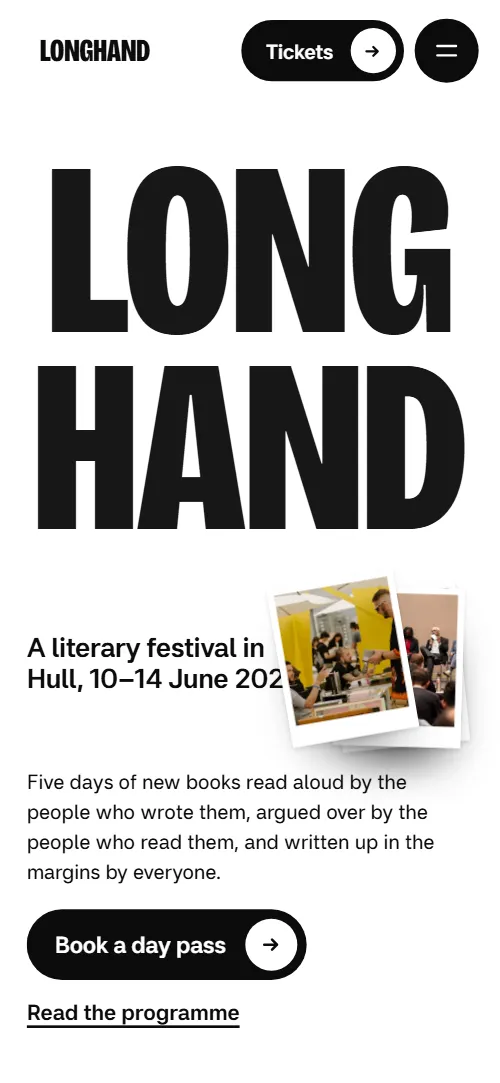
Literary festival website template for a small festival with a few venues and a programme by day: one HTML file with a five-day programme, six featured readings, a late-night strand, a first book prize shortlist, four audiences, venues with addresses, four passes and a newsletter sign-up. It opens on a giant wordmark on a white page that dives into a photo of a reader, and five paper notes are pinned onto it one by one. It is a single HTML file in pure HTML and CSS, and a GSAP version of the same page comes with it.
At a glance, November 2026. One 116 KB index.html: a single HTML file in pure HTML and CSS with a few lines of built-in JavaScript, 13 sections, 24 Unsplash photos, Bricolage Grotesque and Miranda Sans. A GSAP build of the same page, 96 KB, comes with it.
It suits a literary festival, a book festival, a poetry or translation weekend, a writers' festival or a reading series with a timetable, a prize and passes. Literary festival websites mostly need four things on one scroll: what happens on which day, who is reading, where to go and how to get in, and this page gives each its own section. A festival site built from it also gets the parts that make a reader trust a small festival: a statement of how the festival reads, a late-night strand for anyone with a notebook, a prize shortlist and practical answers about access and refunds.
The demo festival is Longhand, an invented festival in Hull. Every writer, book, publisher, venue, street, price and date is demo copy to replace. The programme is built from five days with a theme and three timed sessions each, and the venues show a name, a photo, a sentence and a street, so a festival in any city fills in its own days, rooms and passes; prices are in pounds, and you change them to your own currency and terms.
If you would rather not edit HTML at all, 8B, the AI website builder designs a site from one sentence about your festival, with more pages when you need them. This template is for people who want this exact design in their own hands: one index.html with its CSS and its motion inside, which you or a coding agent can edit and host anywhere, next to the ticket shop you already use.
Good for:
What a literary festival website needs
Festival websites that fill rooms answer the same questions quickly: what is on, who is reading, where and how much. Here is how this template covers each of them.
- A programme by day. Five day cards, Wednesday to Sunday, each with a theme, an idea, a photo and three timed sessions with their venues.
- The writers people come for. Six readings to book first, each with the writer's name, the book, the form (debut novel, poetry, translation) and the day, time and room.
- A reason to stay late. An After Dark section for the night strand, with the dates, hours, venue, a description and a booking button.
- Proof that the festival matters. A first book prize with six shortlisted books, the amount, the date of the announcement and who judges.
- A place for every kind of visitor. Four panels for readers, writers, schools and publishers, each with its own button.
- Where to go and how to get in. Four venues with a photo, a sentence and a street address, four passes with prices and what they cover, and five practical answers on tickets, access, refunds, books and travel.
- A way to keep in touch. A contact section with email, phone, office address, a monthly newsletter field and buttons for volunteers, press and schools.
What it does not have is a ticket shop, a searchable timetable or a speaker database: it is built for a festival with a handful of venues and a printed timetable, and its pass buttons point at the ticket shop or payment links you already use.
Literary festival website design and motion
Palette
#ffffff page ground of the opening, statement, audiences, venues and contact sections#0c0c0c near-black text, the filled buttons, the rules and the outlined buttons#f2e6ca cream paper: the notes, the programme ground and the text on dark sections#146b5a deep green: the writers section and the day cards#8db5a6 sage: the passes ground, the photo halves of the audience panels and every second shortlist card#e8a628 amber: the fade behind the prize shortlist and the footer, the badges and the button hover floods#11261c night green: the After Dark disc and the shade behind the opening photo#686868 quiet grey: the closing SEE YOU IN THE MARGINS capsFonts
- Bricolage Grotesque: the giant condensed capitals: the wordmark, day names, the big section headings, prices and venue names, at weight 800 and a narrow width
- Miranda Sans: the sentence-case headings, body text, sessions, captions, labels, buttons and form fields
A white page with near-black text, where the sections change ground: cream for the programme, deep green for the writers, sage for the passes and a white-to-amber fade for the prize and the footer. The big headings (the wordmark, Five days, After dark, the prize, For you, Passes and the closing line) are giant condensed capitals set tight, and the other headings and the text are a calm sans. The programme is a row of five deep-green day cards that travel past the centre, each with a theme, an idea, a photo and three timed sessions; the writers are a list of six names beside one held portrait frame; the audiences are four split panels, a text half and a photo half; the venues are four wide rows with the name, a photo and an address. On phones the wordmark breaks into two lines, the cards narrow and the panels stack their halves.
The idea behind the page is a festival read aloud, on paper. The notes are cream slips pinned at a tilt, carrying one short statement or one shortlisted book, and the same pinned landing returns in the opening and the prize; the passes are paper slips too. The word LONGHAND is a window onto a reader, After Dark changes the register of the whole section from day to night, and the closing line, see you in the margins, slides together from two sides.
What is on the literary festival website page
- NavigationHeader with the wordmark, the city and dates, four links, Tickets and a menu with six links
The header hides when you scroll down and comes back when you scroll up.
- Long handTwo screens: the giant word LONGHAND on white with the festival line, two actions and three prints, then a full-bleed reader photo with five pinned notes
On load the word LONGHAND rises into place and the date line, the paragraph and the actions slide in and the three prints fan in; the prints then shuffle in a loop, the top one sliding out and tucking under the others. On scroll the cover lifts so the letters show the reader, the text and prints slide away and the word scales up until the photo fills the screen; then the label and the five notes are pinned onto the photo one by one.
- Every book at Longhand is read aloud by the person who wrote it. Then the room gets to answer back.A large statement that darkens word by word, a short paragraph and four facts
The words of the large statement darken one after another as it scrolls through the screen.
- Five daysFive day cards, Wednesday to Sunday, each with a theme, an idea, a photo and three timed sessions with venues
The five day cards are held while the track moves sideways; each card turns in 3D and changes depth by its distance from the centre, and the card at the centre sits flat and full size, from Wednesday to Sunday.
- After darkA round microphone photo above giant AFTER DARK caps, with a night disc that grows, session details and one button
A small dark disc grows behind the round photo until it covers the section, the photo scales and turns, the giant caps change from ink to paper as the disc passes, and the details slide up and appear.
- Six readings to book firstSix readings to book first: a held portrait frame beside six names with book, form and session
The portrait frame is held while the list scrolls past; the photo wipes upward to the portrait of the writer at the centre, the image settling as it opens, and each name is marked as it reaches the reading line.
- Shortlisted for a first bookA first book prize with six tilted shortlist cards and a note on the judges
Each of the six shortlist cards drops from above, overshoots its tilt and settles.
- For youFOR YOU in giant caps and four split panels for readers, writers, schools and publishers
A stage is held while each audience assembles from two halves entering from opposite edges, the text half from above and the photo half from below, on phones from the sides, over the previous panel.
- Four rooms near the riverFour venues in large caps, each with a photo, a sentence and a street address
The intro paragraph darkens word by word, and each venue photo opens from a thin slit to its frame while the image settles from a slight zoom.
- PassesFour passes with name, price, what it covers and a button: day, festival, After Dark and under 18
The list is held while the four passes, first one tilted pile in the centre, slide apart and turn upright into their places; on a phone each pass is dealt in from alternating sides as it scrolls into view.
- Before you comeFive practical questions in native details elements, with an email address
- See you in the marginsSEE YOU IN THE MARGINS in giant caps, a paragraph, email, phone, office, a newsletter field and four buttons
The two lines of the heading slide in from opposite sides and lock together, and the paragraph darkens word by word.
- FooterFooter with the wordmark, a back to top button, address and charity line, four links and the copyright
Before you publish the literary festival website site
- Replace social preview image, favicon, email address, phone number and contact form (sends nothing yet) and the invented demo facts (names, prices, areas, quotes). AGENTS.md lists them.
- Tickets in the header, Book a day pass in the opening and the audiences section, Book After Dark and Book a pass lead to
#ticketsnow; point them to keep them pointing at the passes section, or at your ticket shop. - The four Book buttons on the passes (Book a day, Book all five, Book a night, Claim a seat) lead to
#contact, the contact section: nothing is soldnow; point them to your ticket shop, a payment link or a booking form. - Read the programme, Programme, Writers, Venues and Visit in the header and the menu lead to
#programme, #writers, #venues, #faqnow; point them to keep them: they are the sections of this page. - Join the open notebook, Bring a class and Send a proposal in the audiences section lead to
#contactnow; point them to a sign-up form or the email you want those messages sent to. - Volunteer with us, Press enquiries and Bring a class at the end of the contact section, and Press and Volunteer in the footer lead to
mailto: links to the demo addressesnow; point them to your own addresses, after the replacements above. - Newsletter and Access in the footer lead to
#contact and #faqnow; point them to keep them once the newsletter field is connected. - Scroll-driven animation runs when the browser supports it (Chrome, Edge and Safari today; Firefox does not yet) and the visitor has not asked for reduced motion. Otherwise each section shows its finished layout; the GSAP build, index.gsap.html, also plays the scroll motion in Firefox.
- The newsletter field sends nothing: connect it to your mailing list or a form service. The pass buttons sell nothing either, they scroll to the contact section, so point them at your ticket shop or payment links before you go live.
- It is one page, and the programme shows three sessions a day with a note about a printed timetable. A festival with a longer timetable adds its sessions to the day cards or links to a full schedule of its own.
- The scenes are built for fixed counts: five notes in the opening, six readings and four audience panels. A different count there needs the scene and its layout adjusted; the day cards, venues and passes take another count.
Questions about this literary festival website template
What do I get for $39?
The literary festival website template as a single HTML file, index.html, in pure HTML and CSS, a GSAP build of the same page as index.gsap.html, a DESIGN.md with every colour, font and motion rule, an AGENTS.md for coding agents, the agent prompt and the design prompt from this page, and CREDITS.md for the photos and fonts. Updates to this template are included.
Can I use this literary festival template for client sites?
Yes. One purchase lets you build as many sites as you like with it, for your own festival or for clients, and change anything. What it does not allow is selling or giving away the template itself, as a template, theme or kit, or putting its source in a public repository.
How do I add, change or remove sessions and writers?
Each session is one line of HTML with a time, a title and a venue, inside the card of its day, and each reading is one block with a name, a book, a form and a slot. With Claude Code, Codex or Cursor you say it in a sentence, such as move the poetry night to Saturday at 20:00 and add a translation panel on Thursday, and the agent edits the lines; by hand you copy a line and change the words. The day cards follow your days, since the sideways scene measures the row, but the readings are six because the portrait scene is built for six: say so if you want a different number, and the agent adjusts the scene with it. There is no search or filter, so a festival with hundreds of sessions links the cards to its full timetable.
How do visitors buy a pass?
The four passes show a name, a price and what each covers, and their buttons scroll to the contact section, where visitors can write to you. Nothing is sold on the page until you point the buttons at your own ticket shop, a payment link or a booking form, which is a one-line change per pass and a sentence to a coding agent. The newsletter field at the end sends nothing until you connect it to a mailing list or a form service, and the pure HTML and CSS version shows no thank-you line after sending, so point the form at a thank-you page or add one.
Will it work with Claude Code, Codex or Cursor?
Yes. Put index.html and AGENTS.md in your project and give the agent the prompt that comes with the template. AGENTS.md says which attributes the scroll motion reads, what to keep and what to replace, so the agent swaps writers, sessions, venues, prices and photos without breaking the scenes.
What do visitors see in Firefox or with reduced motion?
Firefox does not support scroll-driven animations yet, so it shows every section in its finished layout, as does any browser when the visitor asks for reduced motion. If the scroll motion must also play in Firefox, use the GSAP build, index.gsap.html, which loads GSAP, ScrollTrigger and Lenis from a CDN.
More templates for festivals, culture and learning
Other designs for events and cultural venues.
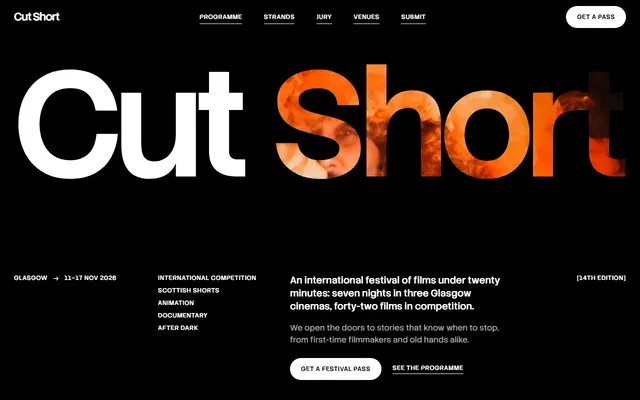
A week-long festival of short films: featured films, strands, a jury, how to submit, venues and passes.
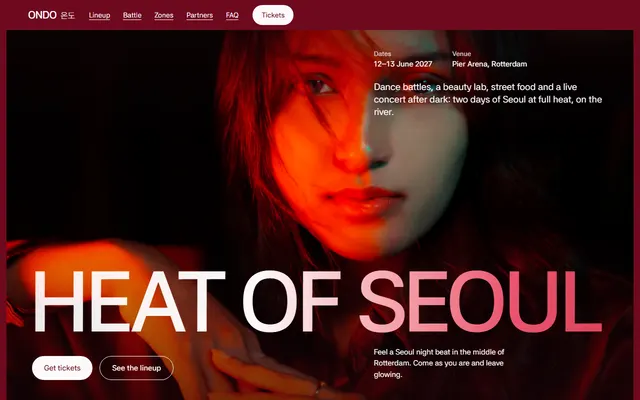
A two-day festival: lineup, a crew battle, four zones, a food board, partner info and three passes.
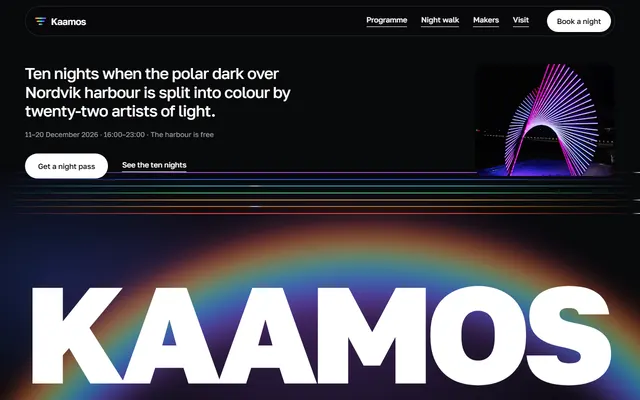
Light festival: ten nights programme, night walk route, makers, passes and an office form.
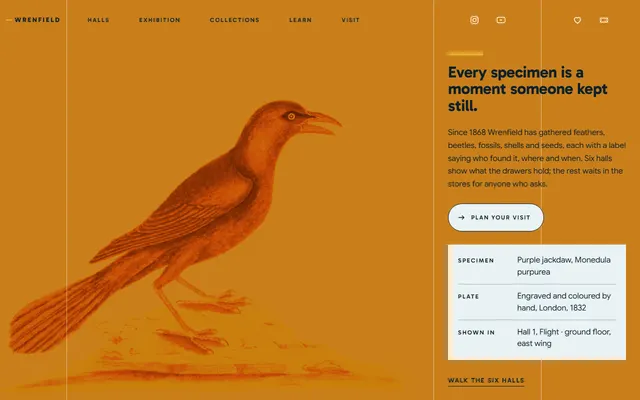
A natural history museum: halls, a main exhibition, learning sessions, late openings, membership and visiting information.
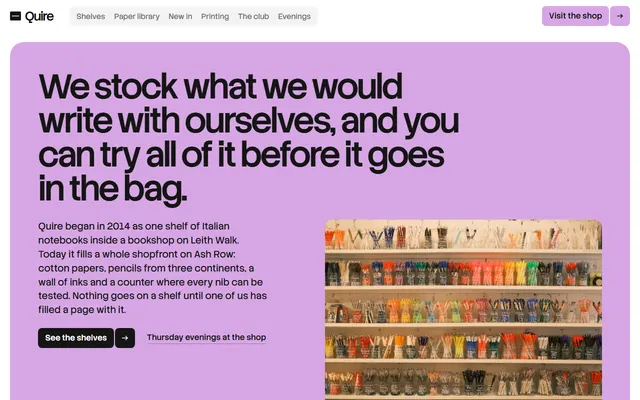
An independent stationer: shelves, a paper library, makers, a letterpress service and workshops.
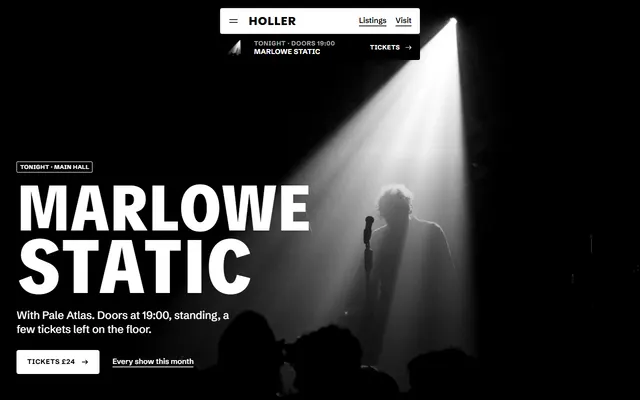
Music venue: tonight's running order, upcoming nights with ticket tags, two rooms, hall hire and a members list.
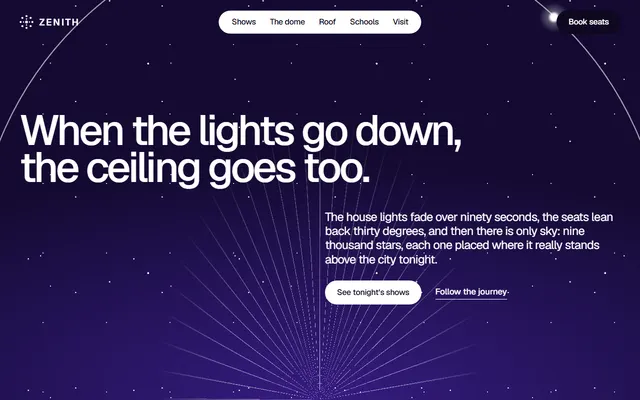
A city planetarium: a flagship show, a programme with times, school trips, late events and a box-office form.
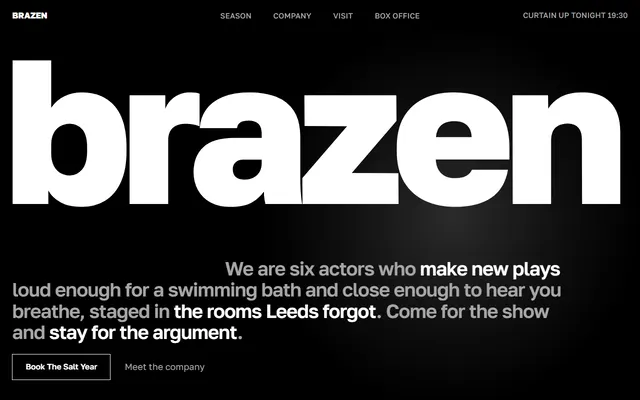
Theater company: current show, season board, company, rehearsal weeks, venues and box office.