What comes with the counseling website template
- index.html: the pure HTML and CSS version, one single HTML file, 152 KB.
- index.gsap.html: the same design built with GSAP, ScrollTrigger and Lenis, for scroll motion in every browser, Firefox included.
- AGENTS.md: what a coding agent must keep and what to replace, so Claude Code, Codex or Cursor edit it without breaking the scenes.
- DESIGN.md: every colour, font, spacing and motion rule of this counseling website design.
- PROMPTS.md: the agent prompt and the design prompt below.
- CREDITS.md and LICENSE.md: the photos and fonts with their licenses, and the 8B license.
- Updates to this template, at no extra cost.
Yours to edit: one index.html with no build step, so you or a coding agent can change the words, prices and photos and upload it to any static host. Not a coder? Describe your business in one sentence to 8B's AI website builder and it designs a new site for you, with more pages when you need them. Designing is free; publishing with hosting is $9 a month, billed yearly. It also works inside Claude and ChatGPT.
Premium template · $39, one-time license · Made by 8B, an AI website builder · Updated November 2026 · Plain text: stillfield-counselling.md
About this counseling website template
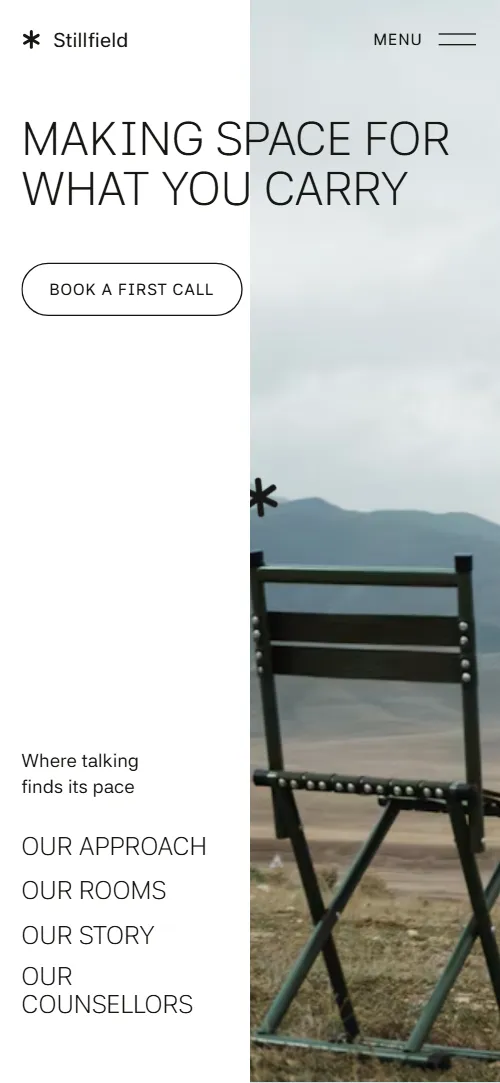
Counseling website template for a small practice: one HTML file with the approach, what people bring, four places to talk, four counselors, the founder's story, couples sessions, questions, three first steps with fees and a contact form. It opens on a four-column page cut by hairlines, where a photo of an empty chair in a wide landscape fills one column and then widens until it is the whole screen. It is a single HTML file in pure HTML and CSS, and a GSAP version of the same page comes with it.
At a glance, November 2026. One 152 KB index.html: a single HTML file in pure HTML and CSS with a few lines of built-in JavaScript, 12 sections, 12 Unsplash photos, Asta Sans. A GSAP build of the same page, 137 KB, comes with it.
It suits a counseling or psychotherapy practice with a few counselors in one building, a solo therapist who also sees clients online or on walks, and a couples or young-adult service. Counseling websites mostly need the same things on one calm scroll: how you work, who you see and for what, who the counselors are, what a first session looks like, what it costs and how to get in touch, and this page gives each its own section. Counseling websites built from it also get what makes a small practice feel safe to ring: no jargon, fees written in plain sentences and a reply promised within one working day.
The demo business is Stillfield, an invented counselling practice in Edinburgh. Every name, fee, room, hour and quote is demo copy to replace. The page uses British wording, pounds and Scottish place names, so a practice in another city or country changes the currency, the places, and the words for the first call. The crisis line in the footer carries real UK numbers, 999 and the Samaritans on 116 123: keep them for a UK practice and replace them with your local crisis line anywhere else. The page has no testimonials, since they sit badly with confidentiality, and you can keep it that way.
If you would rather not edit HTML at all, 8B, the AI website builder designs a site from one sentence about your practice, with more pages when you need them. This template is for people who want this exact design in their own hands: one index.html with its CSS and its motion inside, which you or a coding agent can edit and host anywhere, next to the booking page or practice software you already use.
Good for:
What a counseling website needs
People who look for a counselor are often nervous, so a counseling practice website has to answer a few questions quickly and quietly. Here is how this template covers each of them.
- How you work. A manifesto sentence and three principles: the client sets the pace, nothing is too small, and one counselor stays with you from start to finish.
- What people bring. Four plain lists of five entries each, under feelings, relationships, changes, and work and self, with a line saying no diagnosis is needed.
- Who the counselors are. Four counselors with a portrait, their approach, what they work with and an Ask for link, so a client can name a person.
- Where sessions happen. Four places to talk with a photo each: three rooms in one house, one of them step-free, and walk-and-talk in a park; online sessions are named in the text.
- What a first session takes. Three steps: write or call, a free twenty-minute call, and a first session usually within ten days, with a reply promised within one working day.
- Fees in plain words. The fee for one person and for couples, reduced places, student fees and the cancellation rule, written as sentences under the steps, in the couples section and in the questions.
- Confidentiality and safety. A question on confidentiality, a note that the counselors are registered and supervised, and a crisis line in the footer.
What it does not have is an online booking calendar, a client login, payments or a page for each counselor: it is built for a practice that takes enquiries by form and phone, and the form needs connecting to a form service or your email before you go live.
Counseling website design and motion
Palette
#ffffff page ground and text on the dark footer#161714 near-black ink for text, headings and the pill button#d6d7d1 the light grey hairlines between columns#5c5e57 grey for small text and the room and step names before they turn to ink#e8eae3 mist ground of the topics, story and questions sections#2c3029 deep moss ground of the footer and of the opening's second screen, and the wash that rises over the landscape photoFonts
- Asta Sans: everything: light uppercase for headings, labels and the menu, regular for body text and the form, medium for the small button and menu words
A white page cut into four equal full-height columns by thin grey hairlines, two columns on phones. Content sits at the tops and feet of columns, never in centred blocks: a photo fills one column edge to edge, small captions sit at the top, and two-line light uppercase labels sit at the foot of columns. Section headings are large, light and uppercase and are allowed to cross a hairline. Some sections sit on a pale mist ground, and the footer is deep moss with the wordmark across the full width. The four counselors are four whole columns with a portrait at the top and the name at the foot, and the first steps form a staircase across three columns. A Menu button opens a full-screen overlay of the sections.
The idea behind the page is making space: the first window is one column of a wide landscape with a single empty chair, and the page keeps opening it, so the chair ends up small in the whole landscape. A small asterisk, like a footnote mark meaning there is more to say, is the practice's logo and the marker of the steps. Motion is slow and quiet, and nothing flashes or counts up.
What is on the counseling website page
- NavigationHeader with the Stillfield wordmark and a Menu button that opens a full-screen overlay of eight sections with the address, phone and email
The header bar is clear over the opening photo and takes a white ground and a hairline as soon as the page moves; it hides while you scroll down and returns on the way up. The Menu button opens a full-screen overlay.
- Making space for what you carryTwo screens: a four-column first screen with a landscape photo window, the heading Making space for what you carry, a pill button and four foot labels, then a second screen with a statement and the practical lines, over the whole landscape while the scroll motion runs and on deep moss without it
On load the hairlines draw down, the photo rises into its column, the heading lines and foot labels rise one after another and the button fades in. The landscape then drifts slowly sideways inside its window and the asterisk turns. On scroll the window widens from one column to the whole screen while the landscape zooms out from the chair, the foot labels sink away, the heading lifts off, a dark wash rises and the statement and practical lines arrive over the wide landscape.
- We won't hurry you towards an answer. We stay with the question until it feels lighter.A manifesto sentence over four columns, a photo of two cups of tea and three principles: you set the pace, nothing is too small, one person start to finish
The manifesto's words start filed into four columns like a table and drift out of them into one flowing sentence as it rises into reading position; the three principles then arrive column by column.
- What people bring to usWhat people bring: four lists of five entries under Feelings, Relationships, Changes and Work and self
The hairlines draw down, the heading lines rise from under their baseline and the four lists arrive column by column.
- Four places to talkFour places to talk: the window room, the garden room, the long room and the Meadows, each with a photo and a line of detail
A window one column wide travels across the four places: only one photo shows at a time, the window pauses on each while its name turns from grey to ink and the image drifts against the travel, then it opens back over all four at once.
- Four counsellors, one way of listeningFour counsellors in four columns, each with a portrait, approach, focus and an Ask for link
The four counselors arrive as four whole columns at four different heights, each at its own pace, with their portraits drawn in close; as the row reaches reading height the columns settle onto one line and the portraits widen to their frames.
- Two rooms at the top of a stone stairHow the founder opened the practice in two rooms at the top of a stair, with a stair photo, three paragraphs and a quote
The hairlines draw, the heading lines rise and the three paragraphs arrive one after another.
- CouplesCouples sessions: two voices, how seventy-five minute sessions work and the fee
The two voices start in the outer columns, far apart and at different heights, and close the distance until they stand either side of the centre hairline, then a shared baseline draws out from the middle beneath them.
- Before you callSix questions before you call, as openable items: confidentiality, number of sessions, fit, fees, cancelling and young people
The hairlines draw, the heading lines rise and the six questions arrive one after another. The questions open and close as plain details items.
- Three steps to a first sessionThree steps to a first session in a staircase, with the fees written out below
The asterisk rolls along the column hairlines down the staircase of three steps, turning as it goes; each step turns from grey to ink as the asterisk reaches it, and the mark comes to rest beside the first session.
- Ring the second bellA door photo, the address, phone, email and hours, and a short form with a choice of who the sessions are for
The hairlines draw, the heading lines rise and the address, phone, email and hours arrive one after another.
- FooterFooter with the address, contacts, hours, section links, a crisis line note, the wordmark across the full width and the practice line
The footer columns arrive one after another and the wordmark's lines rise across the full width.
Before you publish the counseling website site
- Replace social preview image, favicon, phone number, email address and contact form (sends nothing yet) and the invented demo facts (names, prices, areas, quotes). AGENTS.md lists them.
- Book a first call, the four Ask for... links, Ask about couples sessions lead to
#contactnow; point them to keep them once the contact form is connected, or point them at your booking page. - The Stillfield logo, Our approach, Our rooms, Our story and Our counsellors labels on the first screen, the menu and the footer links lead to
#opening, #approach, #rooms, #story, #team, #couples, #begin, #faq and #contact on the same pagenow; point them to keep them, or point them at your own pages. - How we work in the opening lead to
#approachnow; point them to keep it. - Phone and email links in the menu, the contact section and the footer lead to
a 0131 000 0000 number and hello@stillfield.example, placeholdersnow; point them to your own phone and email. - Samaritans link in the footer lead to
tel:116123, the real UK Samaritans number, kept on purposenow; point them to your country's crisis line, or keep it for the UK. - Scroll-driven animation runs when the browser supports it (Chrome, Edge and Safari 26.2 and later; Firefox does not yet) and the visitor has not asked for reduced motion. Otherwise each section shows its finished layout; the GSAP build, index.gsap.html, also plays the scroll motion in Firefox (GSAP 3.13).
- The contact form sends nothing: it has no handler and its action points back to the page. Connect it to a form service, your email or your practice software, and add a thank-you page or line yourself.
- It is one page: every link goes to a section of the same page, and there are no pages for individual counsellors, a blog or a booking calendar. Counselling practices that take enquiries by form and phone, as this one does, need nothing more.
- The scenes are built for fixed counts: four places to talk, four counsellors, three principles and three steps. A different count needs its layout and scene adjusted.
- There are no client testimonials on purpose, because they sit badly with confidentiality; the page has two anonymous voices in the couples section instead.
Questions about this counseling website template
What do I get for $39?
The counseling website template as a single HTML file, index.html, in pure HTML and CSS, a GSAP build of the same page as index.gsap.html, a DESIGN.md with every colour, font and motion rule, an AGENTS.md for coding agents, the agent prompt and the design prompt from this page, and CREDITS.md for the photos and fonts. Updates to this template are included.
Can I use this counseling template for client sites?
Yes. One purchase lets you build as many sites as you like with it, for your own practice or for clients, and change anything. What it does not allow is selling or giving away the template itself, as a template, theme or kit, or putting its source in a public repository.
Can clients book a session from the page?
Through a short form, not a calendar. The contact form takes a name, an email, an optional phone number, who the sessions are for (myself, us as a couple or a young person) and an optional note, and it sends nothing until you connect it to a form service such as Formspree or Netlify Forms, or to your email. If you use a booking tool, point the Book a first call and Ask for links at its page; with Claude Code, Codex or Cursor that is one sentence.
How do I change the counselors, fees and rooms?
Each counselor, room and step is a short block of HTML with its own heading and a line or two of text, and the fees are plain sentences in the fees line under the steps, the couples section and the questions. You ask an agent in a sentence, such as change the fee to 70 dollars or rename the garden room, or you change the words by hand. The scenes are built for four counselors, four places and three steps, so a different number needs a small layout change too, which an agent can make with the AGENTS.md that comes with the template.
Will it work with Claude Code, Codex or Cursor?
Yes. Put index.html and AGENTS.md in your project and give the agent the prompt that comes with the template. AGENTS.md says which attributes the scroll motion reads, what to keep and what to replace, so the agent swaps the counselors, fees, rooms and photos without breaking the scenes.
What do visitors see in Firefox or with reduced motion?
Firefox does not support scroll-driven animations yet, so it shows every section in its finished layout, as does any browser when the visitor asks for reduced motion. If the scroll motion must also play in Firefox, use the GSAP build, index.gsap.html, which loads GSAP, ScrollTrigger and Lenis from a CDN.
More templates for care, health and learning
Other designs for practices and services that look after people.
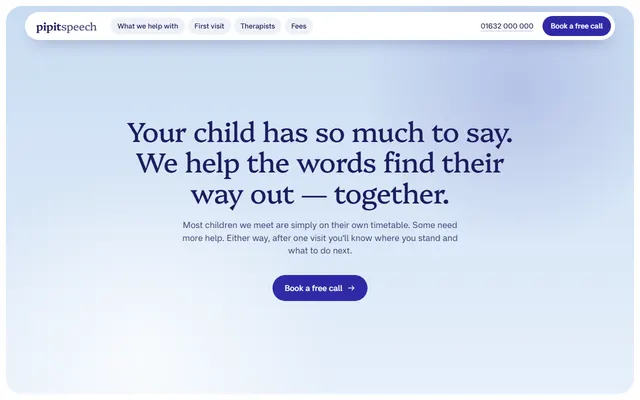
Speech and language therapy practice: five areas of help, a four-step first visit, therapists, fees and a call request form.
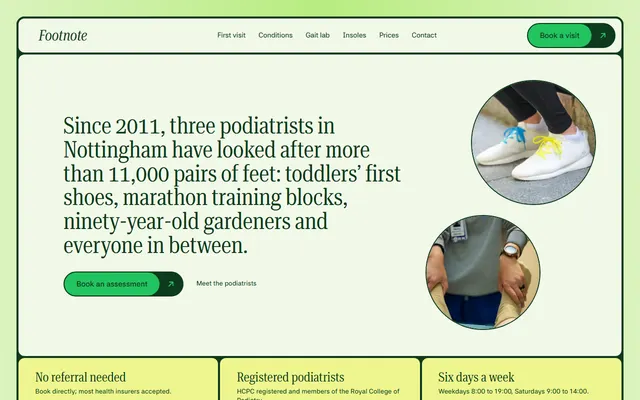
Podiatry clinic: three trust notes, the first visit in four steps, conditions, three podiatrists, a price list and a call-back form.
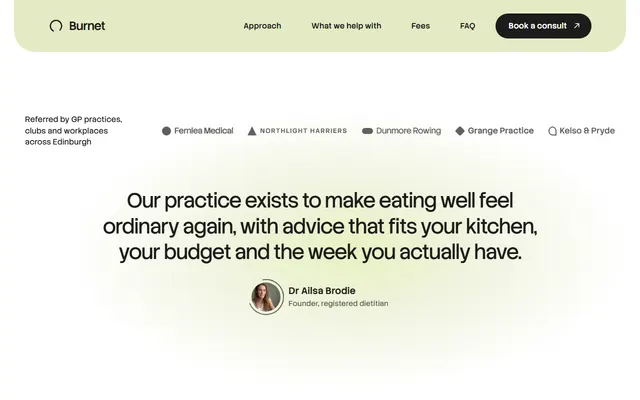
Nutrition or dietetics clinic: a food diary, six areas of help, first visit steps, team, fees and a booking form.
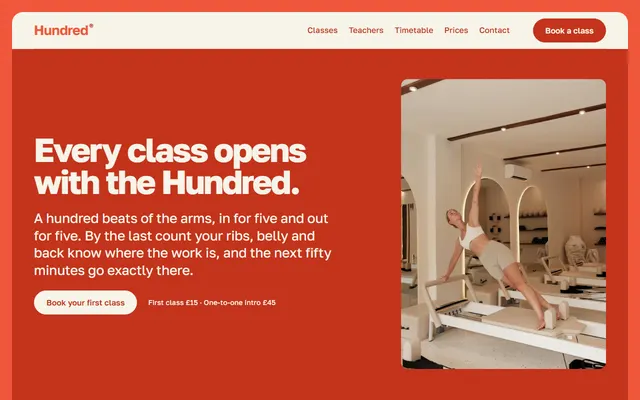
Reformer Pilates studio: class formats, teaching rules, teachers, a weekly timetable, three prices and a booking form.
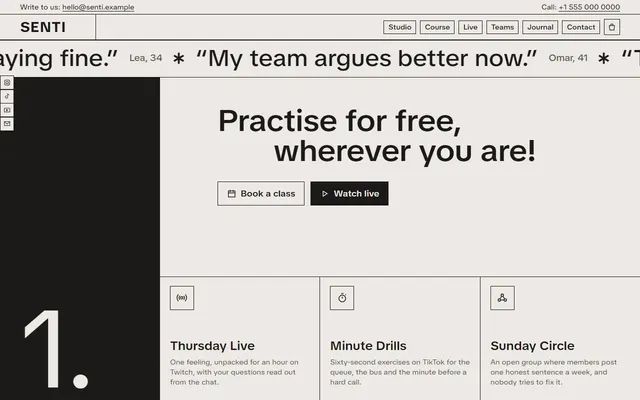
Wellness studio: free ways to practise, a six-week course, a founder letter and team workshops.
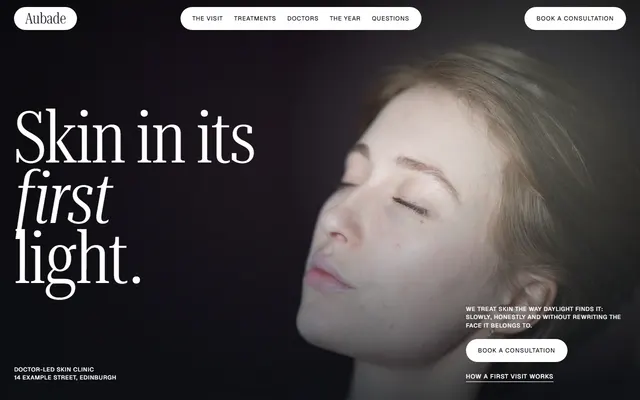
Skin clinic: a first visit plan, treatments with times and prices, doctors, a seasonal plan and a booking form.
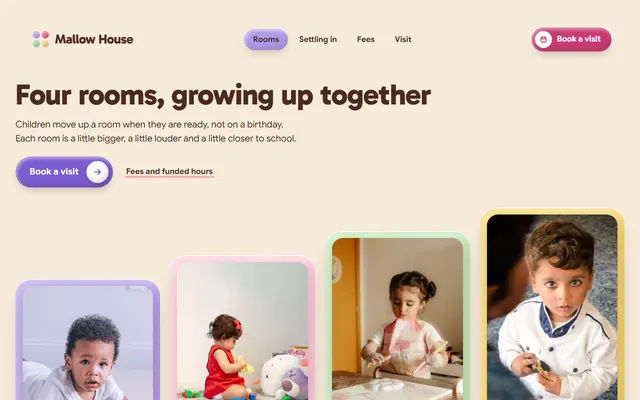
Day nursery: rooms by age, a settling-in plan, parents' questions, fees and an open-morning form.

Dental clinic: same-day crown steps, treatments with prices, team, fees and a visit request form.