What comes with the waste collection website template
- index.html: the pure HTML and CSS version, one single HTML file, 106 KB.
- index.gsap.html: the same design built with GSAP, ScrollTrigger and Lenis, for scroll motion in every browser, Firefox included.
- AGENTS.md: what a coding agent must keep and what to replace, so Claude Code, Codex or Cursor edit it without breaking the scenes.
- DESIGN.md: every colour, font, spacing and motion rule of this waste collection website design.
- PROMPTS.md: the agent prompt and the design prompt below.
- CREDITS.md and LICENSE.md: the photos and fonts with their licenses, and the 8B license.
- Updates to this template, at no extra cost.
Yours to edit: one index.html with no build step, so you or a coding agent can change the words, prices and photos and upload it to any static host. Not a coder? Describe your business in one sentence to 8B's AI website builder and it designs a new site for you, with more pages when you need them. Designing is free; publishing with hosting is $9 a month, billed yearly. It also works inside Claude and ChatGPT.
Premium template · $39, one-time license · Made by 8B, an AI website builder · Updated November 2026 · Plain text: sift.md
About this waste collection website template
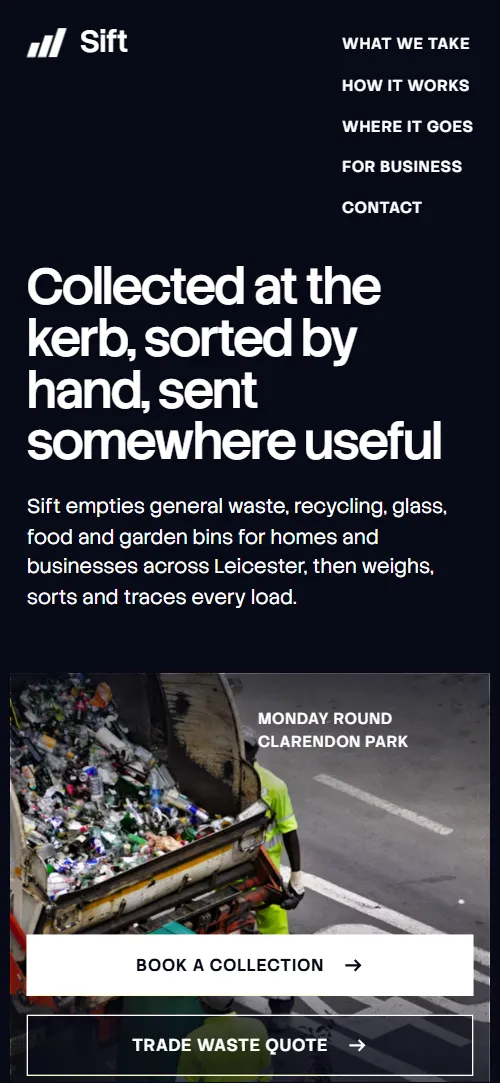
Waste collection website template for a kerbside recycling and waste company: one HTML file with a table of six streams, five steps from booking to the bale, four destinations, trade waste, bulky item prices, three monthly plans, a week of districts with a postcode checker and a collection form. It opens on a navy first screen with a framed photo of a crew loading a lorry, then a hi-vis yellow panel that rises in three columns at three levels and settles flat. It is a single HTML file in pure HTML and CSS, and a GSAP version of the same page comes with it.
At a glance, November 2026. One 106 KB index.html: a single HTML file in pure HTML and CSS with a few lines of built-in JavaScript, 13 sections, 26 Unsplash photos, Stack Sans Headline and Stack Sans Text. A GSAP build of the same page, 97 KB, comes with it.
It suits a household and trade waste collector, a recycling company with a sorting yard, a bulky item and clearance service, or a reuse charity that runs rounds. Waste collection websites mostly need four things on one scroll: what you take and how often, what it costs, which day you are on a street and how to book, and this page gives each its own section. It also gives a collector what a council page rarely does: a published destination for every stream, a monthly weight report and a trade section with paperwork and bin sizes.
The demo business is Sift, an invented collector in Leicester with a sorting yard on Frog Island. Every street, district, postcode, price, bin colour and quote is demo copy to replace. Streams, bin sizes and destinations are plain blocks of text, so a collector in another city or country changes the rules, the currency and the districts without touching the design.
If you would rather not edit HTML at all, 8B, the AI website builder designs a site from one sentence about your business, with more pages when you need them. This template is for people who want this exact design in their own hands: one index.html with its CSS and its motion inside, which you or a coding agent can edit and host anywhere, next to the booking or account system you already use.
Good for:
What a waste collection website needs
Waste and recycling company websites that win customers answer the same questions quickly. Here is how this template covers each of them.
- What you take, and what goes in which bin. A table of six streams with what goes in, how often each is lifted and the bin it uses, and a questions section that lists what can never go in a bin.
- How a collection works. Five steps from booking to the monthly report: bins delivered, out by seven, sorted on the line, weights reported.
- Proof that the waste is recycled. Four destinations, each with a photo and where the stream ends up, and a yard section with its address, drop-off hours and the sorting team.
- Which day is my day. Five weekday rows of districts and postcode areas, with a postcode field above them for your own lookup.
- Trade waste. A trade section with a photo, five things included, four bin sizes by type of business and a quote button.
- Prices without a contract. Three monthly plans with what each includes, and a bulky item list from 18 to 42 pounds.
- An easy way to book. A yellow contact panel with a collection form, phone, email and office hours, and Book buttons that lead to it.
What it does not have is online payment, a customer account or a live round tracker, and the postcode checker answers only in the GSAP version, from the districts on the page, so give it your own list of postcodes and days: link to your booking or account system and the page stays the front door for the company.
Waste collection website design and motion
Palette
#070a16 near-black navy: the page ground and the text on the white and yellow panels#fbef00 hi-vis yellow: the second screen, the postcode checker box, the contact panel, focus rings and the button fills on hover#ffffff text on the dark ground and the white panels for the round, trade, plans and questions#a3a9bc grey-blue for small secondary text on the dark groundFonts
- Stack Sans Headline: the large medium-weight headings and statements
- Stack Sans Text: body text, uppercase labels, table rows, buttons and form fields
A near-black navy page with white and hi-vis yellow panels set inside it by a thin frame, and small uppercase labels that sit on three column lines: the margin, about 60 percent and about 88 percent of the width. The first screen splits the heading and lead from a framed photo band with captions and two buttons; the streams are a table with the name and photo, what goes in and how often; the five steps are photo panels on a white ground; the plans are three rows with a list, a price and a button; the contact is a yellow panel. On phones the table rows stack and the columns follow one another.
The idea behind the page is levels: waste is sorted apart, and the mark is three slanted bars at three levels. So the yellow panel arrives as three columns at different levels that settle flat, photos open in three stepped columns, buttons fill in three stepped bars on hover, and at the end the mark in the contact panel builds itself from three rising bars.
What is on the waste collection website page
- NavigationHeader with the mark and wordmark, a two-line tagline and five section links; on phones, once scrolled, a menu button opens them
While the header is full, the three bars of the mark dip in turn in a slow loop; the header turns into a compact bar once you scroll, hiding on the way down and returning when you scroll up.
- Collected at the kerb, sorted by hand, sent somewhere usefulTwo screens: the heading Collected at the kerb with a framed photo band and two buttons, then a yellow panel with a question, a one-sentence statement and an inset photo of cardboard bales with the mark
On load the heading and lead rise and the photo band opens upward, while its photo drifts sideways in a loop. On scroll the yellow panel comes up in three columns at three levels, the statement lines slide from the right to the margin, the photo band darkens and the mark over the inset photo shrinks into its corner.
- Six streams, kept apart from your kerb to the millA table of six waste streams with a photo, what goes in, how often it is lifted and the bin used
The table arrives with every row out of place and every name lit yellow; four swaps follow one after another, each pair of rows sliding past each other into the other's slot, and each name turns white as its row lands, until the table is sorted.
- From booking to the bale in five stepsFive steps from booking to the monthly report, each with a photo, on a white panel
The white panel holds the screen while the five steps travel sideways as one track, a dark rule fills along the top with the progress, and each step rises from a lower level to its place as it arrives.
- Frog Island, where every round endsThe sorting yard: a wide photo of a lorry tipping card, the yard address and drop-off hours, a quote and a paragraph
The heading rises line by line, the yard photo opens in three stepped columns and moves slowly inside its frame against the scroll.
- Every stream has an addressFour destinations, paper, glass, food and general waste, each with a photo and where the stream ends up
The stage holds while a photo of one mixed load, cut into tiles, parts tile by tile, up and down alternately, to show the four destinations side by side.
- Trade waste for cafés, shops, offices and salonsTrade waste: a photo of bin stores, five things included, four bin sizes and a quote button
The heading rises line by line, the bin store photo opens in three stepped columns and drifts against the scroll.
- Reuse comes before the crusherBulky item collection: two columns of rescued items, a short text, a price list and a booking button
The two columns of furniture photos move in opposite directions past the held text and price list.
- Pay for the lifts, not a contractThree monthly plans in rows, two household and one business, each with a list, a price and a button
The heading rises and each plan row opens in stepped columns as it comes into view.
- Which day are we on your street?A postcode checker and five weekday rows of district names
Each weekday row of district names travels sideways with the scroll, in alternating directions, holding at its place as it crosses the middle of the screen.
- What we can't take, and other questionsSix questions as native details and a batteries note
The heading rises line by line and the batteries note opens in stepped columns.
- Put your street on our roundA yellow panel with the collection form, phone, email, opening hours and the mark built from three bars
The heading rises line by line and the three bars of the large mark rise from below at their own speeds to their three levels, finishing while the mark is still in the lower half of the screen; the form stays still.
- FooterDark footer with the mark, an about line, section links, the yard address and phone, and the company line
Before you publish the waste collection website site
- Replace social preview image, favicon, contact form (sends nothing yet), phone number and email address and the invented demo facts (names, prices, areas, quotes). AGENTS.md lists them.
- Book a collection on the first screen, Ask for a trade quote, Book a bulky collection, the plan buttons and Contact in the menu lead to
#contactnow; point them to your online booking page, or keep #contact once the form is connected. - Trade waste quote on the first screen lead to
#businessnow; point them to keep as it is. - Menu links (What we take, How it works, Where it goes, For business) and the footer links, which add Plans and Questions lead to
#streams, #round, #trace, #business, #plans, #faqnow; point them to keep as they are. - The mark and wordmark in the header and footer, and Back to the top lead to
#openingnow; point them to keep as they are. - Phone and email links in the contact section and the footer lead to
tel:+441160000000 and hello@sift.examplenow; point them to your office number and email, in the link and in the visible text. - Scroll-driven animation runs when the browser supports it (Chrome, Edge and Safari today; Firefox does not yet) and the visitor has not asked for reduced motion. Otherwise each section shows its finished layout; the GSAP build, index.gsap.html, also plays the scroll motion in Firefox.
- In the pure HTML and CSS version the collection form sends nothing and the postcode checker gives no answer, and there is no thank-you line. The GSAP version has a small script for each: the checker names the day from the districts of the five weekday rows, and the form checks the required fields and shows a thank-you line, but it still sends nothing. Connect the form to a form service or your booking system, and give the checker your own postcodes and days.
- The table of streams is built for six rows, the round for five steps, the destinations for four and the week for five days: a different count needs its layout and scene adjusted.
- Streams, bin colours, plans, prices in pounds, districts, postcodes and destinations are for Leicester and the county: replace them with your own area, rules and prices.
Questions about this waste collection website template
What do I get for $39?
The waste collection website template as a single HTML file, index.html, in pure HTML and CSS, a GSAP build of the same page as index.gsap.html, a DESIGN.md with every colour, font and motion rule, an AGENTS.md for coding agents, the agent prompt and the design prompt from this page, and CREDITS.md for the photos and fonts. Updates to this template are included.
Can I use this waste collection template for client sites?
Yes. One purchase lets you build as many sites as you like with it, for your own company or for clients, and change anything. What it does not allow is selling or giving away the template itself, as a template, theme or kit, or putting its source in a public repository.
How do I change the waste streams, plans and prices?
Each stream is one row with a name, a photo, what goes in, how often it is lifted and which bin it uses; plans and bulky prices are plain lines of text. With Claude Code, Codex or Cursor you say it in a sentence, such as replace garden waste with textiles and set the weekly plan at 28 dollars, and the agent edits the rows; by hand you change the words. The streams table is built for six rows, so a different number needs its layout adjusted, and the agent can do that too. If you want a site with more pages that you edit without code, 8B's AI website builder makes one from a sentence about your business.
Does the postcode checker or the collection form work?
Not on their own. The form asks for name, email or phone, postcode, what you need and a message, and it sends nothing until you connect a form service such as Formspree or Netlify Forms, or your booking system. In the pure HTML and CSS version the checker gives no answer and the form shows no thank-you line. The GSAP version has a small script for each: the checker reads the postcode districts on the five weekday rows and names the collection day, and the form checks name, contact and postcode and shows a thank-you line, still without sending anything. With either file, a coding agent can wire the form and give the checker your own list of postcodes and days.
Will it work with Claude Code, Codex or Cursor?
Yes. Put index.html and AGENTS.md in your project and give the agent the prompt that comes with the template. AGENTS.md says which attributes the scroll motion reads, what to keep and what to replace, so the agent swaps streams, prices, districts and photos without breaking the scenes.
What do visitors see in Firefox or with reduced motion?
Firefox does not support scroll-driven animations yet, so it shows every section in its finished layout, as does any browser when the visitor asks for reduced motion. If the scroll motion must also play in Firefox, use the GSAP build, index.gsap.html, which loads GSAP, ScrollTrigger, SplitText and Lenis from a CDN.
More templates for local services and the home
Other designs for businesses that work by the job, the area and the season.
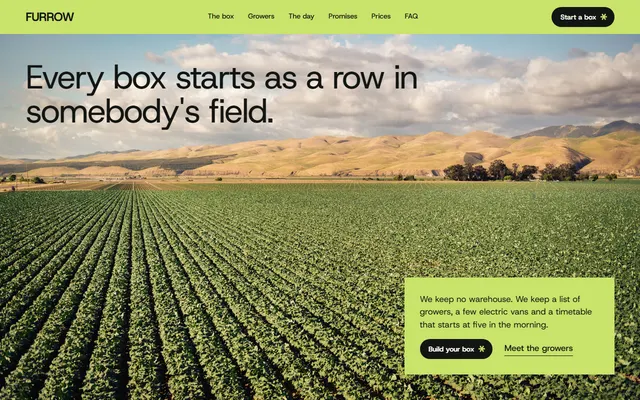
Veg box scheme: this week's vegetables, one delivery day, returnable crates and a box builder.
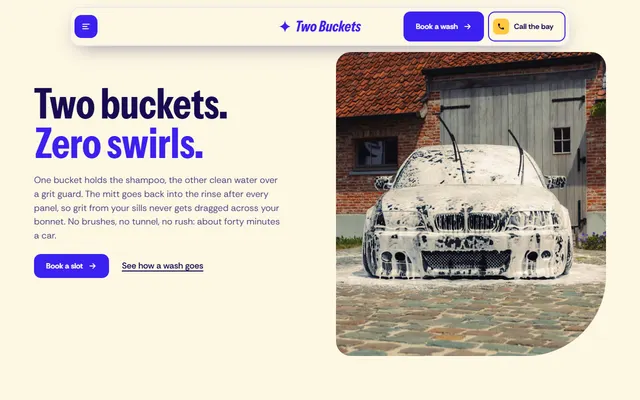
Hand car wash: a five-step method, a price board by vehicle size and a booking form.

Skin clinic: a first visit plan, treatments with times and prices, doctors, a seasonal plan and a booking form.
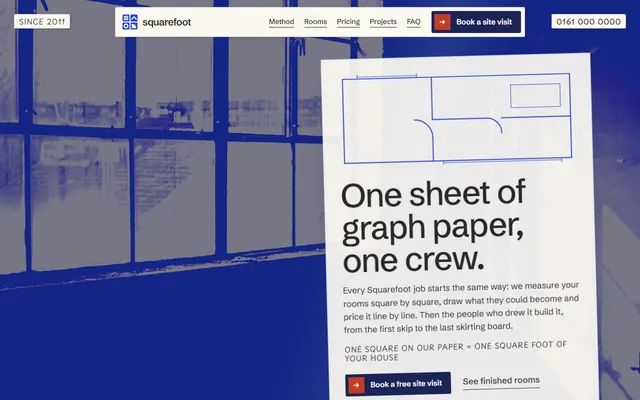
Home renovation: a four-stage method, services as rooms of a plan and prices per square foot.
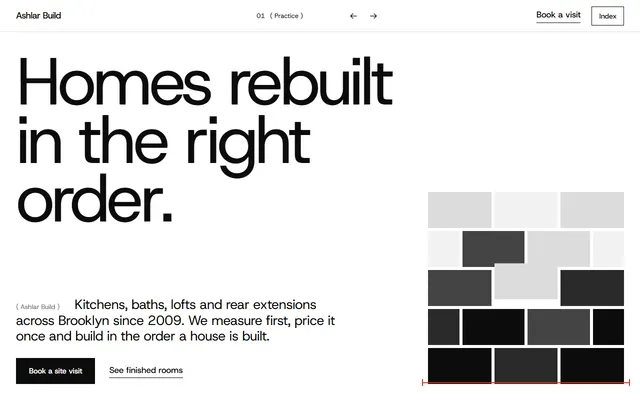
Builder: services with prices, finished work, crew, reviews and a site-visit form.
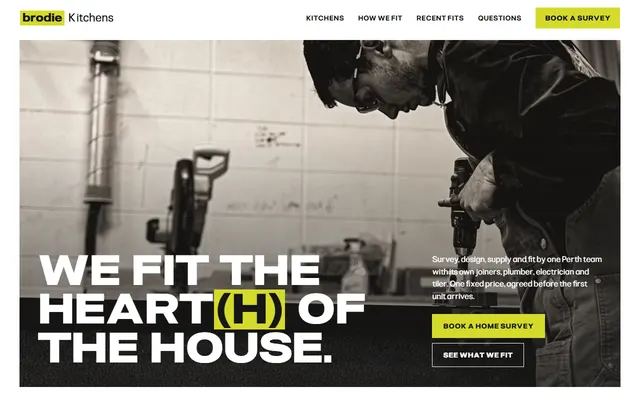
Kitchen company: five kinds of job, in-house trades, a five-step fit, recent fits and a survey form.
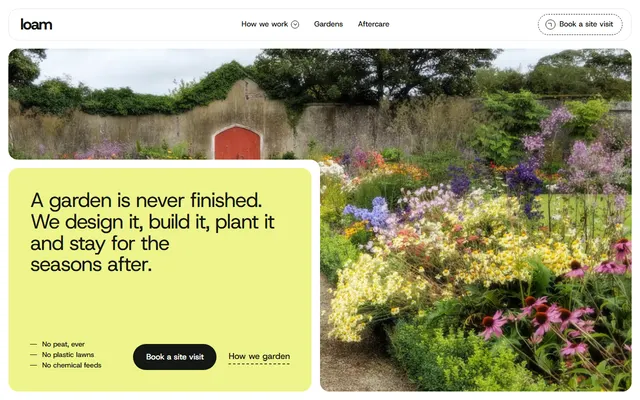
Landscape gardening: a process, finished gardens, local materials and seasons of aftercare.
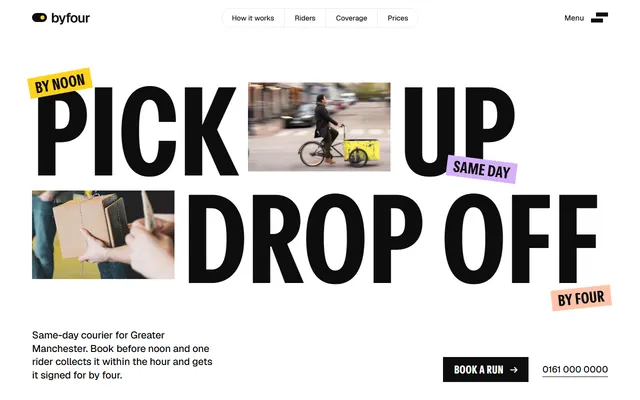
Courier or same-day delivery service: run steps, parcel prices, riders, a coverage map and a booking form.