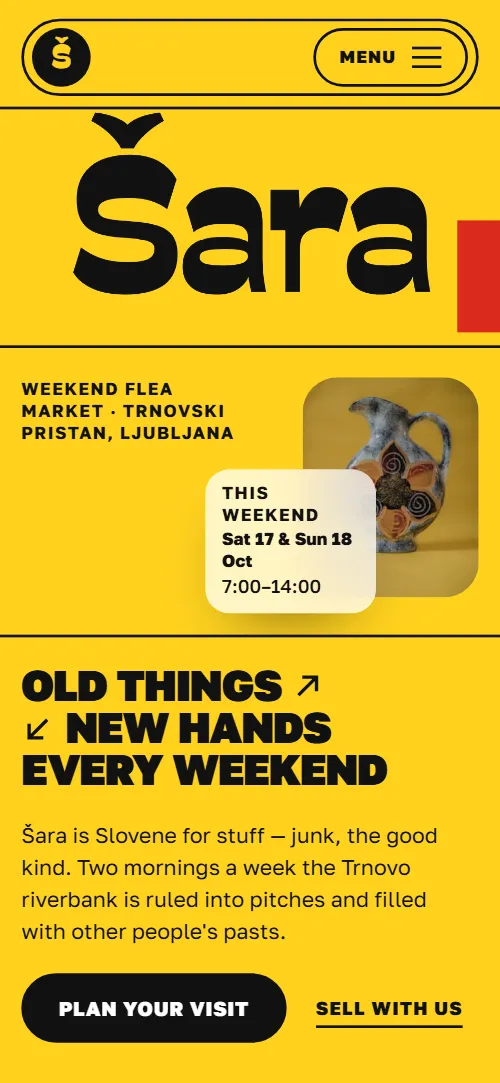
What comes with the flea market website template
- index.html: the pure HTML and CSS version, one single HTML file, 127 KB.
- index.gsap.html: the same design built with GSAP, ScrollTrigger and Lenis, for scroll motion in every browser, Firefox included.
- AGENTS.md: what a coding agent must keep and what to replace, so Claude Code, Codex or Cursor edit it without breaking the scenes.
- DESIGN.md: every colour, font, spacing and motion rule of this flea market website design.
- PROMPTS.md: the agent prompt and the design prompt below.
- CREDITS.md and LICENSE.md: the photos and fonts with their licenses, and the 8B license.
- Updates to this template, at no extra cost.
Yours to edit: one index.html with no build step, so you or a coding agent can change the words, prices and photos and upload it to any static host. Not a coder? Describe your business in one sentence to 8B's AI website builder and it designs a new site for you, with more pages when you need them. Designing is free; publishing with hosting is $9 a month, billed yearly. It also works inside Claude and ChatGPT.
Premium template · $39, one-time license · Made by 8B, an AI website builder · Updated November 2026 · Plain text: sara.md
About this flea market website template
Flea market website template for a weekend market, a car boot sale or a fair with traders who rent pitches: one HTML file with the four corners of the market, a find of the week, nine finds under a category, era and price filter bar, the weekend hour by hour, regular traders, pitch sizes with prices, haggling rules, questions and a contact form. It opens on a yellow field cut by black rules, with a swollen wordmark that breathes while a board of booked and free pitches slides over it. It is a single HTML file in pure HTML and CSS, and a GSAP version of the same page comes with it.
At a glance, November 2026. One 127 KB index.html: a single HTML file in pure HTML and CSS with a few lines of built-in JavaScript, 12 sections, 30 Unsplash photos, Golos Text and Savate. A GSAP build of the same page, 112 KB, comes with it.
It suits a weekend flea market, a vintage or antiques fair, a farmers or craft market, a swap meet or any recurring street market that wants a site with a face. Flea market websites mostly answer four questions on one scroll: when and where it is, what you will find there, what a trader pays for a pitch, and how it works on the day. This page gives each its own section, and a flea market website built from it also gets the things that make a market feel like a place: regulars with their pitch numbers, house rules for haggling and the rain plan.
The demo market is Šara, an invented flea market on a riverbank in Ljubljana run by a traders' cooperative. Every pitch number, trader, price, hour and address is demo copy to replace. Prices are in euros and the weekend runs seven to two, March to December; change the currency, the hours, the corners and the rules to your own city, market days and local habits, such as cash only or a rain venue.
If you would rather not edit HTML at all, 8B, the AI website builder designs a site from one sentence about your market, with more pages when you need them. This template is for people who want this exact design in their own hands: one index.html with its CSS and its motion inside, which you or a coding agent can edit and host anywhere, next to the booking tool or the social page you already use.
Good for:
What a flea market website needs
Visitors and traders ask a flea market the same questions before they set out. Here is how this template answers each of them.
- When and where it is. The first screen carries the market's place, this weekend's date and the hours, and the visit section adds the address, the weekdays and months, how to get there and a directions button.
- What you will find. Four corners of the market with their pitch ranges, a find of the week with its lot, condition and price, and nine finds with pitch number, decade and price.
- A way to narrow it down. A filter bar by category, era and maximum price over the nine finds; in the GSAP version it hides what does not match and updates the count, with a message when nothing matches.
- How the day runs. Six hours from 6:00 to 14:00, from chalking the pitches to the free box, each with a line about what happens.
- Pitch sizes and prices. Three pitch sizes drawn to scale with a price per day, the booking deadline and when the free pitches open.
- The people behind it. A ledger of four regular traders, each with wares, a note and a pitch number, and a line about the cooperative in the footer.
- The practical questions. Six answers about cash, rain, selling without booking, dogs, clearing a household and parking, plus haggling rules in five lines.
What it does not have is a live calendar, online pitch payment, a map of the pitches or a shop: the form sends nothing until you connect it, and the finds are a display. The honest way around it is to link the Book a pitch button to your booking tool and the finds to a social page or a listing.
Flea market website design and motion
Palette
#ffd21f yellow: the page ground and the free pitches#121212 ink: text, the heavy rules and the black cells#1c4fd6 blue: booked blocks, the blue cell of the opening and the pitch blueprint#d92a1c red: booked blocks, the block that rides the right edge, the block that crosses the hours and the hour it passes#ffffff white: heading cells, cards and the blueprint lines#e4e7ec light grey: the ground around the find sheet, the ground under the grey city photo and empty photo windowsFonts
- Savate: the swollen heavy display type: the wordmark and every section heading
- Golos Text: body text, labels, the capital headline lines, navigation, buttons and form fields
A saturated yellow field cut into cells by heavy black rules, like a lattice of pitches. Blue, red and white blocks fill some cells and slide in from beyond the frame; every photo sits in a rounded window set into a cell, some with a frosted label. The opening is a 2 by 2 board with the wordmark, a blue cell and the headline, followed by a six-column board of pitches; the square is four coloured cells; the finds are a ruled lattice of nine windows with spans that fill it exactly; the hours are a row of six cells; the pitches are a blue blueprint beside a price list; the visit is a rounded card over a grey city photo. On phones the cells stack and the wordmark sits first under the header.
The idea behind the page is that the river gets a grid: every weekend the traders chalk their pitches on the embankment and fill each rectangle with other people's things. So the rules draw in, colour blocks are booked in and overshoot their pitch, photo windows open from a pill, and the big wordmark lies under the pitches like the empty field before the market fills it.
What is on the flea market website page
- NavigationHeader with a round Š seal, five links, Rent a pitch and a menu button that opens a popover
The header hides when you scroll down past the top of the page and comes back when you scroll up; the menu button opens a popover with the links.
- Old things new hands every weekendTwo screens: a yellow field cut by black rules with the Šara wordmark, the line Old things, new hands, every weekend, then a board of booked and free pitches with market photos
On load the black rules draw and the wordmark rises into place, the jug window opens from a pill, the headline band lifts, the blue and red blocks slide in from the edges and the date label rises last. Then the wordmark keeps breathing between a lighter and a heavy weight and the red block rides up and down the right edge, both pausing when the section is off screen. On scroll the wordmark is held and grows while the headline band and then the board of pitches slide over it, the board's red and blue blocks are booked in from beyond its edges, its windows open, and in the end the letters show only through the free yellow pitches.
- Four corners, four habitsFour corners of the market on a board whose rules move so each corner takes the big cell in turn
The four corners sit on one board whose rules slide as you scroll: records and paper hold the big cell first, then chairs and lamps, then coats and linen, then glass and clay, while the other three shrink to their names. On phones the cells stack and the horizontal rules move instead, giving the big cell to each corner in list order.
- Two cameras from one drawerThe find of the week: two cameras for 64 euros on a three-panel sheet with era chips, lot, condition, seller and a reserve button
The three panels of the find sheet stand folded like a screen and swing flat one after another as you scroll, with the grey ground showing behind; on phones they turn down from their top edges. The blocks at the corners of the sheet and the coloured band are booked in.
- Search the tablesA category, era and price filter bar with a count over nine finds in a ruled lattice; the filter works in the GSAP version
A calm section: the heading swells as it arrives and the photo windows open from a pill. In the GSAP version the filter changes the lattice and the count at once.
- The weekend, hour by hourSix hours from 6:00 to 14:00 on a sideways track crossed by a red block
The heading swells, then the row of six hours runs sideways while a red block crosses the top rule from left to right, and the time of the hour under the block turns red.
- The regularsA ledger of four regular traders with portrait, wares, note and pitch number
The ledger lines draw across, the round portrait windows open and the heading swells.
- A pitch of your ownA blue blueprint of three pitch sizes drawn to scale beside a price list from 12 euros a day
The heading swells, the smallest pitch grows from its corner, then the medium pitch grows out of it and the large one out of the medium, each size label rising in as its pitch lands.
- How to haggle at ŠaraFive haggling rules as giant capital lines with turning arrows
The five capital lines drift in alternating directions and meet aligned in the middle of the screen, while the arrows in them turn half a circle into place as the line aligns and half a circle on as it leaves.
- Questions at the gateSix questions about cash, rain, selling without booking, dogs, clearances and parking in ruled rows
A calm section: the heading swells and the rules between the questions draw in.
- Find us by the riverA visit card over a grey city photo with a river window, address, hours, transport, phone, email and a contact form
The grey city photo starts zoomed in and settles, the card rises into place over it, the colour window opens from a narrow pill to its full shape and the round Directions seal turns and grows onto the seam; the heading swells.
- FooterFooter of coloured cells with the market's name, a short line about the cooperative, links, opening hours and the legal line
The blue fill slides into its cell from the left and the yellow fill from below, like pitches being booked.
Before you publish the flea market website site
- Replace social preview image, favicon, contact form (sends nothing yet), map, phone number, email address and social media links and the invented demo facts (names, prices, areas, quotes). AGENTS.md lists them.
- Plan your visit, Reserve the pair and Book a pitch buttons lead to
#visit, the contact sectionnow; point them to keep them once the form is connected, or point Book a pitch to your booking page. - Sell with us, Free pitch chip, Rent a pitch in the header, Trader rules in the footer lead to
#pitchnow; point them to keep as it is. - Menu links: The square, Finds, Hours, Haggling, Visit lead to
#square, #finds, #hours, #haggle, #visitnow; point them to keep as they are. - Round Š logo in the header lead to
#opening, the top of the pagenow; point them to keep as it is. - Walk the square seal on the opening board lead to
#squarenow; point them to keep as it is. - Lost and found link in the footer lead to
#faqnow; point them to your lost and found page, or keep the questions. - Directions button in the visit card lead to
a Google Maps search for the demo addressnow; point them to a map link to your own market. - Instagram link in the footer lead to
Instagram's home pagenow; point them to your own profile, or remove it. - Press link in the footer lead to
a mailto addressnow; point them to your press email, or remove the link. - Scroll-driven animation runs when the browser supports it (Chrome, Edge and Safari today, from Safari 26.2; Firefox does not yet) and the visitor has not asked for reduced motion. Otherwise each section shows its finished layout; the GSAP build, index.gsap.html, also plays the scroll motion in Firefox.
- The contact form sends nothing: connect it to a form service or your email. Its thank-you line appears only in the GSAP version, after a valid submit.
- The category, era and price filter over the finds works only in the GSAP version, which carries a small script for it; in the pure HTML and CSS version the bar is shown but all nine finds stay on the table. It suits a market that shows a handful of picks a week; a script of a few lines, or the GSAP version, makes the filter live.
- It is one page: Lost and found, the Instagram and Press links and the map button lead to places the template does not contain. Replace them with your own.
- The finds lattice is built for nine items, the square for four corners, the hours track for six hours, the pitch blueprint for three sizes and the haggling scene for five lines: a different count needs its layout and scene adjusted.
Questions about this flea market website template
What do I get for $39?
The flea market website template as a single HTML file, index.html, in pure HTML and CSS, a GSAP build of the same page as index.gsap.html, a DESIGN.md with every colour, font and motion rule, an AGENTS.md for coding agents, the agent prompt and the design prompt from this page, and CREDITS.md for the photos and fonts. Updates to this template are included.
Can I use this flea market template for client sites?
Yes. One purchase lets you build as many sites as you like with it, for your own market or for clients, and change anything. What it does not allow is selling or giving away the template itself, as a template, theme or kit, or putting its source in a public repository.
How do traders book a pitch?
The pitch section shows three sizes drawn to scale with a price per day, the booking deadline and how to pay, and its button leads to the contact form, where the topic list starts with Book a pitch. The form sends nothing until you connect a form service such as Formspree or Netlify Forms, or your email. There is no live calendar or payment: if you want traders to pick a date and pay online, link the Book a pitch button to your booking tool and keep this page as the market's front door.
How do I change the finds and the hours?
Each find is one block of HTML with a photo, a pitch number, a decade, a category and a price. In the GSAP version a small script reads those values, so a new find shows up in the filter without any extra code; in the pure HTML and CSS version the filter bar is shown but does not hide finds, which suits a short weekly list, and a coding agent can add the same few lines of script to it. With Claude Code, Codex or Cursor you say it in a sentence, such as swap the telephone for a brass lamp at 35 euros, and the agent edits the block; by hand you copy a block and change the words. The hours are six cells in the same way, with a start time, a name, a line and a photo.
Will it work with Claude Code, Codex or Cursor?
Yes. Put index.html and AGENTS.md in your project and give the agent the prompt that comes with the template. AGENTS.md says which attributes the scroll motion reads, what to keep and what to replace, so the agent swaps the corners, finds, hours and prices without breaking the scenes.
What do visitors see in Firefox or with reduced motion?
Firefox does not support scroll-driven animations yet, so it shows every section in its finished layout, as does any browser when the visitor asks for reduced motion. If the scroll motion must also play in Firefox, use the GSAP build, index.gsap.html, which loads GSAP, ScrollTrigger and Lenis from a CDN.
More templates for events, shops and venues
Other designs for markets, shops and places people visit.

Two-day festival: lineup, a battle, zones, a food board and passes.
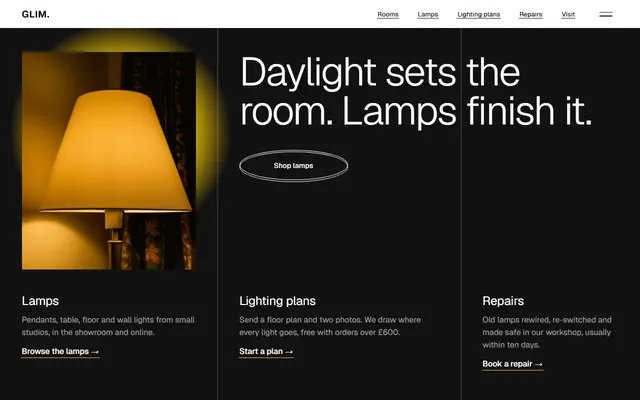
Lamp shop and showroom: rooms on a sideways track, lamp types, repairs and a contact form.
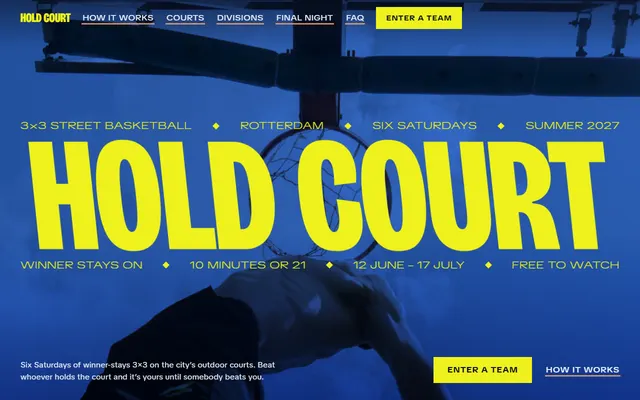
Basketball tournament: winner-stays rules, courts, divisions with fees, a final night and an entry form.
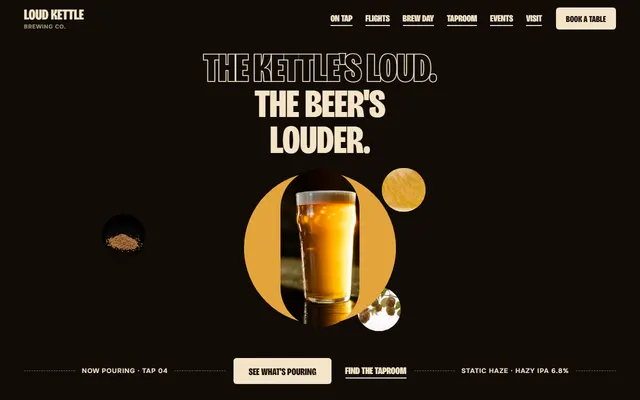
Craft brewery taproom: a tap list, events and a booking form.
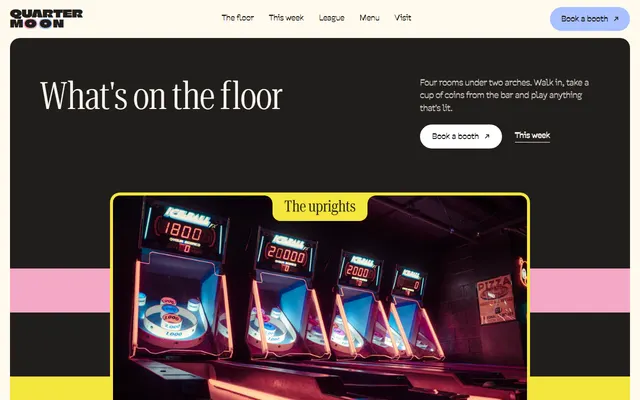
Arcade bar: events, a league board, prices and a booking form.
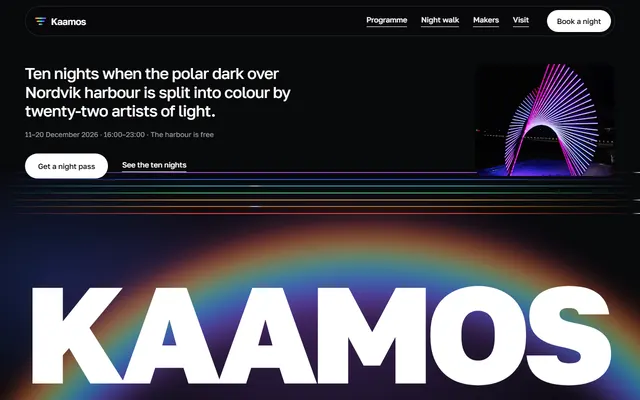
Light festival: ten nights programme, night walk route, makers, passes and an office form.
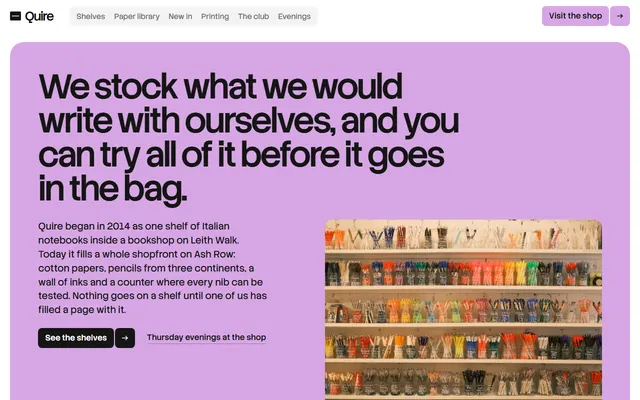
Independent stationer: shelves, a paper guide and an opening statement.

Literary festival: five-day programme, featured writers, prize shortlist, venues and passes.