What comes with the vacation rental website template
- index.html: the pure HTML and CSS version, one single HTML file, 97 KB.
- index.gsap.html: the same design built with GSAP, ScrollTrigger and Lenis, for scroll motion in every browser, Firefox included.
- AGENTS.md: what a coding agent must keep and what to replace, so Claude Code, Codex or Cursor edit it without breaking the scenes.
- DESIGN.md: every colour, font, spacing and motion rule of this vacation rental website design.
- PROMPTS.md: the agent prompt and the design prompt below.
- CREDITS.md and LICENSE.md: the photos and fonts with their licenses, and the 8B license.
- Updates to this template, at no extra cost.
Yours to edit: one index.html with no build step, so you or a coding agent can change the words, prices and photos and upload it to any static host. Not a coder? Describe your business in one sentence to 8B's AI website builder and it designs a new site for you, with more pages when you need them. Designing is free; publishing with hosting is $9 a month, billed yearly. It also works inside Claude and ChatGPT.
Premium template · $39, one-time license · Made by 8B, an AI website builder · Updated November 2026 · Plain text: altana.md
About this vacation rental website template
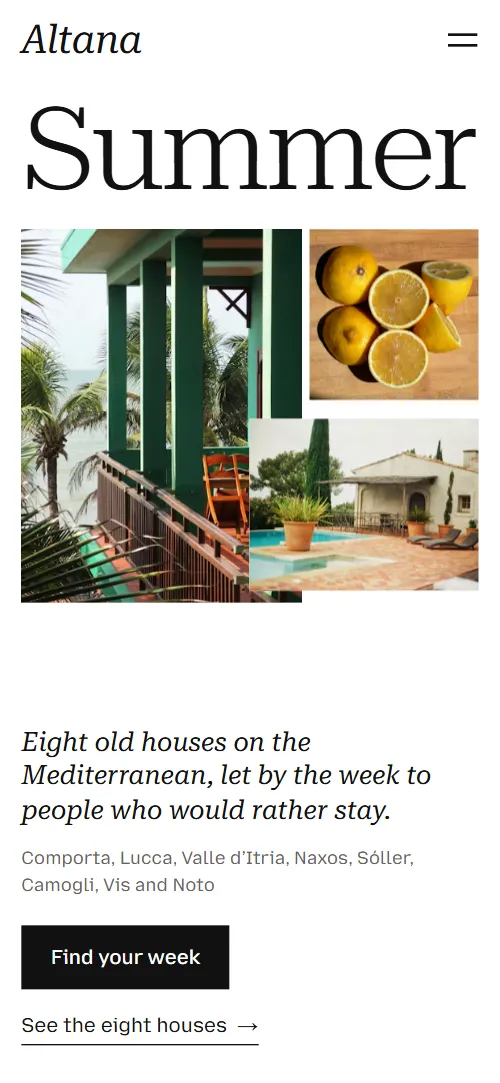
Vacation rental website template for a company that lets a few houses by the week: one HTML file with an index of eight houses with sleeps, bedrooms and weekly prices, a Saturday to Saturday timetable, a roof terrace where night falls on the page, four local keepers, four seasons with prices, a FAQ, guests' house-book entries and an enquiry form. It opens on a giant word, Summer, with three photo frames that travel and roll into a second screen, Kept. It is a single HTML file in pure HTML and CSS, and a GSAP version of the same page comes with it.
At a glance, November 2026. One 97 KB index.html: a single HTML file in pure HTML and CSS with a few lines of built-in JavaScript, 12 sections, 28 Unsplash photos, Mozilla Text, Playwrite US Modern and Roboto Serif. A GSAP build of the same page, 91 KB, comes with it.
It suits a villa or holiday home rental company, an owner of a few self-catering houses, a boutique rental brand with local hosts and a rural, coastal or island portfolio let by the week. Vacation rental websites mostly need four things on one scroll: the houses with sleeps, bedrooms and price, what a stay is like, the seasons with what each costs, and a way to ask for a week. This page gives each its own section, and a holiday rental website built from it also gets what makes a small company different from a listings site: the keeper who lives down the lane, the roof terrace with a bed and the guests' own words from the house books.
The demo business is Altana, an invented company with eight old houses in Portugal, Italy, Greece, Spain and Croatia. Every house, place, price, keeper, quote and term is demo copy to replace. The houses show sleeps, bedrooms, a weekly price in pounds and one line, so an owner anywhere fills in its own houses and currency; the seasons, the Saturday to Saturday rule, the deposit and the cancellation answers are written as examples of the terms a rental states up front.
If you would rather not edit HTML at all, 8B, the AI website builder designs a site from one sentence about your business, with more pages when you need them. This template is for people who want this exact design in their own hands: one index.html with its CSS and its motion inside, which you or a coding agent can edit and host anywhere, next to the booking tool or calendar you already use.
Good for:
What a vacation rental website needs
Vacation rental websites that turn visitors into enquiries answer the same questions quickly. Here is how this template covers each of them.
- The houses up front. An index of eight houses with a photo, place, sleeps, bedrooms, a weekly price and one line each, right after the first two screens.
- What a stay is like. A Saturday to Saturday timetable of seven days, a roof terrace section and the keeper who hands over the key and cooks the first night.
- Who looks after the house. Four keepers as portrait strips, each with the house they keep and one line about them.
- What is in the house. One running sentence of thirteen things in every house, from linen and bicycles to a torch for the roof stairs.
- Prices by season. Four panels, June, August (for July and August), September and October, each with a photo, a line about the month and its terms in pounds.
- Terms before the enquiry. Six questions on weeks, what the price includes, cars, children and dogs, payment and cancelling, in native details elements.
- Proof from past guests. Five handwritten entries from the house books with the guest, the house and the month, and an enquiry form for the house and the Saturday.
What it does not have is an availability calendar, a page per house, a channel manager or online payment: it is built for a rental company with a handful of houses that answers enquiries by hand, and the Ask about links can point to the booking tool you already use.
Vacation rental website design and motion
Palette
#ffffff page ground#121212 ink: text, buttons and the footer ground#67625c warm grey: meta lines, places and small print#ececea quiet fill behind photos while they load#1d5bc7 sea blue: the accent of Casa Lume and Spiti Lefko and the button hover fill#b8432f terracotta: the accent of Ca'n Rosa and Casa Corallo and the slashes between the things in every house#8a6512 ochre: the accent of Trullo Sole and Casa Noto#2b6b45 pine: the accent of Villa Pini and Kuća Bor#0b1428 night: the ground that floods the roof stage#eef0f5 text on the night ground#9aa3b8 secondary text on the night ground and the footerFonts
- Roboto Serif: the giant house names, the section headings and the italic decks, with width and weight that animate
- Mozilla Text: body text, meta lines, navigation, buttons and form fields
- Playwrite US Modern: the handwritten entries from the house books
A white page with ink text, grey meta lines and one accent colour per house. Section headings are large light serif words with a short italic line beside them. The houses are an index of rows: a photo, a giant name, the place in the house's accent, a small list of sleeps, bedrooms and weekly price, one line and an Ask about link. The week is a two-column timetable of seven days with three photos, the keepers are four tall portrait strips above their notes, the kit is one running sentence of thirteen things in large type, and the seasons are four wide panels in a row. The roof section is a held stage where a night-blue ground floods in, and the footer is ink with light text. On phones the houses keep the photo beside the text, the seasons panels take 84% of the screen width and the keepers' notes stack below the strips.
The idea behind the page is that the page re-typesets itself. A composition of one giant word and three photo frames becomes the next composition as you scroll: frames travel and change shape, words widen and narrow, and photos roll inside their frames. The house at the middle of the screen widens and takes its colour, and the roof turns the whole page to night.
What is on the vacation rental website page
- NavigationHeader with the italic wordmark, five links and Find your week, behind a Menu button below 1024 px; after the first 120 px it hides on the way down and returns on the way up
The header hides when you scroll down past the first 120 pixels and returns when you scroll up, in every browser; below 1024 px wide the links open from a Menu button.
- SummerTwo screens: the giant word Summer with a deck, places and two actions, then Kept with the keeper idea, with three photo frames that travel between the two
On load the three photo frames open from a small clip and rise, the word Summer rises, and Summer slowly widens and narrows while the tall photo drifts sideways in its frame. As the second screen scrolls in, the three frames leave their places on a sticky stage and travel, changing shape, into the composition of Kept, while inside each frame the summer photo rolls away and the second screen's photo rises into it. Summer narrows as it leaves and Kept settles from a wide cut into its own width.
- Eight housesAn index of eight houses, each with a photo, name, place, sleeps, bedrooms, weekly price, one line and an Ask about link
The house at the middle of the screen widens and gains weight, takes its accent colour, and its photo grows to full size and comes into colour; the houses above and below stay narrow, light and grey.
- Saturday to SaturdaySaturday to Saturday: seven days in two columns with three photos and a held heading
The heading re-sets from a wide cut into its rest cut with a short rise, the photos roll up into their frames from the bottom edge, and on wide screens the heading stays in view beside the days.
- A bed on the roofA held stage about two and a half screens long: the roof terrace with three moments of the evening, and night that floods the page
The stage holds for about two and a half screens: the night-blue ground rises from the bottom while the photo frame grows to full size and rolls from the day roof to the night sky, and the text turns light as the night passes it.
- The keepersFour keepers as tall portrait strips with their houses and one line each
Each of the four keepers in turn gets the wide strip, with the portrait sliding to stay centred, and the rule above the name draws out in the keeper's colour; on wide screens the stage holds while this runs.
- In every houseIn every house: thirteen things set as one running list in large type, with a short note
The heading re-sets from a wide cut into its rest cut with a short rise.
- When to comeFour seasons (June, August for July and August, September, October) as wide panels walked sideways, each with a photo, a line and its terms
A held screen carries the four panels sideways, and the season words travel against their photos at their own speed.
- QuestionsSix questions as native details elements: weeks, what the price includes, cars, children and dogs, payment, cancelling
The heading re-sets from a wide cut into its rest cut; the six answers open and close as native details elements.
- From the house booksFive handwritten entries from the house books with guest, house and month
Entries away from the middle of the screen lean and drift sideways, as if pinned in by hand, and straighten as they reach the middle; on phones the lean is half as large.
- Ask for a weekEnquiry form for house, Saturday, weeks, name, email and a note, beside the phone, email, hours and a terrace photo
The heading re-sets into its rest cut and the terrace photo rolls up into its frame.
- AltanaFooter with the wordmark, one line, three links, email and enquiry links, the company address and small print
The wordmark re-sets from a wide cut into its rest cut as the footer comes into view.
Before you publish the vacation rental website site
- Replace social preview image, favicon, phone number, email address and contact form (sends nothing yet) and the invented demo facts (names, prices, areas, quotes). AGENTS.md lists them.
- The Altana wordmark in the header lead to
#openingnow; point them to keep. - Find your week in the menu, Find your week in the opening and Ask about <house> on each of the eight houses, Ask for a week and Send the enquiry lead to
#enquire (the form sends nothing)now; point them to keep them once the enquiry form is connected, or point them to your booking calendar. - See the eight houses, Meet the keepers and the menu links Houses, The week, The roof, Keepers, Seasons lead to
#houses, #keepers, #week, #roof, #seasons on the same pagenow; point them to keep. - Footer links Houses, Seasons, Questions lead to
#houses, #seasons and #faqnow; point them to keep. - Write to us, the email in the contact block and the phone number lead to
mailto: and tel: links with example addressesnow; point them to your own email and phone number. - Scroll-driven animation runs when the browser supports it (Chrome, Edge and Safari 26.2 and later; Firefox does not yet) and the visitor has not asked for reduced motion. Otherwise each section shows its finished layout; the GSAP build, index.gsap.html, also plays the scroll motion in Firefox.
- The enquiry form sends nothing: connect it to a form service, your booking system or your email. The pure HTML and CSS version shows no thank-you line after sending; the GSAP version shows one but still sends nothing. The date field is a plain date input, not an availability calendar.
- It is one page: every link goes to a section of the page, and there are no pages per house, no availability calendar and no online payment.
- The opening is built for exactly three photo frames and the keepers list is marked fixed at four: a different count there needs its layout and scene adjusted. Houses, seasons and house-book entries can be added or removed, but the heading Eight houses, the list of places in the opening and the options of the form's house list name the houses and must follow.
- Weekly prices are in pounds and the FAQ states a 30% deposit and a twelve-week cancellation rule: replace them with your own currency and terms.
Questions about this vacation rental website template
What do I get for $39?
The vacation rental website template as a single HTML file, index.html, in pure HTML and CSS, a GSAP build of the same page as index.gsap.html, a DESIGN.md with every colour, font and motion rule, an AGENTS.md for coding agents, the agent prompt and the design prompt from this page, and CREDITS.md for the photos and fonts. Updates to this template are included.
Can I use this vacation rental template for client sites?
Yes. One purchase lets you build as many sites as you like with it, for your own rental business or for clients, and change anything. What it does not allow is selling or giving away the template itself, as a template, theme or kit, or putting its source in a public repository.
How do I add, change or remove a house?
Each house is one row of HTML with a photo, a name, a place, sleeps, bedrooms, a weekly price, one line and an Ask about link, and it appears again as an option in the form's house list. With Claude Code, Codex or Cursor you say it in a sentence, such as add the Lisbon flat that sleeps four from 1,500 a week and remove Casa Noto, and the agent edits the row and the list; by hand you copy a row and change the words. Each row runs its own scroll effect, so the index works with any number of houses; the heading Eight houses and the list of places in the opening name the count and change with it. The keepers list is fixed at four. There is no availability calendar, per-house page or online payment: if you take bookings through a channel manager or your own booking tool, point the Ask about links at it and keep this page as the front door.
Does the enquiry form send requests?
Not yet. The form asks for a house, an arrival Saturday, the number of weeks, a name, an email and a note, but it sends nothing until you connect a form service such as Formspree or Netlify Forms, or your booking system. The pure HTML and CSS version shows no thank-you line after sending, so point the form at a thank-you page or add one; the GSAP version shows a thank-you line but sends nothing either. The date field is a plain date input: it does not know which weeks are taken.
Will it work with Claude Code, Codex or Cursor?
Yes. Put index.html and AGENTS.md in your project and give the agent the prompt that comes with the template. AGENTS.md says which attributes the scroll motion reads, what to keep and what to replace, so the agent swaps houses, prices, seasons and photos without breaking the scenes.
What do visitors see in Firefox or with reduced motion?
Firefox does not support scroll-driven animations yet, so it shows every section in its finished layout, as does any browser when the visitor asks for reduced motion. If the scroll motion must also play in Firefox, use the GSAP build, index.gsap.html, which loads GSAP, ScrollTrigger and Lenis from a CDN.
More templates for hotels, travel and stays
Other designs for businesses around places to stay and trips.
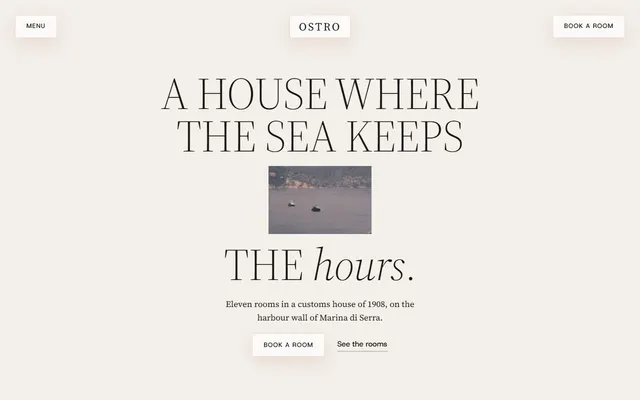
Hotel in an old harbour building: rooms with sizes and prices, an hour-by-hour day, outings and an enquiry form.
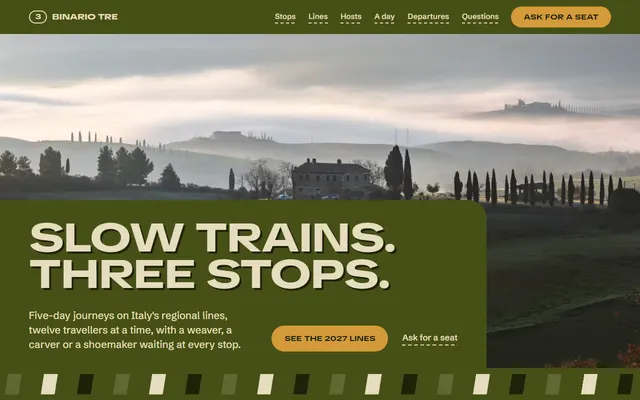
Slow-travel tour operator: a route with three stops, journeys with prices, hosts, departures and an enquiry form.
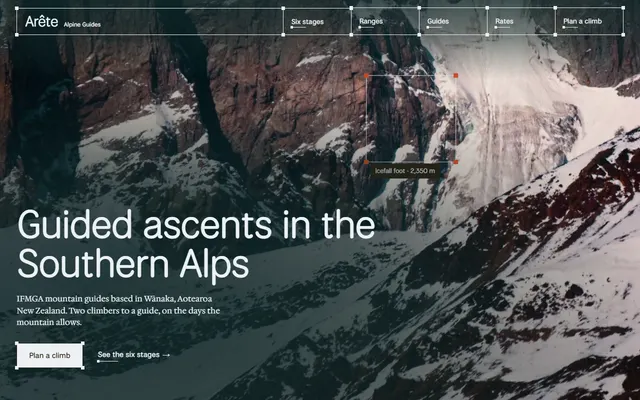
Mountain guiding company: six climb stages, three ranges, kit lists, guides and a rate table.
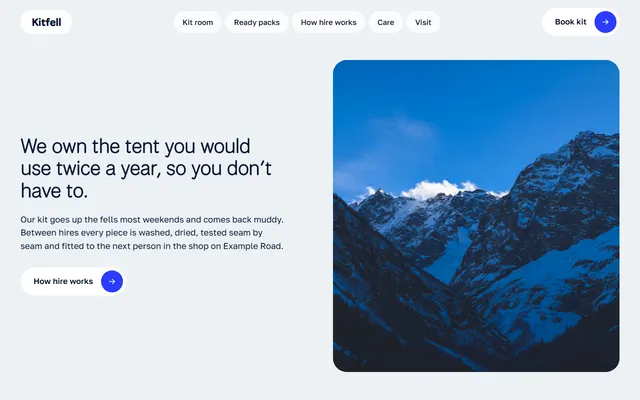
Mountain-town kit hire: shelves of kit with nightly prices, ready packs, hire steps and a fitting section.
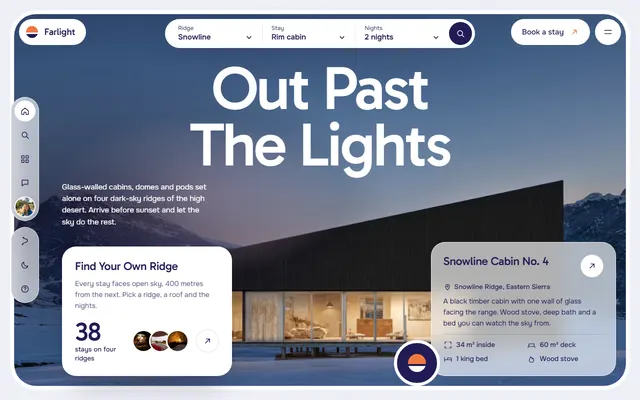
Glamping site with four kinds of stay: a stay finder, one night in five stages, hosts, getting there and a booking request form.
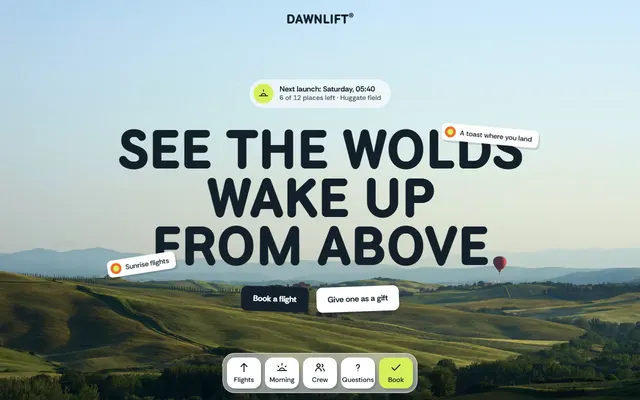
Hot air balloon company: flights with prices, the morning step by step, crew, gift vouchers and a booking form.
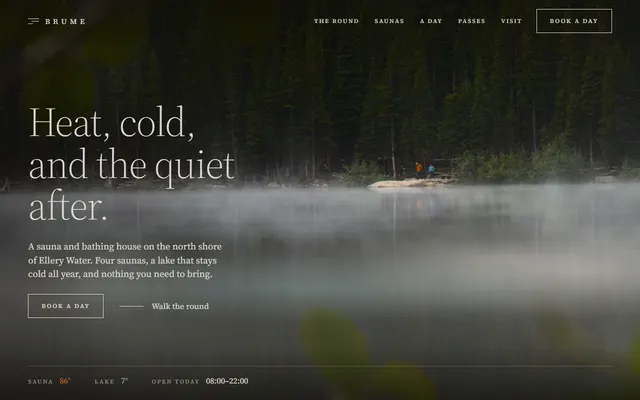
Sauna for a bathhouse or day spa: timed passes.
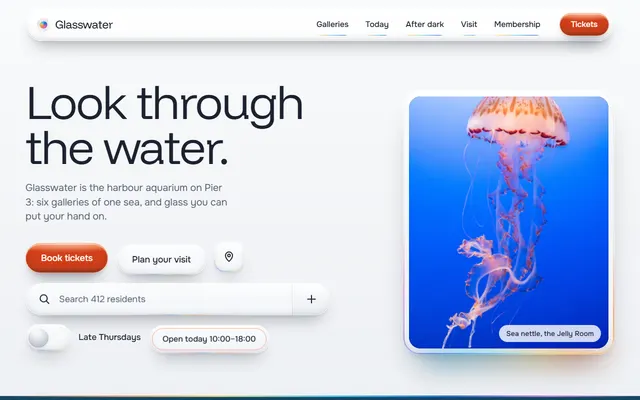
Aquarium: galleries, residents, daily talks, tickets with prices, membership and school visits.