What comes with the physical therapy website template
- index.html: the pure HTML and CSS version, one single HTML file, 103 KB.
- index.gsap.html: the same design built with GSAP, ScrollTrigger and Lenis, for scroll motion in every browser, Firefox included.
- AGENTS.md: what a coding agent must keep and what to replace, so Claude Code, Codex or Cursor edit it without breaking the scenes.
- DESIGN.md: every colour, font, spacing and motion rule of this physical therapy website design.
- PROMPTS.md: the agent prompt and the design prompt below.
- CREDITS.md and LICENSE.md: the photos and fonts with their licenses, and the 8B license.
- Updates to this template, at no extra cost.
Yours to edit: one index.html with no build step, so you or a coding agent can change the words, prices and photos and upload it to any static host. Not a coder? Describe your business in one sentence to 8B's AI website builder and it designs a new site for you, with more pages when you need them. Designing is free; publishing with hosting is $9 a month, billed yearly. It also works inside Claude and ChatGPT.
Premium template · $39, one-time license · Made by 8B, an AI website builder · Updated November 2026 · Plain text: zero-to-ninety.md
About this physical therapy website template
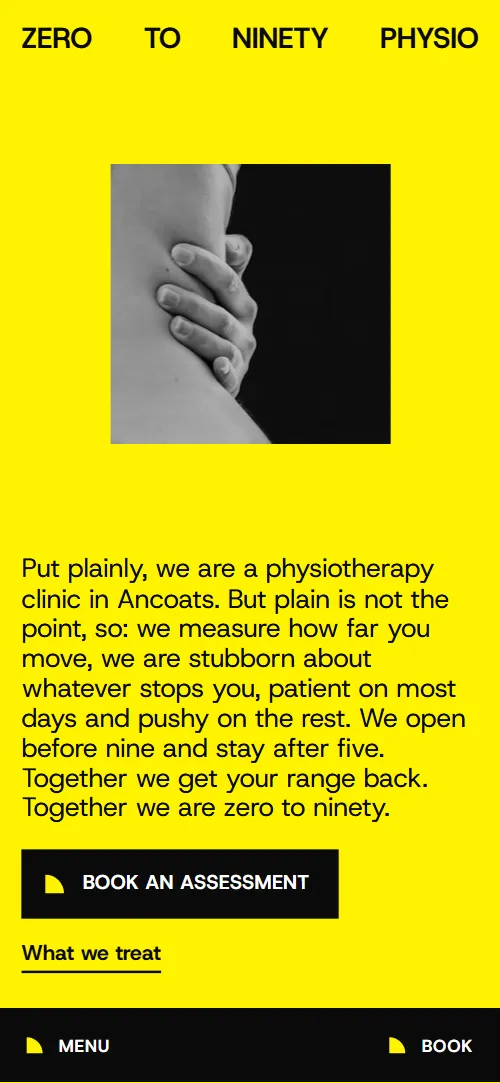
Physical therapy website template for a physiotherapy clinic that opens before nine and after five: one HTML file with seven treated body regions, a first hour step by step, a three-phase rehab method, opening hours as three bands, a gym floor, five clinicians, prices and a booking request form. It opens on an acid yellow screen with the clinic's name spread over four words and a square photo that flexes a quarter turn, like a joint from zero to ninety degrees, and the first scroll turns the words into black vertical bars under a black second screen. It is a single HTML file in pure HTML and CSS, and a GSAP version of the same page comes with it.
At a glance, November 2026. One 103 KB index.html: a single HTML file in pure HTML and CSS with a few lines of built-in JavaScript, 12 sections, 23 Unsplash photos, Host Grotesk. A GSAP build of the same page, 91 KB, comes with it.
It suits a physiotherapy or physical therapy clinic, a sports injury and rehab practice with a gym floor, an osteopath, a chiropractor or a sports massage clinic. Physical therapy websites mostly need five things on one scroll: what you treat, how a first visit runs, when you are open, what it costs and a way to book, and this page gives each its own section. A physical therapy clinic website built from it also gets what makes a small clinic different from a chain: the measurements written down at every session, the early and late hours for people at work and a clinician roll call with real years of practice.
The demo business is Zero to Ninety Physio, an invented clinic in Ancoats, Manchester. Every address, price, clinician, patient and quote is demo copy to replace. Prices are in pounds, insurers are the UK ones and the footer says the physiotherapists are HCPC registered, so change the currency, the insurance line and the registration wording to your own country and regulator. Opening hours, the seven regions and the three phases are plain text, so a clinic in any city fills in its own.
If you would rather not edit HTML at all, 8B, the AI website builder designs a site from one sentence about your clinic, with more pages when you need them. This template is for people who want this exact design in their own hands: one index.html with its CSS and its motion inside, which you or a coding agent can edit and host anywhere, next to the booking system you already use.
Good for:
What a physical therapy website needs
A patient looking for a physical therapist wants the same few answers quickly. Here is how this template covers each of them.
- What you treat. Seven body regions, from back and neck to after surgery, each with a line about the pain and a list of what is often behind it.
- What the first visit is like. A full hour in four timed steps, Talk, Measure, Treat and Plan, with a note on what to wear and what to bring.
- How recovery progresses. Three phases, Settle, Load and Return, with a rule that you move on when the measurements say so.
- When you are open. Three bands for before nine, nine to five and after five, and a week table with Saturday, Sunday and bank holiday hours.
- Who treats you. Five clinicians with their role, focus and years of practice, each with a portrait.
- What it costs. Five price rows with length, price and what is included, plus a line on insurers and free cancellation.
- Proof and a way to book. Three patient stories with the condition and the number of sessions, and a booking form that asks what hurts and when you are free. Connect the form before you go live.
What it does not have is an online diary, a patient login or an insurer lookup: it is built for a clinic that takes bookings by a form, a phone call or a link to its own booking system.
Physical therapy website design and motion
Palette
#fff200 acid yellow: the first screen, the menu, the morning band, the contact section, markers and the progress line#0a0a0a black: text, the side rails, the second screen, the method, the evening band and the team section#ffffff page ground and text on the black sections#ececec light grey: the nine-to-five band, the first-hour section and the stories ground#5e5e5e dark grey: secondary text on light grounds#a6a6a6 mid grey: secondary text on blackFonts
- Host Grotesk: every piece of text: the spread wordmark, headings, manifesto, body, labels, prices, buttons and form fields, in regular and bold
Two fixed black rails frame the page on desktop, Menu and the clinic name on the left with a yellow progress line, Book on the right; on phones they become one bar at the bottom. The first screen is acid yellow with the four-word wordmark spread across the full width, a small square photo, a long manifesto paragraph and two actions, followed by a black screen. The treated regions are tall panels with a vertical label rail; the first hour is a held photo beside four timed steps; the method sits on black with a photo and three phases; the hours are three full-width bands over a week table; the team is a list of large names with a square portrait at the end of each row; prices are ruled rows on four columns; each patient story has a heading that spreads across the full width. The footer ends on the clinic's name set across the page.
The idea behind the page is range of movement: the name is the span a stiff knee or shoulder gets back, from zero to ninety degrees, so things in the design turn through a right angle. The opening words swing down into vertical bars, the square photo in the first screen flexes a quarter turn and back, the method photo opens like a fan to ninety degrees, the team portraits stand upright as each name passes the middle of the screen, and the footer name stands up again from its hanging position.
What is on the physical therapy website page
- NavigationTwo black side rails with Menu, the clinic name and Book, a yellow progress line, and a yellow full-screen menu with the address, phone and email; one bar at the bottom on phones
A yellow progress line fills along the left rail as you scroll, or along the top of the bottom bar on phones. The rails stay in place, and Menu opens a yellow full-screen overlay.
- Zero to Ninety PhysioTwo screens: an acid yellow one with the wordmark spread over four words, a flexing square photo, a manifesto and two actions, then a black one about range of movement with three facts and a photo
On load the four words rise out of their own lines, the square photo window opens from a smaller size and the manifesto and actions slide up, while the photo inside the window flexes a quarter turn and back on a loop. On the first scroll the black second screen rises over the held yellow one, the words swing down into vertical bars, the window turns and grows, the yellow is drawn off to the left and the photo and heading of the black screen settle into place.
- What we treatSeven body regions as panels with a vertical label, a photo, a line about the pain and what is often behind it
On desktop the section holds while the seven panels travel sideways; each panel that reaches the left edge stops there as a labelled slice and the next one slides over it, and the photos settle from slightly enlarged. On phones and tablets the same pile forms vertically, with the covered card easing back and darkening.
- Your first hourA held photo of an assessment beside four steps with their minutes: Talk, Measure, Treat, Plan, and a note on what to wear
The heading rises line by line and the photo swings the last few degrees into place around its bottom-left corner as it scrolls in.
- Settle. Load. Return.Three rehab phases, Settle, Load and Return, beside a photo that a fan opens from its corner
The photo is held while the phases scroll beside it, and a fan opens it from its bottom-left corner to the full frame as Settle, Load and Return pass, with a yellow arm marking the fan's edge and each phase's bar filling as its angle is reached.
- Before nine. After five.Three bands for before nine, nine to five and after five, the first and last with a photo, and a week table with Saturday, Sunday and bank holidays
The heading rises; the yellow morning band and the black evening band start together over the grey one and part as you scroll, the morning band going up and the evening band down, opening the working day between them while its words rise into place.
- A gym floor, not a waiting roomA wide photo of the gym floor, a paragraph, a smaller treatment room photo and four plain facts
The heading rises and both photos swing a few degrees into place as they arrive.
- Five clinicians, one notebookFive clinicians as large names with role, focus and years, each with a square portrait
Each portrait enters turned a quarter and small, stands upright at full size while its name holds the middle of the screen and turns on and shrinks as it leaves, and the bar under the name fills and empties with it.
- What it costsFive price rows with length, price and what is included, a note on insurers and cancellation and a booking button
The heading rises and the rule above each price row draws itself from its left end as the row comes into view.
- Back to itThree patient stories headed Back to the run, lift and serve, each with a photo and a quote
Each four-word heading starts with its words packed at the left like an ordinary line and spreads to the full width as the story rises through the screen, while the photo settles from slightly enlarged.
- Book an assessmentA booking request form with a body region menu and best time as three choices, and the address, phone, email and hours
The heading rises and the rules above the address, phone, email and hours draw themselves from the left.
- FooterA line about the clinic, two link columns, contact links, the legal line and a full-width ZERO TO NINETY wordmark
The three words of the clinic's name hang down at the end of the page and swing up a quarter turn one after another into the wordmark, the opening's turn played backwards.
Before you publish the physical therapy website site
- Replace social preview image, favicon, phone number, email address and contact form (sends nothing yet) and the invented demo facts (names, prices, areas, quotes). AGENTS.md lists them.
- Book in the right rail (bottom bar on phones), Book an assessment buttons in the opening and in prices lead to
#contactnow; point them to keep them once the booking form is connected, or point them to your booking system. - Menu overlay links, footer link columns, What we treat and How a first visit runs in the opening, the clinic name on the left rail lead to
#conditions, #first-visit, #method, #hours, #room, #team, #pricing, #stories, #contact; the clinic name goes to #openingnow; point them to keep; add or remove a line when you add or remove a section. - Footer address line and Privacy and data requests lead to
#contact; the template has no privacy pagenow; point them to your privacy page, or a mailto link to the address for data requests. - Phone and email links in the menu, contact section and footer lead to
neutral tel: and mailto: linksnow; point them to your own phone number and email address. - Scroll-driven animation runs when the browser supports it (Chrome, Edge and Safari today; Firefox does not yet) and the visitor has not asked for reduced motion. Otherwise each section shows its finished layout; the GSAP build, index.gsap.html, also plays the scroll motion in Firefox.
- The booking form sends nothing: connect it to a form service, your booking system or your email. The page has no handler and no thank-you line, so point the form at a thank-you page or add one.
- It is one page: the privacy line and the footer address point to the contact section, and there is no online diary, patient login or insurer lookup. Link the booking buttons to your own booking system if you have one.
- The treatments track is built for seven body regions, the method fan for three phases, the hours scene for three bands and the stories for three stories: a different count needs its layout and scene adjusted.
Questions about this physical therapy website template
What do I get for $39?
The physical therapy website template as a single HTML file, index.html, in pure HTML and CSS, a GSAP build of the same page as index.gsap.html, a DESIGN.md with every colour, font and motion rule, an AGENTS.md for coding agents, the agent prompt and the design prompt from this page, and CREDITS.md for the photos and fonts. Updates to this template are included.
Can I use this physical therapy template for client sites?
Yes. One purchase lets you build as many sites as you like with it, for your own clinic or for clients, and change anything. What it does not allow is selling or giving away the template itself, as a template, theme or kit, or putting its source in a public repository.
How do I change the treatments, prices and opening hours?
Each treated region, price row and hours band is one short block of HTML with its words, so with Claude Code, Codex or Cursor you say it in a sentence, such as change the assessment to 80 and open on Saturdays until 16:00, and the agent edits the block; by hand you change the text in place. The page holds seven regions, three phases and three hours bands, so a different count needs its scene adjusted along with the copy. There is no price calculator or live timetable: the week table and the price rows are plain text that you keep up to date.
Does the booking form send requests?
Not yet. The form asks for name, phone, email, the body region, the best time (before nine, daytime or after five) and a note, but it sends nothing until you connect a form service such as Formspree or Netlify Forms, or your own email or booking system. The page shows no thank-you line after sending, so point the form at a thank-you page or add one. If you use an online diary, link the Book buttons straight to it.
Will it work with Claude Code, Codex or Cursor?
Yes. Put index.html and AGENTS.md in your project and give the agent the prompt that comes with the template. AGENTS.md says which attributes the scroll motion reads, what to keep and what to replace, so the agent swaps the clinic's name, regions, hours, prices, clinicians and photos without breaking the scenes.
What do visitors see in Firefox or with reduced motion?
Firefox does not support scroll-driven animations yet, so it shows every section in its finished layout, as does any browser when the visitor asks for reduced motion. If the scroll motion must also play in Firefox, use the GSAP build, index.gsap.html, which loads GSAP, ScrollTrigger and Lenis from a CDN.
More templates for fitness, wellness and therapy
Other designs for businesses that help people move and feel better.
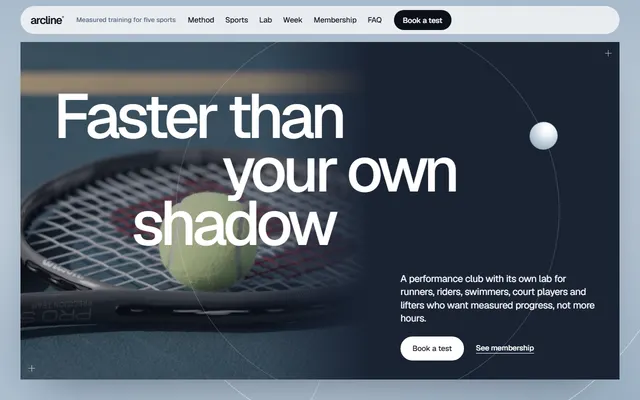
Performance training club with its own test lab, covering running, cycling, swimming, court sports and strength.
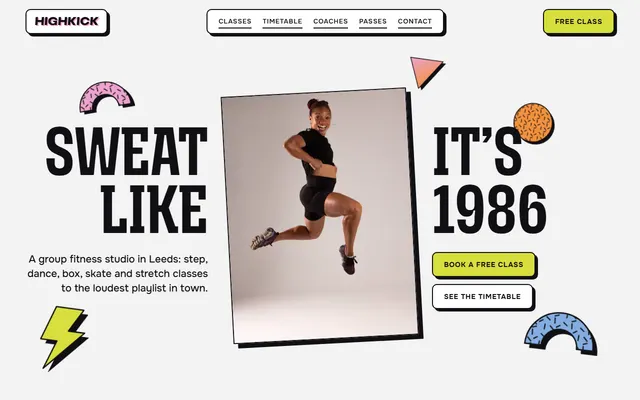
Group fitness studio with seven classes, a week timetable, three passes and a free-class form.
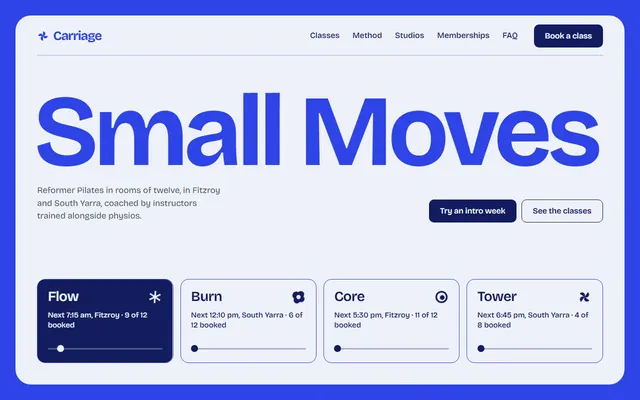
Reformer Pilates studio: spring method, classes, instructors, two studios, memberships and a booking form.

Speech and language therapy practice with a four-step first visit, therapists, fees and a call request form.
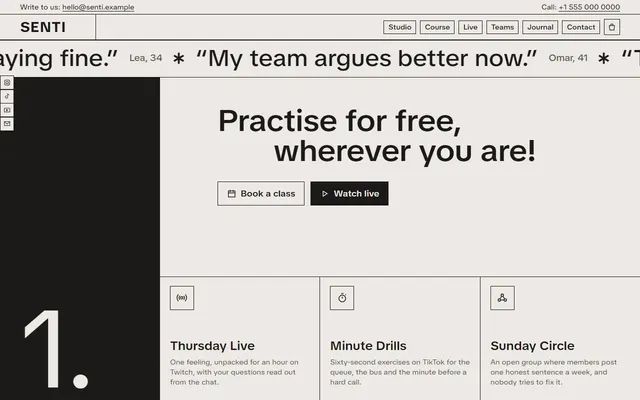
Wellness studio with free ways to practise, a six-week course, a founder letter and team workshops.
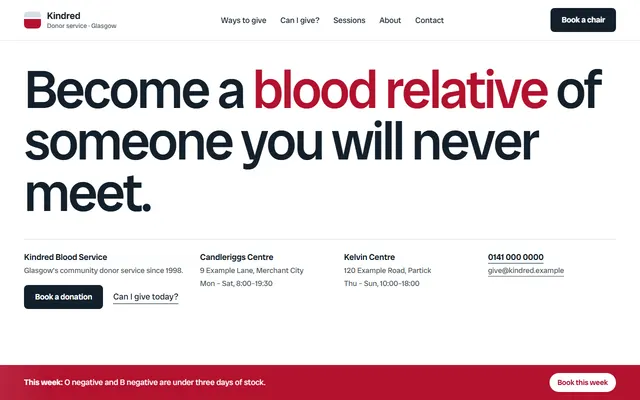
Blood donor service: ways to give, blood group table, donor eligibility, mobile sessions and a booking form.
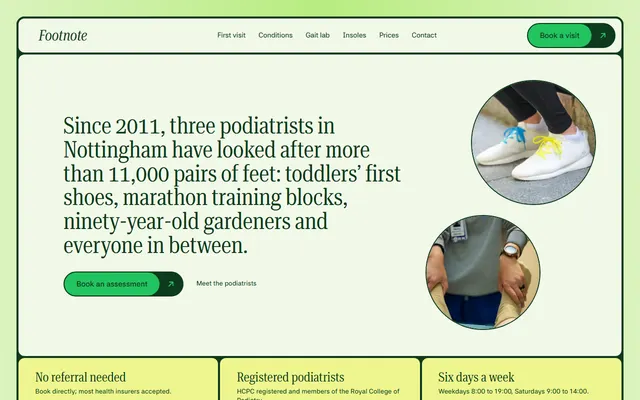
Podiatrist for foot clinics: prices, home visits.
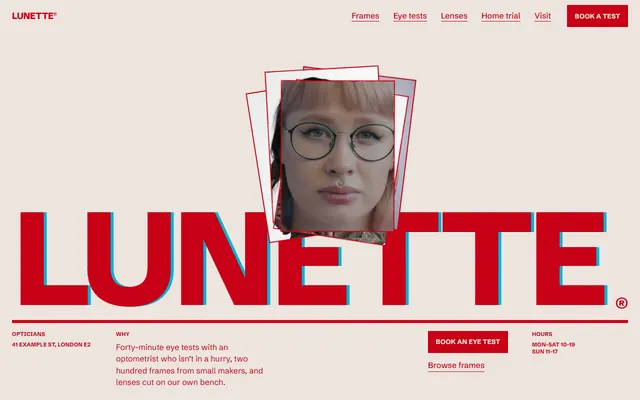
Optician: eye tests, a wall of frames, lens types, prices, a home trial and a booking form.