What comes with the tattoo studio website template
- index.html: the pure HTML and CSS version, one single HTML file, 102 KB.
- index.gsap.html: the same design built with GSAP, ScrollTrigger and Lenis, for scroll motion in every browser, Firefox included.
- AGENTS.md: what a coding agent must keep and what to replace, so Claude Code, Codex or Cursor edit it without breaking the scenes.
- DESIGN.md: every colour, font, spacing and motion rule of this tattoo studio website design.
- PROMPTS.md: the agent prompt and the design prompt below.
- CREDITS.md and LICENSE.md: the photos and fonts with their licenses, and the 8B license.
- Updates to this template, at no extra cost.
Yours to edit: one index.html with no build step, so you or a coding agent can change the words, prices and photos and upload it to any static host. Not a coder? Describe your business in one sentence to 8B's AI website builder and it designs a new site for you, with more pages when you need them. Designing is free; publishing with hosting is $9 a month, billed yearly. It also works inside Claude and ChatGPT.
Premium template · $39, one-time license · Made by 8B, an AI website builder · Updated November 2026 · Plain text: keeps.md
About this tattoo studio website template
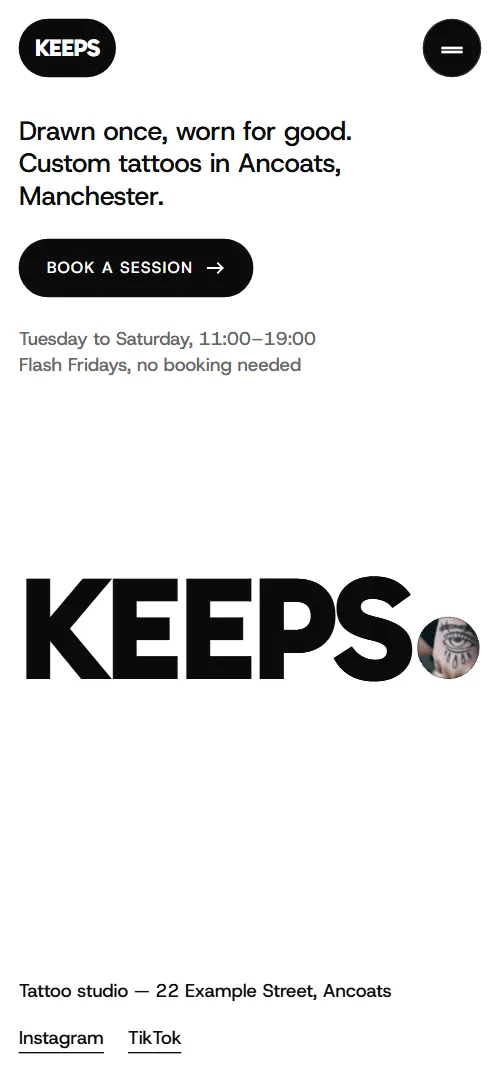
Tattoo studio website template for a custom, appointment-only studio with a few resident artists: one HTML file with healed work, the story of the name, four artists, a room with its rules, a five-step process, questions with prices, a flash day, aftercare and an enquiry form. It opens on a giant KEEPS wordmark that splits down the middle to make room for a photo of tattooed arms, and it closes on the same name in white. It is a single HTML file in pure HTML and CSS, and a GSAP version of the same page comes with it.
At a glance, November 2026. One 102 KB index.html: a single HTML file in pure HTML and CSS with a few lines of built-in JavaScript, 12 sections, 23 Unsplash photos, Gabarito and Host Grotesk. A GSAP build of the same page, 91 KB, comes with it.
It suits a custom tattoo studio, a small team of resident artists who each keep their own books, a single tattoo artist with a studio room, or a cover-up and rework specialist. Tattoo studio websites mostly need the same things on one scroll: proof that the work heals well, who the artists are and what each draws, what it costs, how a booking goes and what to do afterwards. This page gives each its own section, and a tattoo studio website built from it also gets what sets a careful studio apart: only healed photos, one artist per client, a healed check after eight weeks and a Flash Friday sheet where every design is tattooed once.
The demo business is Keeps, an invented studio in Ancoats, Manchester. Every name, price, hour, address and healed piece is demo copy to replace. Prices are in pounds with an hourly rate, a small-piece minimum, a day rate and a deposit, so a studio in any city changes the numbers and the terms to its own, and the five styles, the room rules and the aftercare days adapt to the work you do.
If you would rather not edit HTML at all, 8B, the AI website builder designs a site from one sentence about your studio, with more pages when you need them. This template is for people who want this exact design in their own hands: one index.html with its CSS and its motion inside, which you or a coding agent can edit and host anywhere, next to the booking tool or the Instagram account you already use.
Good for:
What a tattoo studio website needs
A person choosing a tattoo studio wants to see how the work looks once healed, who will do it, what it costs and what happens next. Here is how this template covers each of them.
- Work that has healed. Six pieces, each captioned with the artist, the style and how long it has healed, from one year to four, and a note that new ones are added every month.
- The artists and their styles. Four residents as huge names, each with a style, a line about the work and a Book with link, beside a photo stage that shows each of them at work.
- Prices and deposit. The questions section states an hourly rate, a minimum for small pieces, a day rate and a deposit that comes off the final price.
- How a booking goes. Five steps from a twenty-minute consult to the healed check after eight weeks, with the usual six to ten weeks in the lead.
- Walk-ins and flash. A Flash Fridays section explains the day, the hours and that each design is tattooed once and retired, with a log of retired designs and dates.
- Safety and the room. Single-use needles opened in front of you, vegan inks, step-free access and the rule that clients are 18 or over with photo ID.
- Aftercare. Five dated rows from day 1 to week 8, next to a photo of a healing piece, so the page keeps helping after the session.
What it does not have is an online calendar, a deposit payment, a store or a booking engine: it is built for a studio that takes enquiries through a form and answers them personally, and a booking link or a payment link can go on the buttons and in the questions.
Tattoo studio website design and motion
Palette
#0b0b0b near-black: the dark sections, the header logo and text on the white sections#ffffff white: the page ground of the opening, the name, the room, the questions and the aftercare, and text on the dark sections#666666 grey for secondary text and captions on the white sections; on the black sections captions use a lighter grey, #9d9d9d, and hairlines are #dedede on white and #2c2c2c on black#4c5cff ink blue: the only saturated colour, used for focus rings, the marker of the artist in focus and text selectionFonts
- Gabarito: the heavy uppercase KEEPS wordmark at the top and at the bottom of the page, and the header logo
- Host Grotesk: all other text: statements, captions, labels, navigation, buttons and form fields
Strict black and white grounds that alternate by section with hard cuts, and colour only from the photos and one small blue accent. The first screen is a tagline, a booking button and the hours around a wordmark that fills the width; sections open with large statements, small parenthesised labels set beside the text and small uppercase captions. Healed work is a scatter of six photos at different sizes and offsets, the artists are four huge names beside a stage of their four photos, which the scroll scene stacks and holds in place as one, the process is a row of five photographed panels, and the contact section ends on the wordmark across the full width. On phones the scatter becomes one column that alternates left and right, the artist names pass beneath a held photo, and the process panels take most of the screen width.
The idea behind the page is the name as a promise: a tattoo is the one thing you buy that leaves with you, so the brand literally steps aside for the work. The wordmark splits to let a photo of tattooed arms rise between its halves, photos arrive grey and contrasty and settle into their colour as if healing, and statements part from their centre like the name did.
What is on the tattoo studio website page
- NavigationHeader with the KEEPS logo, six links and Book a session, and a menu with the address and opening hours
The header bar hides as you scroll down once the page is 160 pixels from the top and returns when you scroll up; on screens under 960 pixels the menu button opens a full-screen menu with the section links, the address and the hours, and on phones the header's booking button slides in once the page is scrolled past 60% of a screen.
- KEEPSTwo screens: the tagline, Book a session, hours and the KEEPS wordmark with a round photo window, then a framed photo of tattooed arms and the statement Most tattoos chase a trend
On load the name rises out of its line and the tagline, hours and bottom row shift up in about a second; the round photo window turns slowly while the photo drifts inside it. On scroll the bottom row fades away, the wordmark splits at its centre, its halves slide to the edges and the framed photo of tattooed arms rises into the gap and opens from a narrow strip to its full width.
- We only post healed work.We only post healed work: six captioned pieces with artist, style and healing time, scattered at different sizes
The six pieces move at three different speeds as the section scrolls, so they slide past each other; each photo shifts inside its frame and settles from grey and slightly enlarged to its natural colour as it reaches the middle of the screen.
- Lines follow skin.The story of the name, two captioned photos, Lines follow skin and the list of five styles with a note on placement
The statement parts from its centre, both photos settle from grey to colour and the rows of the styles list open outward from their centre line as they arrive.
- Four residents. One chair each.Four resident artists as huge names with style, a line and a Book with link, beside a stage of their four photos
The four names pass a photo stage held in place; the name in focus turns from grey to white, gets a blue marker and steps in while the stage wipes up to that artist's photo and the previous one shrinks and darkens.
- One client, one room.One client, one room: a calm photo, four ruled facts (needles, inks, access, music) and a machine photo
The statement parts, the photos settle and the four fact rows open outward as the section arrives.
- From first message to healed.Five photographed steps from the first talk to the healed check, with a hairline that fills when the motion plays
The section is held on screen while the five panels travel sideways as one track and a hairline fills along the way; each photo settles as its panel enters.
- Asked before every first tattoo.Six questions about price, walk-ins, booking ahead, cover-ups, preparation and age, answered in native details
The statement on the left stays in place while the questions scroll beside it; the statement parts and each question row opens from its centre line.
- One of one.One of one: the Flash Friday rule, then a full-screen photo scattered with six retired designs and their dates
A small tilted portrait card in the middle grows and straightens to the full screen while the six retired-design labels, stacked tight over it, fly out one after another to their places.
- The second half happens at home.The second half happens at home: a photo of a healing piece and five dated rows from day 1 to week 8
The statement parts, the photo settles and the five dated rows open outward as they arrive.
- Let’s draw the one you keep.Let's draw the one you keep: studio facts, an enquiry form with an artist choice, and the KEEPS wordmark in white
The closing KEEPS arrives as two halves at the edges and closes into one word as the footer comes into view.
- FooterSlim footer with the company line, social links and a back to the top link
Before you publish the tattoo studio website site
- Replace social preview image, favicon, social media links, email address, phone number and contact form (sends nothing yet) and the invented demo facts (names, prices, areas, quotes). AGENTS.md lists them.
- Book a session in the header, the menu and the first screen lead to
#contactnow; point them to your booking page, or keep #contact once the enquiry form is connected. - Book with Mara, Ash, Callum and Jun in the artists section lead to
#contact, without choosing the artist in the formnow; point them to each artist's own booking page, or keep #contact. - Send an enquiry button in the contact section lead to
#enquiry, the form beside it (below it on phones)now; point them to keep as it is. - KEEPS logo, the six section links in the header and the menu, and Back to the top in the footer lead to
#opening and the section ids on the pagenow; point them to keep as they are. - More healed work on Instagram and This Friday's sheet goes up on Thursday night lead to
the Instagram home pagenow; point them to your studio's Instagram profile. - Instagram and TikTok links in the first screen, contact section and footer lead to
the networks' home pagesnow; point them to your own profiles, or remove them. - Phone and email links in the contact section lead to
tel:+441610000000 and hello@keeps.examplenow; point them to your studio's number and email, in the link and in the visible text. - Scroll-driven animation runs when the browser supports it (Chrome, Edge and Safari today; Firefox does not yet) and the visitor has not asked for reduced motion. Otherwise each section shows its finished layout; the GSAP build, index.gsap.html, also plays the scroll motion in Firefox.
- The enquiry form sends nothing: connect it to a form service, your booking system or your email. Without a page script there is no thank-you line after sending; add one or send the visitor to a thank-you page.
- There is no online calendar, deposit payment or artist availability: the Book with links lead to the contact section and the Send an enquiry button to the form, and the Instagram links point to the networks' home pages until you replace them.
- The healed work scatter is built for six pieces, the artists scene for four residents and the Flash Fridays scene for six retired designs: a different count needs its layout and scene adjusted. The process track measures its own width, so another number of steps only needs the five-column grid shown without motion changed.
Questions about this tattoo studio website template
What do I get for $39?
The tattoo studio website template as a single HTML file, index.html, in pure HTML and CSS, a GSAP build of the same page as index.gsap.html, a DESIGN.md with every colour, font and motion rule, an AGENTS.md for coding agents, the agent prompt and the design prompt from this page, and CREDITS.md for the photos and fonts. Updates to this template are included.
Can I use this tattoo studio template for client sites?
Yes. One purchase lets you build as many sites as you like with it, for your own studio or for clients, and change anything. What it does not allow is selling or giving away the template itself, as a template, theme or kit, or putting its source in a public repository.
How do I change the artists, the healed work and the prices?
Each artist is one block with a name, a style, a line and a Book with link, and each healed piece is one photo with a caption. The prices and the booking answers sit in the questions section as plain text. With Claude Code, Codex or Cursor you say it in a sentence, such as add a fifth artist who does Japanese work and change the hourly rate to 160, and the agent edits the blocks; by hand you copy a block and change the words. The healed work scatter and the artists scene are built for six pieces and four artists, so a different count asks for its scene to be adjusted, which an agent can do from AGENTS.md; the process track measures itself, so a step can be added or removed.
Does the enquiry form send requests?
Not yet. The form asks for a name, an email, the artist, the placement with a rough size and the idea, but it sends nothing until you connect a form service such as Formspree or Netlify Forms, or your booking system. The pure HTML and CSS version shows no thank-you line after sending, so point the form at a thank-you page or add one. The Book with links go to the contact section, and there is no online calendar or deposit payment: if you take deposits, put your payment link in the button or the questions text.
Will it work with Claude Code, Codex or Cursor?
Yes. Put index.html and AGENTS.md in your project and give the agent the prompt that comes with the template. AGENTS.md says which attributes the scroll motion reads, what to keep and what to replace, so the agent swaps artists, photos, prices and hours without breaking the scenes.
What do visitors see in Firefox or with reduced motion?
Firefox does not support scroll-driven animations yet, so it shows every section in its finished layout, as does any browser when the visitor asks for reduced motion. If the scroll motion must also play in Firefox, use the GSAP build, index.gsap.html, which loads GSAP, ScrollTrigger and Lenis from a CDN.
More templates for studios and personal services
Other designs for businesses that sell a craft one client at a time.
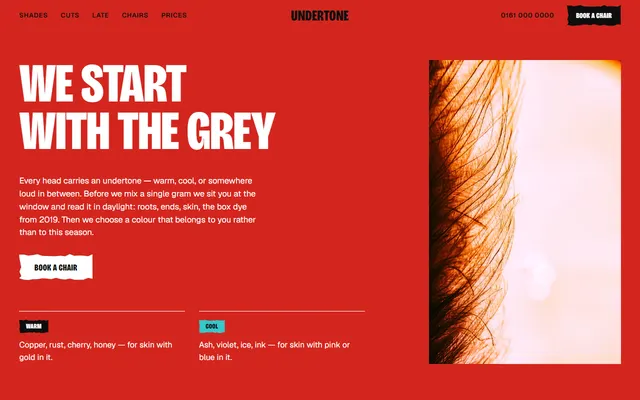
Hair salon: signature shades, a daylight consultation, four stylists, a full price list and a booking form.
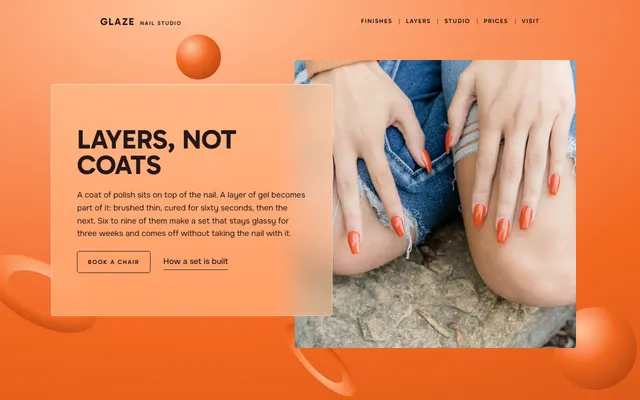
Nail salon: six finishes with prices, a four-layer process, four artists, care notes and a booking form.
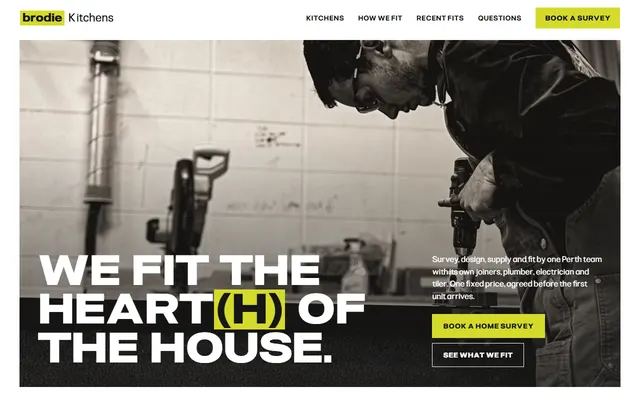
Kitchen company: five kinds of job, in-house trades, a five-step fit, recent fits and a survey form.
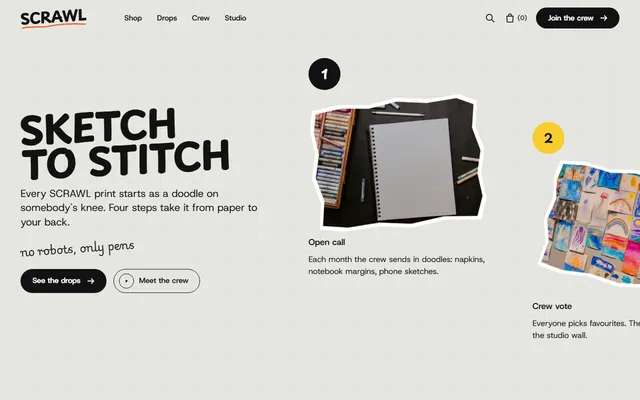
Streetwear label: prints that start as doodles sent in by the crew, a crew wall, a drop calendar and a contact poster.
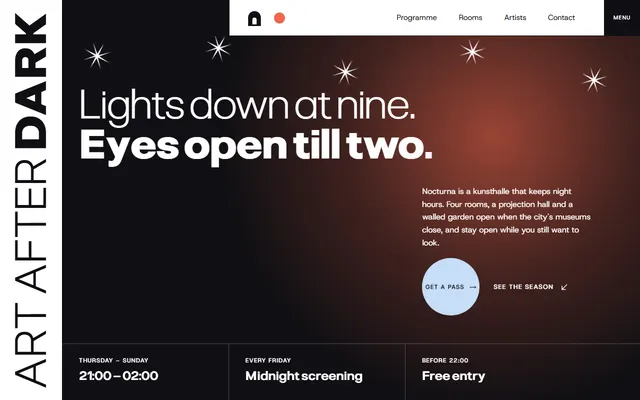
Art gallery that opens after dark: a six-night programme, four rooms, resident artists and a visit form.
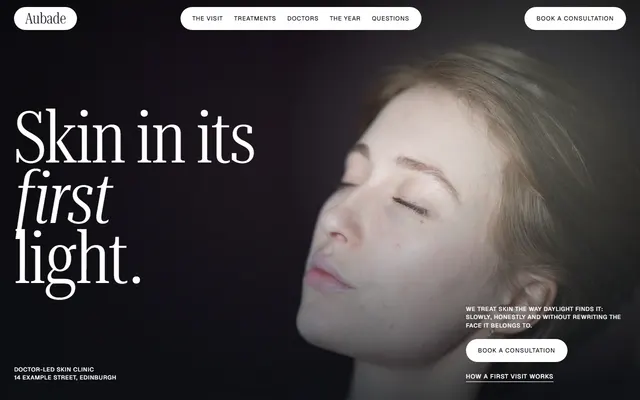
Skin clinic: a first visit plan, treatments with times and prices, doctors, a seasonal plan and a booking form.
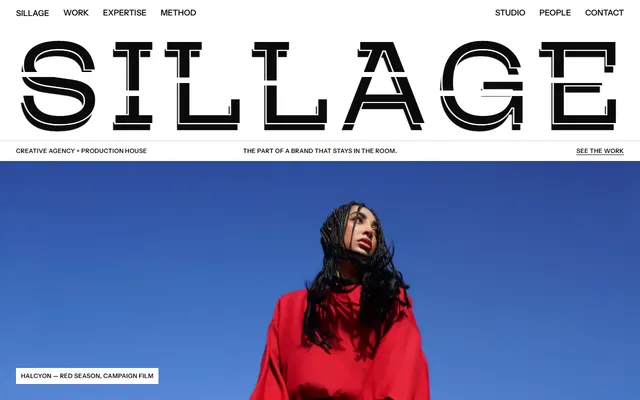
Creative agency with a filterable portfolio, no JavaScript libraries and AGENTS.md for Claude Code.
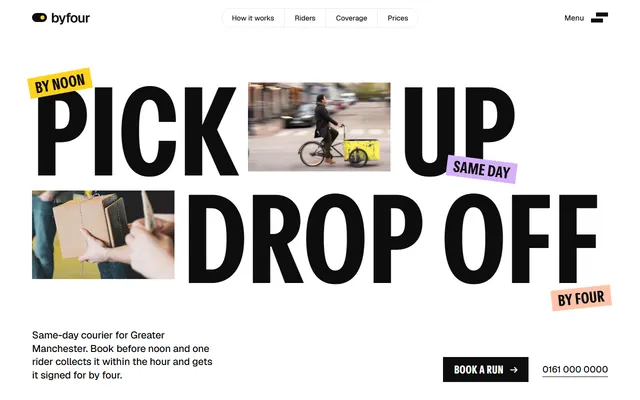
Courier or same-day delivery service: run steps, parcel prices, riders, a coverage map and a booking form.